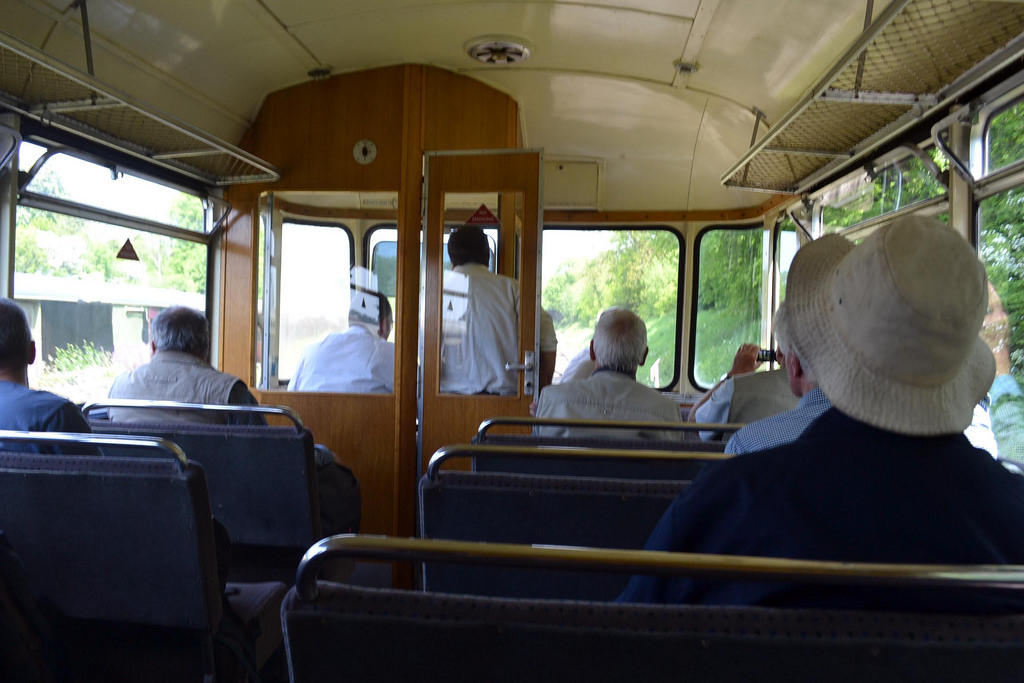
Waggon und Maschinenbau Railbus

British Railways ordered five railbuses from Waggon und Maschinenbau, similar to railbuses then common on German Federal Railways, for loss-making branch lines. The hope being that the lower cost of running the railbus would allow the branch lines to break even and avoid closure. Seventeen other railbuses from four other manufacturers (though of a similar specification) were also bought. Along with the German engines used in Western Region diesel-hydraulic locomotives the W & M Railbuses were a rare foray by British Railways into employing overseas expertise [1] during modernisation from steam.

Information
Number built: 5
Built: 1959
Builder: Waggon und Maschinenbau
Engine: Büssing 6-cyl horizontal diesel
later replaced by AEC 220X
Power: 150 hp (110 kW)

Waggon und Maschinenbau adapted a fairly standard Deutsche Bundesbahn (DB) design for British Railways needs. The railbuses had four wheels, ride being interesting on the often poor quality track they were later used on! The railbuses had a single sliding door on each side. One interesting feature was the cabs only occupied half the width of the cabin. Passengers could thus sit at the front next to the cab. Three of the railbuses had their original Büssing engines replaced by AEC diesels.

The Railbuses were used on branch lines in the London Midland and Eastern Regions [2] especially in East Anglia. They indeed were successful in reducing running costs but the branch lines they were used on were still losing money and closed. Due to the problem with spare parts for this small fleet and the closure of lines they could be used on the fleet was largely redundant by 1964 though continued in intermittent use until 1967 when they were withdrawn. Remarkably four of the five have survived into preservation.
E79960 arrives at Wirksworth

Another view of E79960

Cab view

E79960 at Ravenstor

Notice the cab only occupies half the front, passengers can occupy the other half

E79960 at Shottle

[1] Brian Haresnape, Diesel Multiple-Units: The First Generation (Ian Allan, 1985) p. 79
[2] Colin J Marsden, DMU and EMU Recognition Guide (Ian Allan, 2013) p. 21

NER Petrol Electric Autocar

At the start of the twentieth century a number of experiments were made with railcars fuelled by light fuels such as kerocene and gasoline, the perfecting of the diesel engine put paid to these experiments. In 1903 the North Eastern Railway built two petrol electric railcars at it's York works.

Information
Number built: 2
Built: 1903
Builder: NER York
Engine: Napier later Wolseley petrol engines
Power: 100 hp (76 kW)

The railcars (known as Autocars by the NER as they had cabs at each end) were the forerunners of the diesel electric multiple unit. The petrol engine being coupled to a Westinghouse generator which generated 60kW which fed a 50hp motor under each bogie [1].

They were put into use on the line between Scarborough and Filey. One of the Autocars was later fitted with a 225hp engine and could haul an unpowered trailer. They remained in service until 1930 and 1931. The coach body of one survived scrapping to become a holiday home and is currently undergoing restoration with a new chassis and powertrain.
Front of an Autocar, all images public domain from [1]

Wolseley engine and generator 
Inside the Autocar

Side view of the Autocar

[1] "Self-propelled Petrol Electric Railway Cars Operated by the North Eastern Railway Company of England", Street Railway Journal Vol XXIV No. 19 p. 842

Class 70 (Type 5 Diesel)

The Class 70 diesel locomotive (not to be confused with the original Class 70 which was an early DC electric locomotive) is the most powerful freight diesel locomotive on British rails today with nearly 3,700hp to play with and the first General Electric traction built for the UK [1]. Over thirty have been bought by Freightliner and Colas Rail, they are used on intermodal and heavy haul freight services.

Information
Number built: 37
Built: 2008-14, 2017
Builder: General Electric
Engine: GE PowerHaul P616 diesel
Power: 3, 690 hp (2, 750 kW)
Wheel arrangement: Co-Co

The Class 70 had a troublesome entry into service with a very poor availability rate in its early days on British metals and a number of fires. One locomotive (70 012) was very bad damaged during a mishap during unloading from a cargo ship at Newport Docks and had to be returned to the US [2]. Nowadays the locomotives are much more reliable.

The original twenty Freightliner locomotives are known as the 70/0 with the ten Colas Rail locomotives 70/8. Seven more Class 70s were later ordered for Colas for delivery in 2017.
Freightliner 70 003 at Stafford

Colas 70 807 at Leamington Spa (with a Class 66)

Freightliner 70 020 at Stafford

Freightliner 70 015 at Olton

Freightliner 70 014 and 004 double head through Leamington Spa

Unidentified Freightliner 70 at Lapworth

[1] Colin J Marsden, Diesel & Electric Locomotive Recognition Guide (Ian Allan, 2011) p. 202
[2] Pip Dunn, British Rail Main Line Locomotive Specification Guide (Crowood Press, 2013) p. 143
North Eastern Railway 3-12 / Class EB1

The North Eastern Railway was pioneer of electric traction in Britain. Following on from the construction of a couple of electric shunting engines built in the early twentieth century (the Class ES1) the NER electrified an eighteen and a half mile long freight line between Shildon and Newport County Durham [2] (which included part of the original Stockton & Darlington Railway). The line was electrified to 1500v DC overhead and a fleet of ten Bo-Bo electric locomotives was built for it. These were the first mainline electric locomotives built for 1500v DC in Britain. They were built in-house at NER's Darlington works with electrical equipment supplied by the Siemens factory in Stafford [3]. The locomotives had a low top speed (45 mp/h) though usually ran at 25 mp/h and could haul a train of 1,400 tons [4].

Information
Number built: 10
Built: 1914
Builder: NER Darlington
Engine: 4 Siemens traction motors (1500v DC OHLE)
Power: 1, 100 hp (820 kW)
(Class EB1) 1, 256 hp (937 kW)
Wheel arrangement: Bo-Bo

Unfortunately a decline in coal traffic throughout the 1920s made using electric locomotives on the line uneconomic. The catenary needed replacement by the mid-1930s, the decision was made to revert to steam traction in 1935 [5]. The locomotives were withdrawn though one did survive as a shunter used at the Ilford carriage sidings. For this role it's power output was raised. It survived into British Railway use and became known as the Class EB1. It was finally withdrawn in 1964 when the electrification was converted to AC [7].
Public domain image [1]

View of the catenary in a freight yard, public domain image [6]
[1] "Electrification of an English Freight Line", Electric Railway Journal Vol. XLVIII No. 1 (July 1916) p. 5
[2] Brian Haresnape, Electric Locomotives (Ian Allan, 1983) p. 7
[3] Electric Railway Journal p. 4
[4] R.L. Vickers, DC Electric Trains and Locomotives in the British Isles (David & Charles, 1986) p. 57
[5] Haresnape p. 9
[6] Electric Railway Journal p. 7
[7] Paul Smith & Shirley Smith, British Rail Departmental Locomotives 1948-1968 (Ian Allan, 2014) p. 26

Class 374 Eurostar e320

The Class 374 is the second-generation of unit used on Eurostar services. Eurostar began looking for new stock in the early 2000s as the existing Eurostar e300 Class 373 could be used on a wider range of European networks such as routes electrified using German 15kV AC and Dutch 1.5kV DC overhead wires [1]. The older Eurostar sets also could not be fitted with ERTMS signalling equipment. The Class 374 e320 (the 320 due to the fact it can travel at up to 320 kph) has supplemented around half of the 373 fleet.

Information
Number built: 272 (17 16-car sets)
Built: 2012-18
Builder: Siemens
Engine: Siemens traction equipment (25/15 kV AC / 1.5/3 kV DC OHLE)
Power: 10, 782 hp (8, 000 kW) AC
5, 632 hp (4, 200 kw) DC
Formation: Driving Motor First Open (DMFO)+Trailer Brake First Open (TBFO)+
Motor First Open (MFO)+Trailer Standard Open (TSO)+TSO+MSO+
TSO+Motor Standard Open Restaurant Brake (MSORB) [x2]

The Class 374 consists of eight car half-sets which operate in pairs with the two driving cars at either end. The Class 374 is part of Siemens Velaro high speed train family though with the traction equipment distributed throughout the train for safety whilst travelling in the Channel Tunnel (this has also allowed the 374 to have a greater passenger carrying capacity than the 373). This safety requirement was key to Alstom when they challenged Eurostar awarding Siemens the contract saying the Velaro broke Channel Tunnel safety rules. However the European Commission rejected this argument and Alstom dropped their legal action.

The original order was for ten sets though an extra seven sets was ordered later on. The Class 374 entered service in 2015, the first of the new extended routes through to Amsterdam was launched in April 2018 [2].
Class 374 left and 373 right at St Pancras International

374 016 at St Pancras International

Two 374s at St Pancras International

[1] Colin J Marsden (ed.), "Siemens Class 374 (e320) Stock", Modern Locomotives Illustrated No. 227 October-November 2017 (Eurostar Stock) p. 72
[2] "Eurostar to Amsterdam in April", Modern Railways (March 2018) p. 12

Waterloo and City Line Shunter 75S

As well as electrical equipment for the Waterloo & City Railway Siemens Brothers were also contracted by the LSWR to built a small electric shunter for use on the self-contained underground line [1]. 75S (as it was numbered by the Southern Railway, British Railways later renumbered it DS75) spent all of it's working life underground. The locomotive was used for the shunting of Waterloo & City Stock and also hauling wagonloads of coal which had been bought down the Armstrong Lift up the line for the power station.

Information
Number built: 1
Built: 1898
Builder: Siemens
Engine: 2 Siemens traction motors (530-600v DC third rail)
Power: 120 hp (90 kW)
Wheel arrangement: 4w

75S had a driving cab at only one end and had two nose-suspended traction motors of the same type used on the passenger stock [2] with air brakes fed from a reservoir. It remained in service until 1969 and has been preserved by the National Railway Museum. A second electric locomotive (74S later DS74), a larger Bo-Bo type with a central steeple-cab was also built for the line though was moved to work on the surface at Wimbledon in 1915 [3].
75S as preserved at NRM Shildon in Southern Railways livery
Another view of 75S
[1] Colin J Marsden, Diesel & Electric Locomotive Recognition Guide (Ian Allan, 2011) p. 245
[2] John C. Gillham, The Waterloo & City Railway (Oakwood Press, 2001) p. 133
[3] R.L. Vickers, DC Electric Trains & Locomotives in the British Isles (David & Charles, 1986) p. 23