The Class 69 is a rebuild of the Class 56 with an EMD 710 engine and updated controls and some equipment (similar to those used on the Class 66). GB Railfreight ordered the rebuilds from sixteen Class 56s they bought in 2018, some of which had been out of service for some time. Ten were rebuilt in the initial batch with an option for six more added later on.
The first Class 69 began trials on the Severn Valley Railway in early 2021. The locomotives began to enter service in 2022. The first seven locomotives were withdrawn from service in early 2023 to address some issues but following modifications were returned to service.
As well as GB Railfreight livery, a number of Class 69s have been completed in versions of heritage liveries.
69 010 on test at Derby, still in undercoat, later it was finished in GB Railfreight blue
69 005 approaches Kidderminster hauling two Class 73s
The Class 139 is unique on the British Railways system in being railcar powered by a hybrid diesel-flywheel system. The flywheel stores energy and is charged by a Ford diesel engine when the railcar is at rest, kinetic energy from the brakes and from downhill operation are also recycled [1].
West Midands Railway 139 001 at Stourbridge Town
At first London Midland, and currently West Midlands Railway operates the railcar along the short Stourbridge branch between Stourbridge Junction and Stourbridge Town[2]. Two Class 139s have been built. There was also a prototype built in 2002 which was used to prove the flywheel concept. It ran on a number of heritage lines for testing and was referred to as the Class 999.
Information
Number built:
2
Built:
2007-08
Builder:
Parry People Movers
Motor:
Ford DSG423 diesel driving flywheel
Power:
86 hp (64 kW)
Formation:
Driving Motor Second (DMS)
The Class 139 is a small railcar (less than nine metres long) though has seating capacity for over twenty people plus over thirty standing.
The Class 139 began operation on the Stourbridge branch in 2009 releasing a Class 153 for other duties. The Class 139s are not allowed on any other part of the network and have their own little "depot" at Stourbridge Junction [3].
The Class 999 prototype, seen at Highley on the Severn Valley Railway
The Class 805 is part of the Intercity Express Programme family like theClass 802 and 810 and are bi-mode units for Avanti West Coast to replace the Class 221 on services between London Euston and north Wales.
Avanti West Coast 805 008 at Stafford
Information
Number built:
65 (13 5-car sets)
Built:
2021-
Builder:
Hitachi
Motor:
Hitachi traction system (25kV AC OHLE) &
MTU 12V 1600 R80L diesel
As the Class 805 is bi-mode, a big advantage it has over the pure diesel 221 is that electric traction can be used while travelling under wires, which a fair amount of the route is under.
Testing of the units began in 2022 ahead of an expected entry into service by the end of 2023 but that was pushed back until Summer 2024. In service the trains are called the Evero by Avanti West Coast.
805 001 arrives at Stafford
Such a difference a livery makes! 805 003 at Stafford before it received AWC livery
The Class 196 diesel multiple units are part of the CAF Civity family like the Class 195 and 397. Twenty six sets (in a mixture of two and four car formations) have been built for West Midlands Railway for use on their routes from Birmingham New Street to Shrewsbury replacing Class 170s and other WMR services. Deliveries of the Class 196 began in 2020 and the type entered service in October 2022 initially on services to Shrewsbury [1].
West Midlands Railway 196 008 at Bedworth
Information
Number built:
80 (26 2 or 4-car sets)
Built:
2019-2022
Builder:
CAF Newport
Motor:
Rolls-Royce MTU 6H1800R85L diesel per car
Power:
523 hp (390 kW) per car
Twelve two-car sets and fourteen four-car sets have been built.
The type are also used on the Birmingham to Hereford, the Leamington-Nuneaton line (also known as the Elephant & Bear Line). The new Camp Hill services planned for 2025 could also use the Class 196. Some two-car sets could also be allocated to operate on the new East West Rail line between Oxford and Milton Keynes Central when it opens later this decade.
196 107 at Shrewsbury
Aboard a 196
196 009 at University
196 110 at Birmingham New Street
196 007 at Nuneaton
[1] "West Midlands Trains launches CAF 196s", Modern Railways (November 2022) p. 12
The Urbos 3 fleet is the second generation of light rail rolling stock built for the West Midlands Metro from Wolverhampton to Birmingham, replacing the earlier T-69 fleet [1].
Tram 31 on Corporation Street
Information
Number built:
42
Built:
2012-15, 2021-23
Builder:
CAF
Motor:
12 traction motors (750v DC OHLE)
Power:
1, 320 hp (960 kW)
The Urbos is a successful type of modern tram built by CAF, used in dozens of light rail systems across the world though the West Midlands Metro fleet is the only Urbos 3 stock used in England (the type is also used in Edinburgh).
The trams were introduced for the extension of the West Midlands Metro from Birmingham Snow Hill to Birmingham New Street railway station. They are slightly wider than the T-69s they replaced (about seventeen centimetres) thus the line had to be closed for a few weeks to allow for platform modifications before the Urbos 3 could enter service.
The trams are also nine metres longer and can carry up to 210 passengers per tram compared to 156 on the T-69 (though the actual number of seats is almost the same). All of the trams were given the pink and white livery of the Midlands Metro as it was originally known though all now carry the blue livery of the re-branded West Midlands Metro.
CAF have developed rechargable batteries for fitting to the fleet to allow them to operate on extensions to the metro where there are no overhead wires [2] such as around Birmingham town hall. Twenty one more trams were built in the early 2020s to strengthen the fleet as the West Midlands Metro expands.
Tram 38 (the first in the second batch) arrives at Loxdale
The original livery carried by the trams
Tram 48 at Edgbaston Village, the current terminus of Line 1
Look Ma no wires! A tram passes Birmingham Town Hall on battery power
Tram 51 heads towards West Bromwich
[1] Colin J Marsden, Rail Guide 2016 (Ian Allan, 2016) p. 280 [2] Colin J Marsden (ed.), Light Rail (Key Publishing, 2018) p. 63
The Class 455 electric multiple units were built by BREL York [1] in the early 1980s to replace 4-SUB and EPB stock on Southern Region routes. They are an example of 1982 Standard High Density Stock, 137 sets were built between 1983 and 1985. Currently they are operated by South Western Railway on commuter lines out of London Waterloo. They were also operated by Southern but these units have now been withdrawn.
Painted in BR livery, SWR 455 868 at Cobham & Stoke d'Abernon
Information
Number built:
548* (137 4-car sets)
* including 43 cars from Class 508s
Built:
1983-85
Builder:
BREL York
Motor:
4 EE507-20J traction motors per set (750v DC third rail)
Power:
1, 000 hp (746 kW)
Formation:
Driving Trailer Standard Open (DTSO)+Motor Standard Open (MSO)+Trailer Standard Open (TSO)+DTSO
The units were based on some of the work behind the prototype Class 210 DEMUs and are related to the Class 317 and 318, like those units it was derived from the British Rail Mark 3 coach [2]. There are three sub-classes: 455/7, 455/8 and 455/9, a major visual difference is that the /7 and /9 sub-classes have a more rounded roof than the /8 which despite the numbering was built first. The 455/7s were built as 3-car sets but have included a carriage (TSO) taken from the Class 508 EMUs which they replaced, to turn them into 4-car sets. Since privatisation the Southern 455/8s lost their cab gangways in favour of an air conditioning unit giving them a different look to the other sub-classes.
The SWT Class 455s were refurbished in the late 2010s and some units were fitted with new traction motors [3]. (It is worth noting that the replaced motors were reconditioned English Electric motors from older SR EMUs such as the Class 405 and indeed dated from the early post-war period!)
The change in the South West Trains franchise in 2017 to South Western Railway saw a plan to replace the Class 455 with the Class 701 from 2020 [4] though this has been delayed and the final replacement of the Class 455 may not occur now until late 2025. Southern's Class 455s were withdrawn in 2022.
455 914 at Oxshott
SWR 455 720 at Reading
SWR 455 851 at Byfleet & New Haw, notice the different cab roof
Aboard a 455
455 720 at Longcross
[1] Colin J. Marsden, DMU and EMU Recognition Guide (Ian Allan, 2013) p. 351
[2] Brian Haresnape & Alec Swain, Third Rail DC Electric Multiple Units (Ian Allan, 1989) p. 77
[3] "Vossloh Kiepe UK to deliver traction upgrade to South West Trains’ Class 455 fleet"
[4] "Class 455 Death Sentence", Modern Railways (May 2017) p. 25
The Class 399 was built to augment the existing rolling stock on the Sheffield Supertram and enable an extension to Rotherham Central. The extension requires travel over the mainline and thus the Class 399s are built as tram trains with a dual voltage capability, higher crash worthy standards than other trams and fitted for dual-signalling to operate on the mainline tracks. The trams are fitted with mainline protection systems such as TPWS and are compatible with both mainline and Supertram signalling systems.
Supertram 399 203 at Hyde Park
Information
Number built:
7
Built:
2014-15
Builder:
Vossloh Espana
Motor:
ABB traction system (6 motors) (750c DC / 25kv AC OHLE)
Power:
1, 170 hp (870 kW)
The Class 399 entered service in 2017. To operate on both tram tracks and the mainline, a new wheel profile was designed for these vehicles.
Three or four trams are dedicated at any one time for the Tram-train route of Supertram with the other Class 399s being used on other lines.
399 203 departs Attercliffe
399 203 again, at Fitzalan Square/Ponds Forge
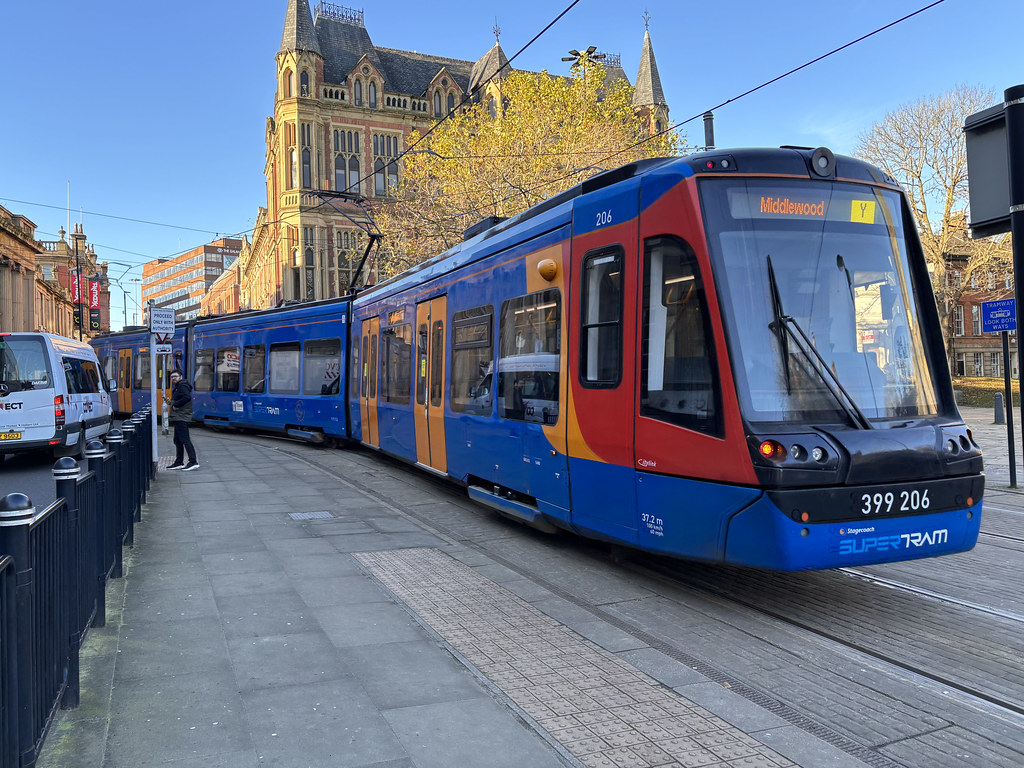
399 206 at Cathedral, Tram train services terminate here but this tram is on the Yellow Line
The Class 458 4-JOP (Juniper Outer-suburban Porterbrook) was built for South West Trains in the late 1990s to replace some Class 411s. Although they were designed for the 750v DC third rail network they were "future proofed" with provision to support a pantograph and overhead electric collection, though have not carried one yet [1].
6 Althom ONIX 800 traction motors (750v DC third-rail)
Power:
2, 172 hp (1, 620 kW)
Formation:
(original) Driving Motor Composite Open (DMCO)+
Pantograph Standard Open (PSO)+Motor Standard Open (MSO)+
DMCO
(rebuilds) Driving Motor Standard Open (DMSO)+
PSO+MSO+TSO+DMSO
Their entry into service as 458/0 was unfortunately fraught with technical difficulties with serious usage on the London Waterloo to Reading and Guildford-Ascot routes not happening for several years and after many modifications [2]. The unreliability of the trains saw SWT plump for the "Desiro" Class 444/450s instead of more 458s to order to replace the majority of its "slam door" EMU fleet [3].
In 2011 after the withdrawal of the similar Class 460 from the Gatwick Express it was decided to use cars from the 460 to strengthen the 458s as five car trains (5-JOP). The trains were also refurbished and rebuilt with an improved appearance including full gangways. Five "new" 458/5s (as they became known) were also created from spare rebuilt 460 cars. Work was completed in 2016 [5]. They are now operated by South Western Railway.
458 509 arrives at Winnersh Triangle
In SWT days, 458 534 and friend at Clapham Junction
458 520 arrives at Addlestone
458 535 at Clapham Junction
458 515 at Clapham Junction
[1] "Class 458" Southern Electric Group <http://www.semgonline.com/gallery/class458_01.html> [2] Colin J. Marsden, DMU and EMU Recognition Guide (Ian Allan, 2013), p. 356 [3] "Train firm to replace new fleet", BBC News <http://news.bbc.co.uk/1/hi/england/london/3388679.stm> [4] "Fire damaged 458 under repair", Railways Illustrated Issue 157 (March 2016) [5] "458/5 programme nears completion", Today's Railways UK Issue 171 (March 2016)
The Class 387 is the final development of the Electrostar family having a higher top speed of 110mp/h. When the final carriages were built in November 2017 [1] it bought to an end eighteen years of continuous Electrostar production with a grand total of 2,805 carriages built of the Classes 357, 375, 376, 377, 378, 379 and 387 [2].
GWR 387 156 at Theale
Information
Number built:
428 (107 4-car sets)
Built:
2014-17
Builder:
Bombardier Derby
Engine:
Bombardier MITRAC DR1000 traction system
(750v DC third rail and 25kv AC OHLE)
Power:
2, 250 hp (1, 900 kW)
Formation:
Driving Motor Composite Open (DMCO)+Motor Second Open (MSO)+Trailer Second Open (TSO)+DMCO
The Class 387 is in service with Great Northern, Great Western Railway, Gatwick Express and Heathrow Express. They were also in service with Thameslink until being transferred to Great Northern after being replaced by Class 700s and also c2c for a time.
Extermally Class 387s look the same as the likes of the Class 377. Class 387/1s are in service with Great Northern, Heathrow Express and GWR. 387/2s with Gatwick Express and Great Northern and 387/3s with Great Northern.