Showing posts with label Shunter. Show all posts

Class 03 (British Railways 204hp Diesel-Mechanical)

After purchasing a number of small fleets of privately built diesel mechanical shunters, British Railways finally decided to build a "standard" type, the resulting Class 03 ended up being very similar to the Drewry built Class 04 [1]. 

03 066 at Barrow Hill Roundhouse


Information
Number built: 230
Built: 1957-61
Builder: BR Swindon and Doncaster
Engine: Gardner 8L3 diesel
Power: 204 hp (152 kW)
Wheel arrangement: 0-6-0

The Class 03s served with British Rail for many years, outlasting all other shunters except for the standard diesel-electrics (Class 08/09). Although much of their work disappeared in the 1970s and 1980s, as the nature of the freight sector changed, they continued to have a role on the network in places where larger and heavier locomotives were unsuitable and the last was not withdrawn until 2008 [2].

A good number of Class 03s have seen further use after British Rail with industrial users and no fewer than fifty-five have been preserved. Although primarily intended for shunting (and trip work) Class 03s did occasionally haul passenger trains, though these tended to be special workings such as taking Channel Island boat trains up to Weymouth harbour where the line ran through the streets [3] and unadvertised special services for workers [4].

03 073 at Crewe Heritage Centre

D2059 at Havenstreet, Isle of Wight Steam Railway

Another view of 03 073 at Crewe Heritage Centre

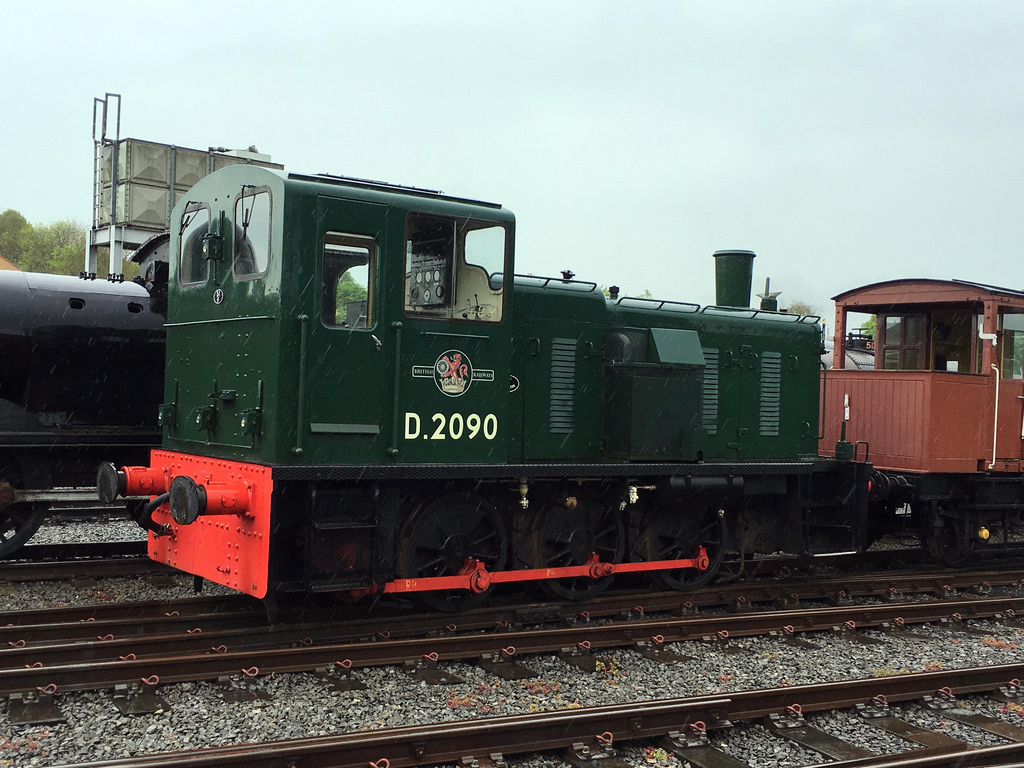
D2090 at NRM Shildon in original BR green

03 099 at Rowsley South, Heritage Shunters Trust

[1] Brian Haresnape, Diesel Shunters (Ian Allan, 1984) p. 56
[2] Colin J. Marsden (ed.), "BR Class 03 0-6-0 DMs", Modern Locomotives Illustrated No 217 February-March 2016 (SR, GW, LNER, LMS & Trial Shunters & Class 03s), p. 67
[3] Haresnape, Shunters p. 20
[4] Michael Welch, Diesels on the Western (Capital Transport, 2013) p. 18

Ruston and Hornsby 223741 (20DL)

Ruston & Hornsby built many 20DLs over a lengthy period. The example here, with the works number 223741 is now preserved at Crich Tramway Museum. The 20DL refers to the power rating (20hp) and DL means narrow gauge. However, 223741 is now a standard gauge locomotive having been converted from 600mm gauge in 1963. A similar locomotive at Crich is 326058.

223741 at Crich


Information
Number built: 1
Built: 1944
Builder: Ruston & Hornsby
Motor: Ruston & Hornsby 2VSHL diesel
Power: 20 hp (15 kW) 
Wheel arrangement: 4wDM

The locomotive was formerly operated by the Accrington Corporation.

F. C. Hibberd Planet Industrial Locomotives

F.C. Hibberd began building petrol and diesel locomotives for industrial purposes in 1927. Their locomotives had the name Planet, though this name was also used by the company's road tractors. The origin in the name came from the Kent Construction & Engineering Company who built industrial locomotives after World War 1 under the Planet name. In 1926 the company closed but two of the directors set up F.C. Hibberd and continued the Planet name.
Planet locomotive [1]


Information for typical late model Planet
Built: 1960
Builder: F. C. Hibberd
Motor: BUT 680 series 6-cyl diesel
Power: 163 hp (122 kW) 
Wheel arrangement: 4wDH

F.C. Hibberd continued building Planet locomotives in a variety of configurations and gauges until 1968, by then the company was part of Butterley Engineering. Many examples of Planet locomotives have been preserved.

[1] "Products of interest", International Railway Journal (December 1961) p. 54

Ruston and Hornsby 326058

The small shunter is a former narrow gauge industrial shunter which worked at the Clay Cross quarry in Crich. After withdrawal it was preserved but did not have to move very far, to the National Tramway Museum at Crich to be exact! The shunter was re-gauged to standard gauge and is used for shunting and as a works vehicle on the museum's tram network.
326058 in a tram shed


Information
Number built: 1
Built: 1952
Builder: Ruston & Hornsby
Motor: Ruston & Hornsby diesel
Wheel arrangement: 4wDM


326058 at work helping maintain the overhead lines

Class 10 (BR/Lister Blackstone 0-6-0 Diesel-Electric)

The Class 10 was a variation of the standard Class 08 diesel shunter built for British Railways that had a Lister Blackstone diesel instead of an English Electric 6KT and two GEC WT360 traction motors [1]. One hundred and forty six were built, the vast majority at BR Darlington though six were also built at BR Doncaster.
D4092 preserved at Barrow Hill


Information
Number built: 146
Built: 1955-62
Builder: BR Darlington and Doncaster
Motor: Lister Blackstone ER6T diesel
Power: 360 hp (261 kW)
Wheel arrangement: 0-6-0

They had the same performance as the Class 08 and, apart from the traction package, were pretty identical. However, due to being non-standard they were withdrawn between 1967 and 1972. None carried their TOPS numbers. Four have survived into preservation.
Another view of D4092


[1] Brian Haresnape, Diesel shunters (Ian Allan, 1984) p. 68

Hudswell Clarke D564

This locomotive is one of the oldest diesel locomotives to be built by Hudswell Clarke. It was one of a batch of 610mm gauge locomotives built for industrial use in the early 1930s. It began it's working life at Beswick's Limeworks in Buston in 1930. It was joined by three others including D558 which has also been preserved (at the Apedale Valley Light Railway).
D564 at Aberystwyth


Information
Number built: 1
Built: 1930
Builder: Hudswell Clarke
Motor: Dorman 4-cylinder diesel
Power: 36 hp (27 kW)
Wheel arrangement: 4wDM

D564 was equipped with a McLaren 3-cylinder diesel from new but this was replaced by a Dorman unit in the late 1950s. D564 is now stored on the Vale of Rheidol railway in Aberystwyth.
Side view of D564


Class 02 (Yorkshire Engine Co 170hp Diesel-Hydraulic)

Into the 1960s British Rail continued to have a number of goods yards with very tight radius curves which required locomotives (and indeed rolling stock) with short wheel bases. The Class 02 locomotives were built to replace 0-4-0ST "Pug" steam locomotives mostly at dockyards in the Liverpool area [1] but also at other locations in London Midland Region such as Burton-on-Trent [2] and Fleetwood [3].
D2868 at Barrow Hill Roundhouse


Information
Number built: 20
Built: 1960
Builder: Yorkshire Engine Company
Engine: Rolls Royce C6 diesel
Power: 170 hp (130 kW)
Wheel arrangement: 0-4-0

These neat little diesel hydraulic locomotives were designed to be similar in size, weight and flexibility to the little steam engines they replaced. An interesting part of their design was that cab access was via a platform at the rear, the only production class of locomotive built for British Rail to have this feature [4].

As with many shunters though they soon were becoming surplus to requirements as the nature of the freight business changed and many marshalling yards closed. Withdrawals began in 1969, though a small number did see service into the early 1970s and carried TOPS numbers. All were withdrawn by 1975, some of these shunters were sold onto further service with industrial users. Seven have been preserved (one with the National Collection) which is a good proportion of what was only a small number built.
D2854 at the Heritage Shunters Trust

02 003 at Barrow Hill

A Class 02 being rebuilt at the Heritage Shunters Trust

D2854 ahead of some fellow shunters

Another view of 02 003


[1] Brian Haresnape, Diesel Shunters (Ian Allan, 1984) p. 63
[2] David Dunn, D for Diesels 10 (Booklaw Publications, 2015) p. 16
[3] David Dunn, D for Diesels 11 (Booklaw Publications, 2016) p. 47
[4] Heritage Shunters Trust Stock List May 2015 p. 2

Hudswell Clarke D1012 / Cadbury No. 14

This locomotive was built by Hudswell Clarke for Cadbury in 1956, assigned to the company's factory in Moreton on the Wirral. The locomotive could haul up to 200 tons. It remained in service until 1977 and was preserved initially at the Llangollen Railway however it's working time on the railway was short. 
The locomotive at the Statfold Barn Railway


Information
Number built: 1
Built: 1956
Builder: Hudswell Clarke
Motor: Gardner 6LW diesel
Power: 107 hp (80 kW) 
Wheel arrangement: 0-4-0DM

In 2003 the locomotive was put on display at Cadbury World in Birmingham, later on at other food manufacturers including Premier Brands at Moreton. The locomotive has now been donated to the Gloucester Railway Carriage & Wagon Company with a view to returning the locomotive to working order.
Another view of Cadbury No. 14

Mather and Platt Electric Locomotive for Tweedle and Smalley

This early electric locomotive was built by Mather & Platt of Salford Iron Works for the textile factory of Tweedle & Smalley in Castleton. The locomotive was used to shunt wagons containing coal for the boiler house as well as other stores. The locomotive could haul a loaded wagon that weighed up to twenty tons at up to two miles per hour. The locomotive collected power from an overhead conductor wire via two collector bars mounted on the roof. This system was found to work well on with the tight radii of the track circuit the locomotive worked on. The locomotive was of very simple construction and resembled a wagon. Speed was regulated using a resistance box.

Information
Number built: 1
Built: 1895
Builder: Mather & Platt
Motor: Manchester electric motor (DC OHLE)
Wheel arrangement: 4wWE

[1] J.F. Gairns, "Electric locomotives for mining, factory and allied uses", Electrical Age (August 1904) p. 91

Funkey Diesel Locomotives

South African manufacturer C H Funkey (now under the name DCD Rolling Stock) has been building industrial locomotives since 1930, many for work in mines. A couple of ex-industrial use locomotives have also been imported for use on the Welsh Highland Railway. The locomotives were used at a diamond mine in Namibia and later a cement factory in South Africa. The two locomotives were purchased by the Ffestiniog Railway in 1993. Originally the locomotives had a single centre cab but one of the locomotives has been rebuilt with a cab at each end.
The two Funkey locomotives at Statfold Barn Railway


Information for Ffestiniog / WHR locomotives
Number built: 2
Built: 1967
Builder: CH Funkey
Motor: Caterpillar later Cummins diesel
Power: 335 hp (250 kW)
Wheel arrangement: B-B

Other C H Funkey built locomotives in the UK include two 600mm gauge mine locomotives from South Africa now preserved at the Statfold Barn Railway.

Simplex 60S

The Motor Rail / Simplex 60S was, along with the 40S, the successors to the highly successful 32/42. The 60S has increased power between 50 to 72hp and had an improved version of the 32/42's three speed gearbox [1]. The 60S could be fitted with a cab or an exhaust quencher depending on the customer's requirements.
Sandy (11218/1962) at the Statfold Barn Railway


Information
Builder: Simplex
Motor: Dorman L series diesel
Power: Up to 72 hp (52 kW)
Wheel arrangement: 4wDM

The illustrated locomotive, Sandy, is Simplex 11218/1962 which is fitted for 607mm gauge. It is preserved at the Lancashire Mining Museum [2] and is shown whilst undergoing work at the Statfold Barn Railway.
Another view of Sandy

Sandy is fitted with a cab


[1] Alan M. Keef, Simplex Locomotives at Work (Lightmoor Press, 2019) p. 11
[2] Industrial Locomotives Handbook 18th Edition (Industrial Railway Society, 2019) p. 157

Baguley Cars 800

This locomotive was built to order by McEwan Pratt & Co. for Dought Son & Richardson in 1920 (McEwan Pratt being a pseudonym for Baguley Cars). However, the locomotive was never delivered and instead remained at Baguley as a works locomotive until 1933. It was finally sold to the London Brick Company and remained in service with a number of owners until the mid-1960s until it entered preservation.

Information
Number built: 1
Built: 1920
Builder: McEwan Pratt & Co (Baguley Cars)
Motor: Baguley 4-cyl petrol engine
Power: 100 hp (74 kW)
Wheel arrangement: 0-4-0PM

Baguley Cars 800 is similar in form to the earlier 680 from the same manufacturer though more powerful. The engine was located next to the cab, ahead of it was a large water tank used for coolant. This gave the locomotive an appearance similar to the steam engines it was intended to replace.
Baguley 800 at Tyseley


Class 01/5

The Class 01/5 designation is used for a multitude of privately owned diesel shunters which are cleared to operate on the mainline rail network. Class 01/5 includes shunters used by the Ministry of Defence, Train Operating Companies (TOCs) and other railway support companies. The designation has nothing to do with the original Class 01.
01 553 now at the Mid-Hants Railway


An example of one of these locomotives is 01 509 which is a 1963 built Ruston & Hornsby 0-6-0DH shunter operated by Chiltern Railways at their Aylesbury depot. The designation can also cover shunters which belonged to other TOPS classes in their original BR service. 01 553 is a Class 11 which also became a Class 01/5 for mainline use, it has now been preserved again.
01 509 at Aylesbury


Clayton Devonport Locomotives RTU 1 & 2

These two locomotives were built for the Royal Navy in 2000 by Clayton Equipment and spend their time at Devonport. One can imagine the cargos they handle (which is no doubt top secret) are often very sensitive! The locomotives, which are known as Dennis (RTU 1) and Henry (RTU 2) [1], have a Clarke hydraulic transmission and a Clayton spur and bevel final drive [2]. One interesting feature of the shunters is that they have two sets of buffers at different heights.
RTU 2 at Wirksworth on test following overhaul


Information
Number built: 2
Built: 2000
Builder: Clayton Equipment
Engine: Deutz BF6M1013E diesel
Power: 194 hp (145 kW)
Wheel arrangement: 4wDM

Front view of RTU2


[1] Industrial Locomotives 13EL (IRS, 2003) p. 66
[2] Ray King, An Introduction to British Industrial Diesel Locomotives (Traction & Rolling Stock Advertiser, 2006) p. 16

Kerr Stuart 4415

Kerr Stuart built 4415, one of the earliest purpose-built diesel locomotives in the world, in 1928 for trials on the Welsh Highland Railway. The locomotive was fitted with a McLaren-Benz diesel engine with mechanical transmission and chain drive. The locomotive was tested on a number of narrow gauge lines in Wales and Northern Ireland before heading to a sugar plantation in Mauritius in 1934.
Manufacturer's photo [1]


Information
Number built: 1
Built: 1928
Builder: Kerr Stuart
Motor: McLaren-Benz 4-cylinder diesel
Power: 60 hp (45 kW)
Wheel arrangementr: 6wDM

The locomotive was fitted with a more powerful McLaren MR4 engine in 1945 and remained in service until 1962, though in latter years mainly as a reserve locomotive. The locomotive was preserved and plinthed in 1971. In 1997 it was repatriated to the UK and work is ongoing to restore it to working order at the Ffestiniog & Welsh Highland Railway, the railways 4415 was first used on in 1928.
Cutaway diagram showing the chain drive [1]

View of the chain drive [1]


[1] "Locomotives of the future", Meccano Magazine (January 1929) p. 32

LMS 1831

In 1931 the LMS, at it's Derby Works, rebuilt a steam locomotive as a diesel shunter, the first of a number of experimental diesel shunters built by the "Big 4" railway companies in the 1930s. The original steam locomotive was a Midland Railway 1377 class steam locomotive. The locomotive was rebuilt and fitted with a Paxman diesel engine and Haslam & Newton hydraulic transmission [1].
1831 after construction [3]


Information
Number built: 1
Built: 1932 (rebuild)
Builder: LMS Derby Works
Motor: Paxman 6-cyl diesel
Power: 400 hp (298 kW)
Wheel arrangement: 0-6-0

The locomotive had a very box-like body with small cab windows. The locomotive was not a great success. It was withdrawn from service in 1939 after a number of years in storage. It was converted into a mobile power unit [2] and survived in this guise until 1951.

[1] Brian Haresnape, Diesel Shunters (Ian Allan, 1984) p. 4
[2] Colin J Marsden, Diesel & Electric Locomotive Recognition Guide (Ian Allan, 2011) p. 8
[3] "A heavy oil shunting locomotive, Meccano Magazine (July 1933) p. 525

Hunslet Engine Company 8975

Hunslet 8975 is typical of the kind of narrow gauge diesel shunters which were built for colliery use by the Hunslet Engine Company in the late 1970s. The diesel-hydraulic locomotive worked at the 762mm gauge surface stockyard at Parkside Colliery, Newton-le-Willows and was withdrawn in 1993 with the closure of the colliery.
8675 at the Statfold Barn Railway


Information
Number built: 1
Built: 1979
Builder: Hunslet Engine Company
Motor: Perkins 4-cyl diesel
Power: 52 hp / 39 kW
Wheel arrangement: 4wDH

The locomotive was preserved at the Lancashire Mining Museum at Astley Green and has helped with the building of a line at the museum, and now hauls passenger trains. During preservation it has been converted to 610mm gauge at the Statfold Barn Railway.
The locomotive carries the name Newton

Another view of 8975


Hunslet 1697 (LMS 7051)

In 1932 the Hunslet Engine Company built a small diesel-mechanical shunter as a demonstrator. It was unveiled at the British Industries Fair in that year and for a time worked at the colliery. It was given a trial by the LMS in 1933. They liked it so much they bought it a few months later! The shunter, given the LMS number 7051, had an eventful life. It was loaned to the War Department in 1940. After the war it was sold back to Hunslet who used it as a works shunter and was hired out to industry. Since 1960 the shunter has been preserved by the Middleton Railway.
The shunter's early days on the Middleton Railway [1]


Information
Number built: 1
Built: 1932
Builder: Hunslet Engine Company
Motor: (original) MAN WV16/22 diesel
Power: 150 hp (112 kW)
Wheel Arrangement: 0-6-0DM

The shunter has a four speed pre-selector gearbox. The original MAN diesel was replaced by a 132 hp (98 kW) McLaren Ricardo MR6.

[1] Arthur Gaunt, The World's Oldest Railway (Meccano Magazine November 1963) p. 451

SR/Paxman 500hp 0-6-0 Diesel-Mechanical

This locomotive was a Bulleid designed shunter also capable of branch line and trip working. Due to delays caused by economic conditions immediately after the Second World War the shunter, which was given the number 11001, was not completed until the Southern Railway had become part of British Railways [1].
11001 in BR black [2]


Information
Number built: 1
Built: 1949
Builder: SR/BR Ashford
Motor: Paxman Ricardo V12 diesel
Power: 500 hp (373 kW) 
Wheel arrangement: 0-6-0

By the time it entered service in 1950, British Railways was already busy creating a standard diesel shunter (the Class 08). 11001's gearing was, like many compromises, not perfectly suited for shunting duties or trip working although was the most powerful shunter built up until then [3]. It's working life was short and it was cut up in 1959.

[1] Brian Haresnape, Diesel Shunters (Ian Allan, 1984) p. 34
[2] Meccano Magazine (August 1950) p. 37
[3] J.A.M. Vaughan, Diesels on the Southern (Ian Allan, 1980) p. 6

Class D3/12 (SR/English Electric 350hp Diesel-Electric)

In the latter years of the 1930s the Southern Railway, as with the other railway companies, began to experiment with diesel traction for shunting. These three locomotives were very similar to locomotives built a couple of years earlier by English Electric and Hawthorn Leslie for the LMSR. One key difference being larger diameter wheels to allow safe operation on lines with raised third conductor rails [1].

Information
Number built: 3
Built: 1937
Builder: Southern Railway Ashford Works / English Electric
Motor: English Electric 6K diesel
Power: 350 hp (260 kW) 
Wheel arrangement: 0-6-0

The shunters had a top speed of forty-eight km/h to allow for trip working as well as yard shunting. The shunters quickly proved their worth over steam shunters, although they were more expensive to build the running costs over a steam locomotive were much lower [3]. The three shunters were used by the War Department during the Second World War but were returned to the Southern Railway and then British Railways after the end of the conflict. They were withdrawn from service in the mid-1960s though one survived in departmental use until 1970. 

Following the war, twenty-six similar locomotives were built which became the Class 12.
Number 2 in Southern colours [2]


[1] Brian Haresnape, Diesel Shunters (Ian Allan, 1984) p. 25
[2] "Driving a diesel-electric locomotive", Meccano Magazine (April 1945) p. 112
[3] Colin J Marsden, Diesel & Electric Locomotive Recognition Guide (Ian Allan, 2011) p. 4