Showing posts with label Electric Loco. Show all posts

Class 89

With new electrification of British Rail routes continuing in the 1980s, especially the East Coast Main Line (ECML), a new generation of electric locomotives would be required. The Class 89 was a prototype locomotive, with a Co-Co wheel arrangement unlike earlier AC electric locomotives which had all been Bo-Bos. The Class 89 was also fitted with advanced power control systems with a maximum power output of nearly 8,000 hp (and a continuous output of over 5, 748 hp). It is capable of travelling at 125 mp/h.

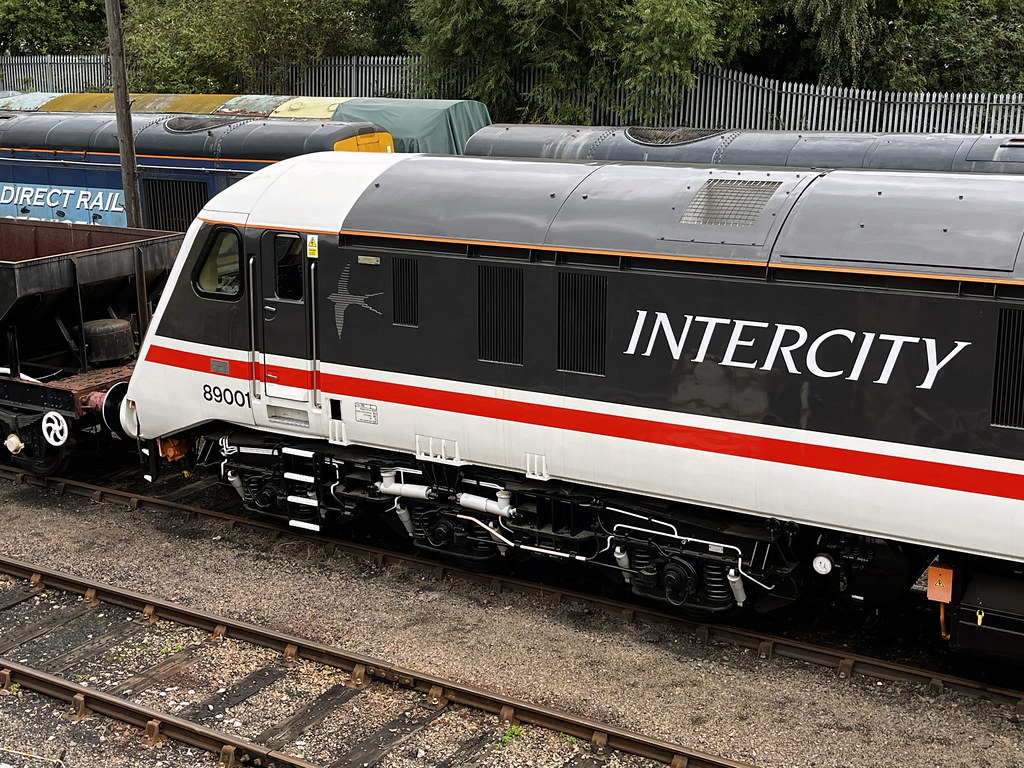
89 001 at Barrow Hill Roundhouse


Information
Number built: 1
Built: 1986
Builder: BREL Crewe / Brush Traction
Motor: 6 Brush TM2201A traction motors (25kV AC OHLE)
Power: 5, 748 hp (4, 286 kW)
Wheel arrangement: Co-Co

The locomotive was designed by Brush Traction and built by BREL Crewe in 1986. Early in the programme the Class 89 was considered as potential traction for the East Coast Main Line [1] and an eventual fleet of 33 to be built though by the time the Class 89 was built the specification for the ECML had changed (to be filled by the Class 91) and only one Class 89 ended up being built.

The Class 89 was used on test trains on both the West Coast Main Line and ECML in the late 1980s. Operations continued until 1992 when the locomotive suffered a serious failure, it was withdrawn by BR as being surplus to requirements (by then) and non-standard [2].

The Class 89 was saved by the privatising railway in 1996. The new operator on the ECML, Great North East Railway bought it back into service [3] and paid for an overhaul to help cover a shortage of motive power at the time. The Class 89 was withdrawn due to another failure in 2000 and again surplus to requirements. The locomotive was purchased for preservation in 2006, after a long overhaul and refurbishment it is planned for the Class 89 to return to the mainline for charter work.

89 001 front profile

89 001 wears Intercity swallow livery

Another photograph of 89 001


[1] Brian Haresnape, Electric Locomotives (Ian Allan, 1983) p. 20
[2] Gavin Morrison, AC Electric Locomotives (Ian Allan, 2013) p. 57
[3] Colin J. Marsden, Diesel & Electric Locomotive Guide (Ian Allan, 2011) p. 234

JNR Class 1040 / ED50 / ED17 / ED18

In the early 1920s the Imperial Government Railways of Japan began electrification of the Tokaido and Yokosuka Lines. The railway imported electric locomotives from the UK, US and Switzerland to provide the motive power and also to give the Japanese experience with the locomotive type before they pursued their own designs. By far the largest class of locomotives to be built was the seventeen strong Class 1040 which were constructed by English Electric and North British Locomotive Company (two examples of the earlier and similar Class 1030 were also built). The locomotives arrived in Japan between 1924 and 1925 and were put into use hauling passenger trains, the locomotives were built for 1, 067mm gauge. After 1928 they were classified as the ED50.
Class 1040 [1]


Information
Number built: 17
Built: 1923
Builder: English Electric / North British Locomotive
Motor: 4 DK86 electric motors (1500v DC OHLE)
Power: 1, 200 hp (865 kW) 
Wheel arrangement: B-B

Between 1930 and 1931 the locomotives were rebuilt as the ED17, they were regeared for their new role hauling mostly freight traffic along the Chuo Line. Two locomotives (classified as ED18) were later modified with A1A-A1A bogies to reduce the axle load on the Iida Line which was more lightly built than other lines. Most of the ED17 fleet survived the war and continued to be used on the Chuo Line but were gradually replaced by more modern types by in mid-1960s. The final ED17s and ED18s were retired from service in 1972. One ED17 has been preserved.
Another view of a Class 1040 locomotive [1]


[1] "Electric locomotives of the Imperial Government Railways of Japan", English Electric Journal Vol. 2 Issue 6 (1924) p. 294

Class 86 (BR Doncaster / English Electric AL6)

The Class 86 AL6 was the production class of AC electrics built for the West Coast Main Line following on from the pilot-scheme AL1-5 (Classes 81 to 85). The AL6 took advantage of experience gained from the earlier locomotives including the fitting of only one pantograph and with changes to equipment. The AL6 is very similar to the Class 85 AL5 technically except for the stub nose cab ends.

Freightliner 86 622 at Crewe Heritage Centre


Information
Number built: 100
Built: 1965-66
Builder: BR Doncaster / English Electric
Engine: 4 AEI 282AZ or GEC G412AZ (86/1) traction motors (25kV AC OHLE) 
Power: (86/0) 5, 900 hp (4, 400 kW) max output
Wheel arrangement: Bo-Bo

The AL6 was designed for mixed traffic including travelling at up to 100mp/h on West Coast Main Line expresses. Unfortunately this caused some problems with the original axle-hung traction motors, with troublesome riding qualities and damage caused to the track and to bogies. Following research at BR Derby, a "flexicoil" suspension system was adopted for fifty eight of the class which were designated Class 86/2 [1]. Another early sub-class was the 86/1, a trio rebuilt to help develop the follow-on Class 87 and able to reach 110mp/h [2][3].

A later sub-class was the 86/3 which were fitted with SAB resilient wheels for improved high speed running and reducing track wear, and with equipment for multiple-working. The Class 86/4 were fitted with flexicoil suspension and SAB wheels for mixed-traffic duties. The 86/5 was a trial locomotive to test ways of improving performance on heavy freights. The 86/6 were a sub-class used on Freightliner trains, finally the 86/9s were a couple of locomotives used as load banks by Network Rail.

Despite their advancing years the Class 86 can still be seen on the network, they have recently been withdrawn from hauling Freightliner trains though can appear on some passenger charters (86 259 as shown below has been returned to it's original Electric Blue livery [4]). Some have also been exported to Eastern Europe.

86 259 at Tyseley

Freightliner 86 639 and friend head through Stafford

Also heading through Stafford is 86 259

Most Freightliner 86 hauled duties uses pairs of locomotives

Another Freightliner 86 pair head through Rugeley Trent Valley


[1] Brian Haresnape, Electric Locomotives (Ian Allan, 1983) p. 64
[2] Gavin Morrison, AC Electric Locomotives in Colour (Ian Allan, 2013) p. 25
[3] Pip Dunn, British Rail Main Line Locomotives Specification Guide (Crowood Press, 2013) p. 161
[4] David Lawrence, British Rail Designed 1948-97 (Ian Allan, 2016) p. 155

English Electric NZR EO Class

The EO class was built by English English for New Zealand Railways for use on the Otira to Arthurs Pass section of the 1,067mm gauge Midland Line. This included an 8.5km long tunnel section and was too long and steep for the use of steam locomotives due to ventilation reasons (the NER ES1 class was built for a similar reason in the UK).
Locomotive with both pantographs raised [1]


Information
Number built: 5
Built: 1922
Builder: English Electric (Dick Kerr)
Motor: 4 English Electric traction motors (1500v DC OHLE)
Power: 680 hp (510 kW)
Wheel arrangement: Bo-Bo

The five locomotives worked well in service, often working trains in trios (they could work in multiple). Due to this the locomotives were later modified to just have the one cab at one end. They remained in service until 1968, one has been preserved.
Hauling a train [1]

Emerging from the tunnel [1]


[1] "Railway electrification in New Zealand", The Electrical Review (March 13 1925) p. 419

Dick, Kerr Electric Locomotives for South America

These locomotives were constructed in 1908 for the Lacroze Rural Tramway / Buenos Aires Central Railway in Argentina. They were designed with a central cab as was common at the time for electric locomotives of this size. The locomotives used a trolley pole for current collection (500v DC overhead). They were able to travel at up to 20 mp/h and could maintain maximum output for an hour.
One of the locomotives [1]


Information
Number built: 6
Built: 1908
Builder: Dick, Kerr
Motor: 4 DK7B electric motors (500v DC OHLE)
Power: 200 hp (149 kW)
Wheel arrangement: Bo-Bo

The locomotives continued to be operated into the 1920s at least [2].

[1] "Electric locomotives for South America", Railway Times (March 20 1909) p. 289
[2] George S. Brady, Railways of South America: Part I. Argentina (1926) p. 197

Manx Electric Locomotive 23

This electric locomotive was built at the Manx Electric Railway's own workshop in 1900 to haul engineering trains on the island's 914mm gauge railway. It was the only locomotive operated by the Manx Electric Railway. Originally built in the pictured configuration with a central cab it was rebuilt with wagon bodies at either side of the cab in the 1920s following accident damage in 1914 [1]. The bogies came from one of the line's 1906 trams.
Number 23 in original configuration [2]


Information
Number built: 1
Built: 1900
Builder: Isle of Man Tramways & Electric Power Company
Motor: Electric (500v DC OHLE)
Formation: 4w-4wWE

The locomotive was withdrawn in the 1940s and put into storage. It was restored in 1983 though is currently stored out of use.

[1] R.L. Vickers, DC Electric Trains and Locomotives in the British Isles (David & Charles, 1986) p. 93
[2] "The Manx Electric Railway", Street Railway Journal (Vol. XXIV No. 10 March 05 1904) p. 356

Class 85 (AEI/British Railways AL5)

British Railways, in it's wisdom, split an order for 100 AC electric locomotives for the West Coast Main Line five ways. The largest share however, was kept in house with 40 of the locomotives built at BR's Doncaster Works using AEI electrical equipment. The Class 85 was similar to the BRCW Class 81, having the same AEI equipment. However, the Class 85 had semiconductor based rectifiers (at first a mixture of germanium and silicon, later retrofitted to be all silicon) and rheostatic braking [1].

Information
Number built: 40
Built: 1961-64
Builder: Associated Electrical Industries / BR Doncaster
Motor: 4 AEI 189 traction motors (25kV AC OHLE)
Power: 3, 200 hp (2, 400 kW)
Wheel arrangement: Bo-Bo

The Class 85 (along with the 81) proved to be the best of the prototype AC electrics, their only real issue being ride quality at top speed. They were displaced from expresses by the Class 86 but remained in service on secondary passenger services and freight until the early 1990s when they were finally withdrawn. One has been preserved.
85 006 preserved at Barrow Hill


[1] Brian Haresnape, Electric Locomotives (Ian Allan, 1983) p. 61

Class 73 (BR Eastleigh / English Electric 1,420/600hp Electro-Diesel)

Despite the fact that diesel locomotives often spend a fair amount of time operating along electrified routes it is unusual that British Rail only ever built two classes of electro-diesel locomotives (these days better known as bi-mode) which could operate both as electric or diesel locomotives, the Class 73 and Class 74. Both were operated by BR's Southern Region, the Class 73 is the only survivor [1]. A number have been rebuilt and upgraded in the last few years (Class 73/9) so they look set to remain in service for a long time to come. these will be covered separately.
GB Railfreight 73 128 leads a class mate through Tonbridge


Information
Number built: 49
Built: 1962, 1965-67
Builder: BR Eastleigh / English Electric
Motor: English Electric 4SRKT Mk II diesel
EE542A or EE546/1B traction motors (750v DC third-rail)
Power: 1, 420 hp (1, 059 kW) - Electric
600hp (447kW) - Diesel
Wheel arrangement: Bo-Bo

The Class 73 is an electric locomotive designed to work with SR's 660-750v DC third-rail system. It also has a small diesel engine for operating on non-electrified lines or if the power is off. They are highly versatile locomotives that served on a whole range of traffic in Southern England, being true mixed traffic locomotives they could be found on passenger and freight services. 

Their numbers however were reduced in the privatisation era but only ten have been scrapped to date. Twelve have been preserved with the rest still operating on the network most usually employed hauling engineering trains.

Sub-class Details
73/0 Original prototype batch, originally to have been called the Class 72
73/1 Main production batch, higher power output and speed
73/2 Modified for Gatwick Express push-pull duties
(coupled to the Class 488 and 489)
73/9 Re-engineered and upgraded examples

They are currently operated by GB Railfreight, Network Rail, South Western Railway and Southern. 
GB Railfreight 73 136 is led through Kidderminster

73 140 preserved in NSE livery seen at Eridge

73 136 at Kidderminster Town

Another view of 73 140

73 210 preserved in Intercity livery at Wirksworth


[1] Colin J. Marsden, Traction Recognition (2nd Edition) (Ian Allan, 2008) p. 82

Class 82 (AEI/Beyer Peacock AL2)

The Class 82 (or AL2) was another of the five classes of AC electric locomotive built for the West Coast Main Line electrification. The Class 82 used AEI/Metropolitan-Vickers electrical equipment though the locomotive building was sub-contracted out to Beyer Peacock [1]. The Class 82 used a number of components in common with the Class 81, though were overweight compared to British Rail's specification due to a sturdier and more traditional method of construction used. To get back within the weight limit some parts of the structure were replaced with aluminium or fibre glass and lighter versions of some items of electrical equipment were fitted [2].
82 008 at Barrow Hill


Information
Number built: 10
Built: 1960-62
Builder: Beyer Peacock / Metropolitan-Vickers
Engine: 4 Metropolitan-Vickers 189Z traction motors (6.25 / 25kV AC OHLE)
Power: 3, 300 hp (2, 460 kW) continuous
Wheel arrangement: Bo-Bo

Although the Class 82 had problems with their mercury-arc rectifiers like some of the other early electric locomotives, it was not as bad as with some of the other classes. The rectifiers were replaced with silicon-diode rectifiers as with the other classes in the early 1970s. One problem the Class 82 did have at times was a tendency to overheat when stationary if the equipment was still running due to inadequate internal ventilation [3].

One was withdrawn due to fire damage in 1966, another in 1971. The rest survived into the 1980s but began to be withdrawn as sufficient supplies more modern traction became available. Two survived (along with two Class 83s) on Euston empty stock movements until 1987. One Class 82 (82 008) has been preserved.
Another view of 82 008, externally it is very similar to the other five early AC loco classes


[1] Gavin Morrison, AC Electric Locomotives (Ian Allan, 2013) p. 11
[2] Brian Haresnape, Electric Locomotives (Ian Allan, 1983) p. 49
[3] Morrison p. 11

Class 81 (AEI/Birmingham Railway Carriage and Wagon Company AL1)

For the electrification of the West Coast Main Line British Railways required one hundred locomotives. In typical BR manner this fleet was to consist of five different types from five different manufacturers! Twenty five of the locomotives built were the Class 81.

Information
Number built: 25
Built: 1959-64
Builder: Associated Electrical Industries /
Birmingham Railway Carriage & Wagon Company
Motor: 4 AEI 189 traction motors (25kV AC OHLE)
Power: 3, 300 hp (2, 461 kW) 
Wheel arrangement: Bo-Bo

The locomotives were built by AEI, a company formed by the merger of Metropolitan Vickers and British Thomson Houston, and the Birmingham Railway Carriage & Wagon Company. Of the five classes built, the Class 81 (or AL1 as it was then known) was the first to arrive. The first was unveiled at a press reception at Sandbach station in November 1959 [1], the first new build British AC electric locomotive.

The AL1 like it's fellow first generation electric locomotives such as the Class 83/AL3 had a similar body shell and appearance, though internally and equipment wise the five classes all differed.

Originally the plan was for two of the AL1s to be of a Type B specification with gearing for freight use and a lower top speed (80 mp/h instead of 100) but in the end all of the locomotives had the standard passenger service gearing.

The Class 81 was used on WCML expresses until the arrival of the Class 86 when they, along with the other early AC electric locomotives, were gradually switched to other duties such as freight and parcel trains. They remained in service until the arrival of the Class 90 meant there was now sufficient electric locomotives available to allow for the final withdrawal of the original locomotives. The last two Class 81s were withdrawn in 1991. One has been preserved.
81 003 (left) preserved at Barrow Hill alongside a Class 83 and 85


[1] Brian Haresnape, Electric Locomotives (Ian Allan, 1983) p. 46

Llechwedd Quarry Electric Converted Locomotives

The Llechwedd slate quarry in North West Wales was an early adopter of hydro-electric power with the first generator at the quarry in 1891. In the late 1920s the quarry decided to convert two WG Bagnall built narrow gauge steam locomotives (1890/1278 and 1895/1445) to overhead electric to join a number of battery electric locomotives already in service. A third steam locomotive was also dismantled ready for conversion but this does not seem to have been carried out.
1278 at the Statfold Barn Railway


Information
Number built: 2
Built: 1927, 1930
Builder: Llechwedd quarry (conversion to electric locomotive)
W.G. Bagnall (original steam locomotive)
Motor: Electric motor (DC OHLE)
Formation: 0-4-0WE

The locomotives were supplied from an overhead wire collected via twin trolley poles on the cab roof. They worked at the quarry until the 1960s and survived into preservation though are in need of a lot of restoration after being outdoors. They have recently transferred to the Statfold Barn Railway.
Side view of 1278

Another view showing the buffer, and a spare!

Side view


Mather and Platt Electric Mining Locomotive

This locomotive was another small electric locomotive built by Mather & Platt in the early twentieth century. The locomotive was intended for use in mines, though was standard gauge unlike many other mining locomotives. The locomotive was able to haul a load of 13 tons up a 1 in 33 incline. The locomotive had a fully enclosed motor on each axle.
The locomotive [1]


Information
Number built: 1
Built: 1904
Builder: Mather & Platt
Motor: Two electric motors (500v DC OHLE)
Formation: 4wWE

[1] J.F. Gairns, "Electric locomotives for mining, factory and allied uses", Electrical Age (August 1904) p. 94

Mather and Platt Electric Locomotive for Sweden

This locomotive was built by Mather & Platt of Manchester for industrial use in Sweden at an iron works. The locomotive had a very similar cab to the locomotives built by Mather & Platt for the City & South London Railway (the first London "tube"). It was also powered by Hopkinson electric motors of the double armature type with a spur gearing to allow for very slow speeds. The locomotive could haul up to seventy tons.
Photo of the locomotive [1]

Information
Number built: 1
Built: 1890
Builder: Mather & Platt
Motor: 2 Edison-Hopkinson traction motors
(300-330v DC third rail)
Wheel arrangement: 4wWE

Preserved CSLR locomotive at the LT Museum, notice the similar body and cab design


[1] J.F. Gairns, "Electric locomotives for mining, factory and allied uses", Electrical Age (August 1904) p. 93

Mather and Platt Electric Locomotive for Tweedle and Smalley

This early electric locomotive was built by Mather & Platt of Salford Iron Works for the textile factory of Tweedle & Smalley in Castleton. The locomotive was used to shunt wagons containing coal for the boiler house as well as other stores. The locomotive could haul a loaded wagon that weighed up to twenty tons at up to two miles per hour. The locomotive collected power from an overhead conductor wire via two collector bars mounted on the roof. This system was found to work well on with the tight radii of the track circuit the locomotive worked on. The locomotive was of very simple construction and resembled a wagon. Speed was regulated using a resistance box.

Information
Number built: 1
Built: 1895
Builder: Mather & Platt
Motor: Manchester electric motor (DC OHLE)
Wheel arrangement: 4wWE

[1] J.F. Gairns, "Electric locomotives for mining, factory and allied uses", Electrical Age (August 1904) p. 91

Class 87 (BR/GEC Traction 5,000hp AC Electric)

The Class 87 was built for the extension of the electrification of the West Coast Main Line into Scotland and was Britain's first 5, 000hp locomotive [1]. The Class 87 was a development of the then standard AC electric locomotive, the Class 86. It shared the same body shell though had redesigned bogies with Flexicoil suspension to reduce track wear [2] and frame mounted traction motors. The Class 87s were cleared to travel at up to 110 mp/h (177 kp/h).
87 035 in the process of being repainted into Virgin livery


Information
Number built: 36
Built: 1973-75
Builder: BREL Crewe / GEC Traction
Engine: 4 GEC G412AZ traction motors
Power: 5, 000 hp (3, 728 kW)
Wheel arrangement: Bo-Bo

Thirty five Class 87/0s were built with a 36th locomotive built as the solo Class 87/1, this locomotive tested a thyristor control system. The later Class 90 was a development of the 87 and indeed was at one stage to have been the Class 87/2.

One one is now still in operation on the main line and two have been preserved. Quite a few have been exported to the continent and continue to operate in Bulgaria [3].
Preserved 87 001 in original BR blue at NRM York

Inside the cab

Front view of 87 035

Another view of 87 001

87 035 in BR Intercity livery at Crewe Heritage Centre

[1] Chris Heaps, BR Diary 1968-1977 (Ian Allan, 1988), p. 70
[2] Brian Haresnape, Electric Locomotives (Ian Allan, 1983), p. 69
[3] Colin J. Marsden, Traction Recognition (Ian Allan, 2008), p. 88

Laing, Wharton and Down Electric Industrial Locomotive

This locomotive was built by Laing, Wharton & Down of London (which later became British Thomson-Houston) for light industrial use. The locomotive weighed four tons and could haul up to sixteen tons up an incline. The locomotive followed current tram technology with it's use of a Brill 21E truck and a trolley pole for electric current collection. The locomotive's cab gave good views for the driver with a glass front.
The locomotive [1]


Information
Number built: 1
Built: 1898
Builder: Laing, Wharton & Down of London
Motor: 2 Wharton No. 3S electric motors (DC OHLE)
Power: 50 hp (37 kW)
Wheel arrangement: 4wWE

The locomotive was tested on a private siding in the North of England where it replaced a team of horses.

[1] "An electric locomotive for small lines", Street Railway Journal (Vol. XIV No. 10 October 1898) p. 686

Metropolitan Railway BTH Locomotives

Following on a year after the first batch of locomotives for the Metropolitan Railway, were these locomotives which used British Thomson-Houston electrical equipment and General Electric motors. Unlike the earlier locomotives which had a central cab, these locomotives had a cab at each end. In 1919 the BTH equipment was replaced by Westinghouse.
No. 11 [1]


Information
Number built: 10
Built: 1907
Builder: Metropolitan Amalgamated / British Thomson-Houston
Motor: 4 GE69 electric motors (600v DC third rail)
Power: 800 hp (567 kW)
Formation: Bo-Bo

In the 1920s the Metropolitan Railway decided to have it's electric locomotives rebuilt by Metropolitan Vickers though this was quickly changed into an order for twenty new locomotives, which reused equipment from the earlier two batches. The BTH locomotives were withdrawn in the early 1920s.
Another view of No. 11 [1]

Inside showing the electric equipment, notice no cab partition [1]

Cab controls [1]


[1] "Metropolitan Railway locomotives for passenger and goods service", Railway Times (Aug 17 1907) p. 173

Class 70 (SR/English Electric 1,470hp Co-Co DC Electric Type CC)

These locomotives were built for Southern Railways / BR Southern Region originally intended for mixed traffic work [1]. The first, originally known as CC1, was built at SR's Ashford Works in 1941, various delays meant the second CC2 was not completed until 1945. The third locomotive was built at BR's Brighton Works in 1948 and had a number of differences over the two earlier locomotives, being slightly longer and with flatter front ends. It also had some equipment changes including a larger boiler for heating trains.
The third locomotive [2]


Information
Number built: 3
Built: 1941, 1945, 1948
Builder: SR Ashford / BR Brighton Works
Motor: 6 EE245 electric motors (660-750v DC third rail)
Power: 1, 470 hp (1, 100 kW) 
Wheel arrangement: Co-Co

The locomotives included a flywheel driven generator, known as the "booster unit", to help prevent the locomotives being stranded by short gaps in the third rail electrification. The locomotives also had a pantograph for operating in goods yards where third rail could be dangerous to railway workers.

The locomotives spent most of their time working passenger trains and were reliable locomotives. They were withdrawn in 1968 due to the small size of the fleet. None were preserved. They were later classified as Class 70 under TOPS though did not carry TOPS numbers, Class 70 was later reused for a Type 5 diesel locomotive.

[1] Brian Haresnape, Electric Locomotives (Ian Allan, 1983) p. 36
[2] Railway Notes (Meccano Magazine January 1949) p. 13

Kearsley / Heysham Electric Locomotives

It is an interesting, though these days often forgotten fact, that industrial railways were among the pioneers of electric traction in the UK, with some industrial electric locomotives predating those designed for the main line networks [1]. Coal mines and power stations were the most typical users of these early electric locomotives including at Kearsley Power Station which had this fleet of four electric locomotives built over an extended period as dictated by demand. The Kearsley locomotives operated off 500v DC overhead supply [2] and were owned by the Lancashire Electric Power Company [3].
Heysham Electric Locomotive 1


Information
Number built: 4
Built: 1928, 1936, 1944, 1946
Builder: Hawthorn & Leslie / Robert Stevenson & Hawthorn
Motor: 4 BTH traction motors (500v DC OHLE / battery)
Power: (First 2) 180 hp (134 kW)
(Last 2) 260 hp (193 kW)
Wheel arrangement: Bo-Bo

Following the closure of Kearsley Power Station in 1982 two locomotives were converted to battery operation [4] with the pantograph removed and batteries fitted in the cab. These worked at Heysham Nuclear Power Station until 2009. Three of the four (locomotives 1 to 3 in fact) locomotives have been preserved.
Heysham No. 1 seen at the now defunct Electric Railway Museum

Kearsley Electric Locomotive 1

Another view of Heysham No. 1

[1] R.L. Vickers, DC Electric Locomotives in the British Isles (David & Charles, 1986) p. 95
[2] Electric Railway Museum - Full Stocklist <http://www.electricrailwaymuseum.co.uk/old/collect.htm>
[3] Michael Poulter, Industrial Railways in Colour (North West) (Irwell Press, 2009) p. 51
[4] Industrial Locomotives Handbook 13EL (Industrial Railway Society, 2003) p. 114