Showing posts with label Post Office Railway. Show all posts

Post Office Railway 1927 Stock

These trains were the original rolling stock on the Post Office Railway which began operating in tunnels below London linking major railway termini and post sorting offices. Ninety of these units were built which typically operated in trains of two or three [1]. Each unit carried wheeled trollies which could contain mail bags, these were loaded or unloaded at the various stops on the Post Office Railway.
Preserved unit 601 at Mail Rail


Information
Number built: 90
Built: 1927
Builder: English Electric
Motor: English Electric (440v DC third rail)
Power: 22 hp (16 kW)
Wheel arrangement: 4wRE

Unfortunately the original rolling stock had a number of drawbacks which became apparent soon after the railway began operating in 1927. As the units had a fixed wheelbase this was causing excessive wear and tear on the unit's own wheels and on the track. This resulted in increased power consumption [2]. The system was already becoming overwhelmed with the amount of mail being carried.

The 1927 Stock was replaced within a couple of years by the 1930 Stock which consisted of two smaller powered units either side of a mail carrying wagon. These articulated units solved many of the problems with the original stock. Many of the 1927 Stock's internals were reused in the replacement 1930 Stock including the motors, axles and wheels. One unit of 1927 Stock has been preserved.
A train of 1927 Stock in operation [3]


Side view of 601, notice the hatches to the mail carrying compartments

Another view of 601


Loading mail trollies [4]


[1] Mike Sullivan, Mail Rail (Redshank Books, 2019) p. 19
[2] Peter Johnson, Mail by Rail (Ian Allan, 1995) p. 118
[3] "London's Post Office Tube Railway", Meccano Magazine (October 1928) p. 812
[4] E. Flaxman, "New cars for London P.O. Tube Railway", Meccano Magazine (June 1930) p. 463

Post Office Railway 1930/36 Stock

The Post Office Railway opened in 1927 linking major railway termini like London Paddington with mail sorting offices via an underground railway. Very quickly however the original 1927 Stock was proving problematic, as they were of rigid construction it was found they were rapidly wearing out the tracks and their own wheels [1] plus they were becoming overwhelmed with the amount of traffic.

The replacement 1930 Stock was built which featured two motors at either end of an articulated mail carrying section [2]. The new stock was also larger and could carry more mail, fifty 1930 Stock trains were built to replaced ninty of the original trains but these had the mail carrying equivalent of one hundred and fifty of the old trains!
824 preserved at the Post Office Museum

Information
Number built: 60
Built: 1930-31, 1936
Builder: English Electric
Motor: English Electric (440v DC third rail)
Power: 22 hp (16 kW)
Wheel arrangement: 2w-2-2-2wRE

Although there were some early problems with derailment, the new trains soon settled down into reliable service. They were more efficient and reduced energy consumption by nearly forty percent compared to the old stock. A further ten trains were built in 1936 to strengthen the fleet, these are known as 1936 Stock though were identical to the earlier trains.

The trains were largely replaced by the updated 1980 Stock in the early 1980s though seventeen remained in operation to augment the new fleet. These remained in service until the closure of the Mail Rail (as it by then called) in 2003. A number have been preserved and others still extant on the now largely shut down railway.
809 preserved at NRM York in original Post Office green

Another view of 824

Motor unit of 814 (later 45)

A mail carrying trolly is shown aboard this train

Another view of a preserved 1930 Stock train

[1] Peter Johnson, Mail by Rail (Ian Allan, 1995) p. 118
[2] Mike Sullivan, Mail Rail (Red Shank Books, 2019) p. 20

Post Office Railway 1980 Stock

The Post Office Railway operated under the streets of London linking London Paddington and London Liverpool Street with Royal Mail sorting offices. Unmanned electric trains, consisting of two motor units either end of post carrying compartments, carried post under London from 1927 until the network was shut down in 2003 [1]. The 1980 Stock was built to replace older trains built by English Electric in the 1930s.
A preserved 1980 Stock train at the Postal Museum

Information
Number built: 34
Built: 1980-82
Builder: Greenwood & Batley, Hunslet Engine Company
Motor: English Electric (440v DC third rail)
Power: 22 hp (16 kW)
Wheel arrangement: 2w-2-2-2wRE

The origin of the 1980 Stock goes back to the 1960s and two prototypes built as the 1962 Stock. These were updated versions of the 1930/1936 Stock with new motors for better acceleration, disc brakes and improvements for loading and unloading mail [2]. These prototypes were extensively tested though the decision to built a series fleet based on the prototypes did not come about until the late 1970s [3].

The new fleet was an updated version of the prototypes. An order was placed with Greenwood & Batley though the manufacturer went into administration in 1980 after just three were built. Hunslet Engine Company, who took over Greenwood & Batley, built the bulk of the fleet despite that the 1980 Stock are often referred to as Greenbats.

The 1980 Stock formed the backbone of the Post Office Railway (which was re-branded as Mail Rail) along with some 1930/1936 Stock until the system was shut down. Some 1980 Stock was fitted with aerodynamic covers to reduce air resistence in the tunnels.

A number of 1980 Stock trains have been officially preserved, it is thought the rest are also still extant stored on the Mail Rail network which is closed (apart from the Postal Museum tourist attraction at Mount Pleasant - a Museum Train now runs on some of the track) but mostly intact.
Number 30 at Mount Pleasant

The system was renamed Mail Rail in it's latter years

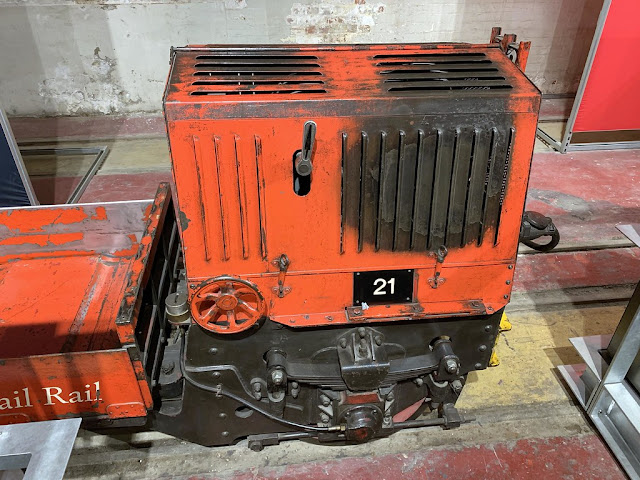
Side view of the motor compartment of 21

How the post was carried on the trains, the trollies transferred at stations

Number 30 at Mount Pleasant, dwarfed by the station tunnel

[1] Peter Johnson, Mail by Rail (Ian Allan, 1995) p. 115
[2] Mike Sullivan, Mail Rail (Red Shank Books, 2019) p. 24
[3] Johnson p. 122