The Class 10 was a variation of the standard Class 08 diesel shunter built for British Railways that had a Lister Blackstone diesel instead of an English Electric 6KT and two GEC WT360 traction motors [1]. One hundred and forty six were built, the vast majority at BR Darlington though six were also built at BR Doncaster.
D4092 preserved at Barrow Hill
Information
Number built:
146
Built:
1955-62
Builder:
BR Darlington and Doncaster
Motor:
Lister Blackstone ER6T diesel
Power:
360 hp (261 kW)
Wheel arrangement:
0-6-0
They had the same performance as the Class 08 and, apart from the traction package, were pretty identical. However, due to being non-standard they were withdrawn between 1967 and 1972. None carried their TOPS numbers. Four have survived into preservation.
Another view of D4092
[1] Brian Haresnape, Diesel shunters (Ian Allan, 1984) p. 68
The Class 24 was part of the original wave of diesel locomotives built as part of the British Railways Modernisation Plan in the 1950s. The initial twenty were Type B (later Type 2) pilot-scheme locomotives and the design was sufficiently successful to gain a full production run of 151. The locomotive was further developed as the follow-on Class 25.
Preserved 5081 at Kidderminster Town
Information
Number built:
151
Built:
1958-61
Builder:
BR Darlington, Derby and Crewe
Motor:
Sulzer 6LDA28 diesel
Power:
1, 160 hp (865 kW)
Wheel arrangement:
Bo-Bo
The Class 24 saw service across the network but mainly on the London Midland and Eastern Regions handling lighter freights and passenger services, and double heading on heavier trains. One problem which the locomotives had was a lack of sufficient brake force on longer loosely coupled freights which meant that diesel brake tenders were required [1]. The locomotives also served on the Southern and Scottish Regions, the latter batch having tablet catchers on the cab side for use on the Far North Line.
Compared to other Type 2s such as the Class 26, which had the same engine, the Class 24 had a number of disadvantages. The engine room air intakes and louvres were awkwardly situated making maintenance difficult [2] and filtering inefficient, they also suffered from having draughty cabs due to the little used cab end doors.
Withdrawal of the Class 24s began in earnest in the 1970s with the last withdrawal from revenue earning service in 1980. A number remained in departmental use [3] until the last was withdrawn in 1987. Four have been preserved.
Another view of 5081
5081 (24 081) was the last loco to be withdrawn from revenue service in 1980
5081 at Kidderminster Town
5081 arrives at Arley
[1] Brian Haresnape, Early Prototype & Pilot-Scheme Diesel-Electrics (Ian Allan, 1981) p. 67
[2] Brian Haresnape, Production Diesel-Electrics Types 1-3 (Ian Allan, 1983) p. 33
[3] Colin J Marsden, Departmental Stock (Ian Allan, 1984) p. 106
Tinsley goods yard was an example of what was known as a "hump yard". Wagons were pushed over the hump or high point in the yard and then gravity (and a complicated control system) could do the rest. The yard needed a more powerful locomotive than the standard Class 08 shunter [1] and so with typical British Rail ingenuity a "new" locomotive was created out of two Class 08s! The two shunters were connected in a master and slave arrangement, with the cab of one locomotive controlling both. The shunter was known as the Class 13, three such conversions were made in the mid-1960s.
13 001 at Tinsley yard (KD Collection)
Information
Number built:
3
Built:
1965 (Conversions from Class 08)
Builder:
BR Darlington
Motor:
2 English Electric 6KT diesels
Power:
700 hp (522 kW)
Wheel arrangement:
0-6-0+0-6-0
At first the two locomotives were connected with the cabs together in the middle but later on the cab from the master locomotive was placed outmost to aid visibility. The cab from the slave unit was removed. Extra weights were added in the bufferbeams to aid tractive effort (the weight of a Class 13 was 120 tons [2], 20 tons more than two Class 08s would be). The locomotives were withdrawn in the early 1980s as the practice of hump shunting ended. None of the Class 13s were preserved.
[1] Colin J Marsden, Diesel & Electric Locomotive Recognition Guide (Ian Allan, 2011) p. 95 [2] Brian Haresnape, Diesel Shunters (Ian Allan, 1984) p. 75
Number 13 was the ultimate expression of the North Eastern Railway's electric traction developments in the early twentieth century (see also the Class ES1 shunter and EB1 freight locomotive). Number 13 was an express passenger locomotive designed to haul trains between York and Newcastle. When built it was the one of the most modern and powerful electric locomotives in Europe [1] and the first British high-speed electric locomotive built to haul passenger trains on trunk routes [2].
Number 13 [2]
Information
Number built:
1
Built:
1922
Builder:
NER Darlington
Motor:
6 Metropolitan-Vickers electric motors (1500v DC OHLE)
Power:
1, 800 hp (1, 343 kW)
Wheel arrangment:
2-Co-2
Unfortunately for Number 13 the NER's post First World War plans to electrify their main line remained just that, plans. When the locomotive was finished it was tested along the Shildon-Newport line including hauling fourteen coach test trains. However post-war financial pressures and the absorbing of the NER into the LNER the year after Number 13 was completed finally killed off the main line electrification plan [3].
Number 13 was put into storage and never earned a penny in revenue service however managed to survive it's time as an unused LNER locomotive, it was finally given the name Class EE1 (Express Electric) in 1945. The locomotive passed into British Railways ownership though was finally scrapped in 1950.
Number 13 with a test train [2]
[1] R.L. Vickers, DC Electric Trains and Locomotives of the British Isles (David & Charles, 1986) p. 58 [2] "North Eastern Railway Electrification", The Electrical Review (Vol. 91 No. 2340) September 29 1922, p. 436 [3] Brian Haresnape, Electric Locomotives (Ian Allan, 1983) p. 7
The Class 08 was a development of earlier diesel shunters built during the last few years of the "Big 4" railway companies such as the LNER J45 and especially the LMS Class 11 [1]. The Class 08 became the standard diesel heavy shunter for British Railways and over 1,000 of it and the related Classes 09 and 10 were built over a ten period.
08 911 at NRM Shildon
Information
Number built:
996
Built:
1952-62
Builder:
British Railways Derby, Crewe, Darlington, Doncaster, Horwich
Engine:
English Electric 6KT diesel
Power:
350 hp (261 kW)
Wheel arrangement:
0-6-0
The Class 08 could be seen nearly everywhere on the British Rail network, only restricted where their axle-load prohibited them. The Class 08s were built with vacuum brakes for trains (they have air brakes for their own use) but the introduction of air braked freight stock such as Freightliner trains in the 1960s saw a large number of Class 08s either fitted with air or dual brakes [2]. Some were also fitted with radio telephones for use in larger marshalling yards.
Despite the need for dedicated shunters having reduced considerably over the years there are still plenty of Class 08s in service, they are a fairly common sight on national rails in motive power depots and freight yards, plus over sixty have been preserved and others sold to private companies. The vast majority of the class were of the standard 08/0 sub-class with a small number having cut down cab heights for operating in South Wales known as the 08/9 [3].
One interesting development was the Class 13 which consisted of pairs of Class 08s permanently coupled, the cab on one of the 08s removed, to form a 700hp shunter for the Tinsley Marshalling Yard, unfortunately none of these survived withdrawal.
D3586 (08 471) at Bridgnorth MPD
08 704 approaches Wirksworth
08 825 at Chinnor
08 830 at Rowsley South
Another view of 08 704 at Wirksworth
[1] Colin J. Marsden, Traction Recognition (Second Edition) (Ian Allan, 2009) p. 6 [2] Brian Haresnape, Diesel Shunters (Ian Allan, 1984) p. 66 [3] Colin J Marsden, Motive Power Recognition: 1 Locomotives 3rd Edition (Ian Allan, 1988) p. 10
Following on from the Class 24, the Class 25 Type 2 diesel-electric locomotive was built in large quantities in the 1960s and became a very common sight on British Rail in the late 1960s and 1970s before being phased out in the 1980s.
The early Class 25s shared the same design flaws of the Class 24 such as the awkward layout of the engine room which hindered maintenance and the position of air intake louvres and filters (some of which got so filthy they stopped working). The draughtiness of the cab was also a problem largely thanks to the seldom used gangway doors [1]. During the long production run a number of improvements were made which are detailed below.
D7535 at Kidderminster Town
Information
Number built:
327
Built:
1961-67
Builder:
BR Derby, Darlington, Crewe and Beyer Peacock
Motor:
Sulzer 6LDA 28B diesel
Power:
1, 250 hp (932 kW)
Wheel arrangement:
Bo-Bo
The Class 25s were mixed traffic locomotives, spending much of their time on freight duties (not all were fitted with train heating boilers) and also some cross-country passenger services [2]. As the 1980s wore on the changing nature of the freight business meant they were becoming underpowered and regional cross country passenger duties were increasingly going over to multiple units. They were all withdrawn by 1987 though twenty have been preserved.
Class 25 sub-classes are listed below but there were also differences within sub-classes too especially with respect to train heating provision (or lack of).
Sub-class
Details
25/0
Original, very similar to Class 24 but with uprated engine
25/1
Improved lighter traction motor and other weight saving measures
25/2
Redesigned interior, air filter louvre layout and cab with gangway doors removed
25/3
Final version with improved equipment
25/9
Locomotives dedicated to mineral traffic
D7629 at Duffield
D7659 at Rowsley South
D7535 at Hampton Loade
D7612 at Chinnor
D7535 at Kidderminster Town
[1] Brian Haresnape, Production Diesel-Electrics Types 1-3 (Ian Allan, 1983) p. 33 [2] John Vaughan, Diesels on the London Midland (Ian Allan, 1981) p. 30
The North Eastern Railway was pioneer of electric traction in Britain. Following on from the construction of a couple of electric shunting engines built in the early twentieth century (the Class ES1) the NER electrified an eighteen and a half mile long freight line between Shildon and Newport County Durham [2] (which included part of the original Stockton & Darlington Railway). The line was electrified to 1500v DC overhead and a fleet of ten Bo-Bo electric locomotives was built for it. These were the first mainline electric locomotives built for 1500v DC in Britain. They were built in-house at NER's Darlington works with electrical equipment supplied by the Siemens factory in Stafford [3]. The locomotives had a low top speed (45 mp/h) though usually ran at 25 mp/h and could haul a train of 1,400 tons [4].
Information
Number built:
10
Built:
1914
Builder:
NER Darlington
Engine:
4 Siemens traction motors (1500v DC OHLE)
Power:
1, 100 hp (820 kW)
(Class EB1) 1, 256 hp (937 kW)
Wheel arrangement:
Bo-Bo
Unfortunately a decline in coal traffic throughout the 1920s made using electric locomotives on the line uneconomic. The catenary needed replacement by the mid-1930s, the decision was made to revert to steam traction in 1935 [5]. The locomotives were withdrawn though one did survive as a shunter used at the Ilford carriage sidings. For this role it's power output was raised. It survived into British Railway use and became known as the Class EB1. It was finally withdrawn in 1964 when the electrification was converted to AC [7].
Public domain image [1]
View of the catenary in a freight yard, public domain image [6]
[1] "Electrification of an English Freight Line", Electric Railway Journal Vol. XLVIII No. 1 (July 1916) p. 5 [2] Brian Haresnape, Electric Locomotives (Ian Allan, 1983) p. 7 [3] Electric Railway Journal p. 4 [4] R.L. Vickers, DC Electric Trains and Locomotives in the British Isles (David & Charles, 1986) p. 57 [5] Haresnape p. 9 [6] Electric Railway Journal p. 7 [7] Paul Smith & Shirley Smith, British Rail Departmental Locomotives 1948-1968 (Ian Allan, 2014) p. 26
A relatively tiny adjutant to the huge Class 08 shunter fleet, twenty six Class 09s were built for Southern Region. They were almost exactly the same as the 08 but had different gearing [1] to allow a top speed of 27.5 mp/h [2] (compared to the Class 08's 15 mp/h) and waist high air brake connections for working with Southern multiple-units. Because of this different gearing they have a lower tractive effort than the 08s.
Information
Number built:
38 (including 12 conversions from Class 08)
Built:
1959-62
1992-93 (09/1 and 09/2 conversions)
Builder:
BR Darlington & Horwich 09/1 and 09/2 conversions by RFS Kilnhurst
Engine:
English Electric 6KT
Power:
400 hp (268 kW)
Wheel-arrangement:
0-6-0
In the early 1990s twelve more Class 09s were built from 08s to fulfil a need for faster shunters [3]. These later conversions, known as the 09/1 and 09/2, lack the high-level air brake connections (the original locomotives became 09/0). The main difference between the two later sub-classes is that the 09/1 has an 110v electrical equipment and the 09/2 90v.
Although the Class 09s spent most of their time on shunting duties there were the odd occasions they were used for passenger duties such as deputising for a Class 33 on Clapham Junction-Kensington Olympia services! The 09s originally were largely restricted to Southern Region but in the privatised era they can be found much wider afield. Ten have been preserved including one used as the National Railway Museum's yard shunter.
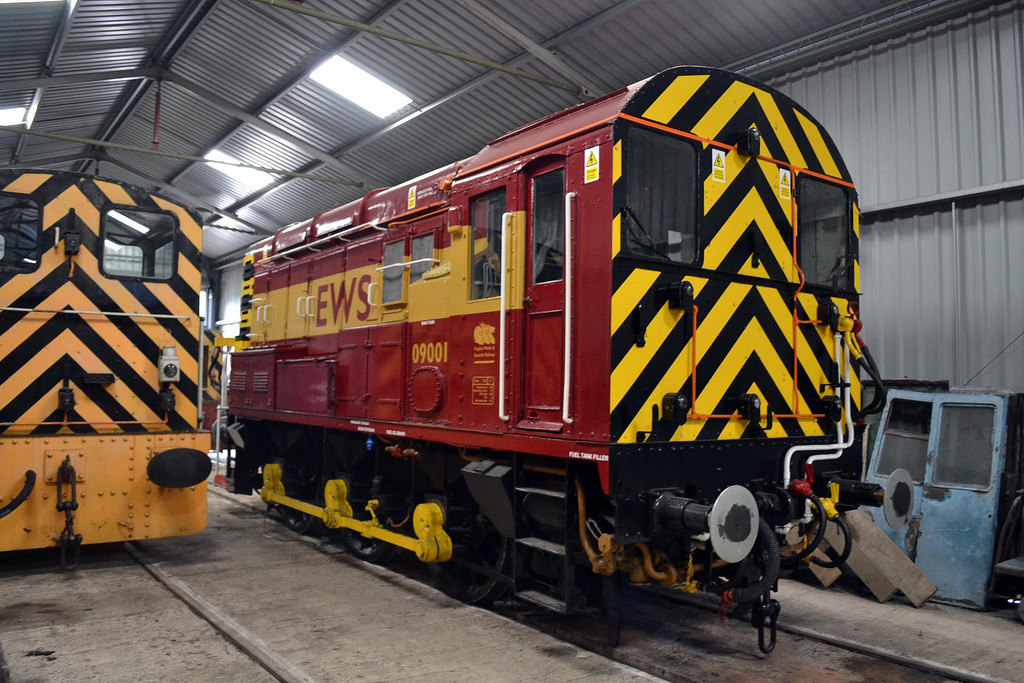
EWS liveried 09 001 at the Heritage Shunter Trust
D4100 at Kidderminster SVR
The National Railway Museum's 09 017
09 001 next to 03 099
Another view of 09 017
D4100 amid Class 50s
[1] Brian Haresnape, Diesel Shunters (Ian Allan, 1984) p. 71 [2] Colin J. Marsden, Traction Recognition (Second Edition) (Ian Allan, 2008) p. 12 [3] Colin J. Marsden, Diesel & Electric Locomotive Recognition Guide (Ian Allan, 2011) p. 90