Showing posts with label BREL Swindon. Show all posts

Class 03 (British Railways 204hp Diesel-Mechanical)

After purchasing a number of small fleets of privately built diesel mechanical shunters, British Railways finally decided to build a "standard" type, the resulting Class 03 ended up being very similar to the Drewry built Class 04 [1]. 

03 066 at Barrow Hill Roundhouse


Information
Number built: 230
Built: 1957-61
Builder: BR Swindon and Doncaster
Engine: Gardner 8L3 diesel
Power: 204 hp (152 kW)
Wheel arrangement: 0-6-0

The Class 03s served with British Rail for many years, outlasting all other shunters except for the standard diesel-electrics (Class 08/09). Although much of their work disappeared in the 1970s and 1980s, as the nature of the freight sector changed, they continued to have a role on the network in places where larger and heavier locomotives were unsuitable and the last was not withdrawn until 2008 [2].

A good number of Class 03s have seen further use after British Rail with industrial users and no fewer than fifty-five have been preserved. Although primarily intended for shunting (and trip work) Class 03s did occasionally haul passenger trains, though these tended to be special workings such as taking Channel Island boat trains up to Weymouth harbour where the line ran through the streets [3] and unadvertised special services for workers [4].

03 073 at Crewe Heritage Centre

D2059 at Havenstreet, Isle of Wight Steam Railway

Another view of 03 073 at Crewe Heritage Centre

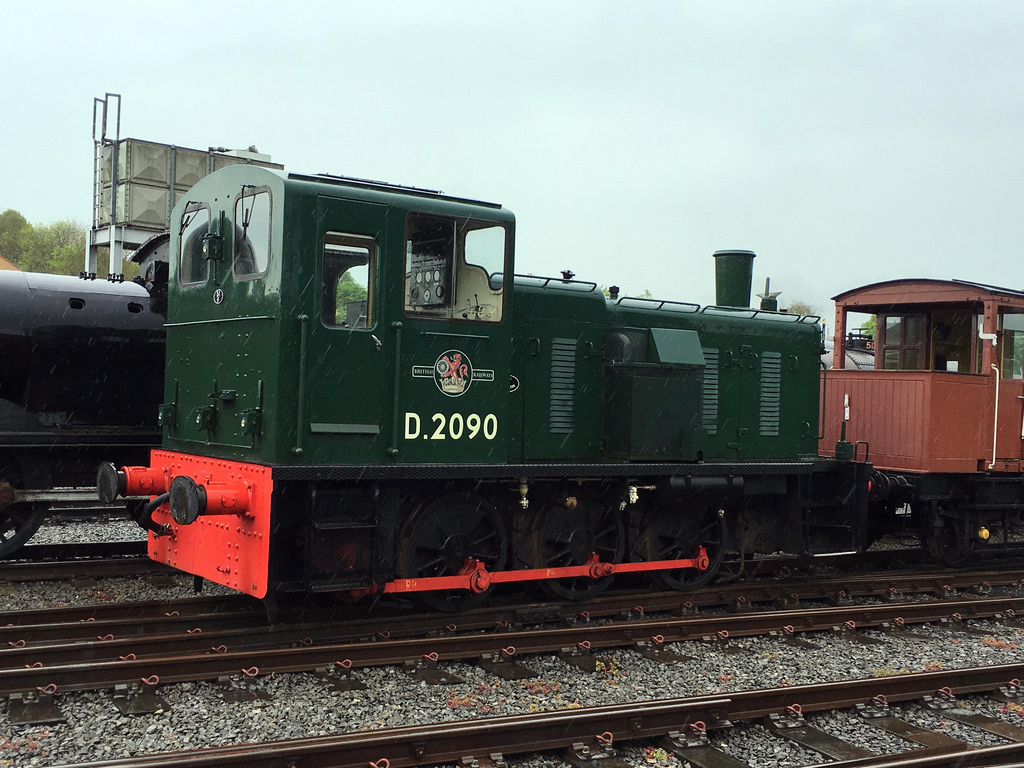
D2090 at NRM Shildon in original BR green

03 099 at Rowsley South, Heritage Shunters Trust

[1] Brian Haresnape, Diesel Shunters (Ian Allan, 1984) p. 56
[2] Colin J. Marsden (ed.), "BR Class 03 0-6-0 DMs", Modern Locomotives Illustrated No 217 February-March 2016 (SR, GW, LNER, LMS & Trial Shunters & Class 03s), p. 67
[3] Haresnape, Shunters p. 20
[4] Michael Welch, Diesels on the Western (Capital Transport, 2013) p. 18

Class 124 (BR Swindon Trans-Pennine 6-car)

The Class 124 was the most distinctive looking example of first generation diesel multiple unit built for British Rail. The class of 6-car (initially) units had large cab windows unlike any other DMUs though mechanically did share components with the Class 123 and 126. They were introduced into service in the early 1960s and used exclusively on trans-Pennine services where they reduced journey times by up to forty-five minutes.
In original configuration [2]


Information
Number built: 51 (8 6-car sets plus 3 spares)
Built: 1960
Builder: BR Swindon
Motor: 2 Leyland Albion 6-cylinder diesels per power car
Power: 1, 840 hp (1, 360 kW) 
Formation: DMC (Driving Motor Composite)+MBSL (Motor Brake Standard
Lavatory)+TSL (Trailer Sandard Lavatory)+TFLRB (Trailer First
Lavatory Restaurant Buffet)+MBSL+DMC

In later years they often operated as 4-car units, in these cases the motors in the MBSLs were removed and they were reclassified TBS [1]. In the late 1970s they were moved to Western Region and merged with their sister class 123. They operated Reading services in 4-car hybrid units before final withdrawal in 1984. Unfortunately none were preserved.

[1] Colin J Marsden, DMUs (Ian Allan, 1982) p. 78
[2] "Trans-Pennine Diesel Sets", International Railway Journal (April 1961) p. 22

Class 42 (BR Swindon Type 4 2,200hp Diesel-Hydraulic)

With electrification a distant dream, British Rail's Western Region turned instead to Continental style light weight diesel-hydraulic locomotives with fast-running engines in the 1950s to replace steam. The Class 42 was a licence-built version of German Federal Railway's V200 locomotive [1], modified to fit within the smaller British loading gauge. Two batches of locomotive were built, the Swindon built Maybach powered Class 42 and the North British Locomotives built MAN powered Class 43.
D821 at Kidderminster Town


Information
Number built: 38
Built: 1958-61
Builder: BR Swindon
Engine: 2 Bristol Siddeley Maybach MD650 diesels
Power: 2, 200 hp (1, 641 kW)
Wheel arrangement: B-B

The Class 42 was powered by two Maybach diesels built under licence by Bristol Siddeley. The first few locomotives were limited to 2,000hp due to limitations with the transmission though most of the class was rated at 2,200hp. One locomotive was fitted with a pair of Paxman 12YJXL diesels and was rated at 2,400hp. The Class 42 looked very similar to the V200 class though originally British Railways wanted it to look different, their designs were later used on the Class 52 [2].

The locomotives had a successful entry into service, Western Region found they could comfortably handle heavier trains than the Class 40. However there were problems with riding at high speeds which resulted in speed restrictions until bogie modifications could be carried out in 1960 [3]. Most of the class were named after Royal Navy ships and hence the nickname of the class became "Warships".

As with the other diesel-hydraulic designs the Class 42 was doomed once British Rail, in it's drive for standardisation and rationalisation, had sufficient diesel-electric motive power to take over the Class 42's duties. Withdrawals began in 1968 and were completed by 1972 [4]. Two Class 42s have been preserved.

D832 Onslaught at Wirksworth

D821 at Bridgnorth in BR maroon

D832 at Duffield

D821 cab

D821 at Bewdley


[1] John Jennison & Tony Sheffield, Diesel Hydraulics of the 1960s and 1970s (Ian Allan, 2014) p. 4
[2] David Lawrence, British Rail Designed 1948-97 (Ian Allan, 2016) p. 107
[3] Brian Haresnape, Western Region Diesel-Hydraulics (Ian Allan, 1982) p. 28
[4] Pip Dunn, British Rail Main Line Locomotive Specification Guide (Crowood Press, 2013) p. 80

Class 14 (BR Swindon 650hp Type 1 Diesel-Hydraulic)

The early days of BR dieselisation was littered with mistakes and sometimes outright lunacy, and the sad story of the Class 14 must rank as one of the worst. The Class 14s were built, at BR Swindon - the final locomotives built at the historic old works, as part of Western Region's experiments with diesel hydraulic transmission.
D9551 in yellow ochre livery at Kidderminster Town


However, the Class 14 was doomed from the start. Even as they were being built BR was already moving to standardise on diesel electric transmission and marking the WR diesel hydraulic fleet for early withdrawal. If that wasn't enough the work intended for these small Type 1 locomotives, trip working and inter-freight yard transfers, was quickly drying up [1] in the wake of the Beeching Report.

Information
Number built: 56
Built: 1964-65
Builder: BR Swindon
Engine: Paxman Ventura 6YJXL diesel
Power: 650 hp (485 kW)
Wheel arrangement: 0-6-0

BR began withdrawals of the Class 14 in 1968 as work dried up. Some were sent to work outside of Western Region such as at Hull but their lack of power and poor reliability did nothing to delay the inevitable [2]. All were gone by 1970, at most the locos had five years service for BR and most had far less than that.


Luckily, many were sold on to industrial users who eagerly snapped up these nearly new locomotives going cheap! Most of these locomotives went on to have good careers on private metals, with a number going abroad. Nineteen have been preserved, with many in running order.

One preserved Class 14 was even hired by BR's successor to work on the High Speed 1 route then under construction mainly shunting near London St Pancras. The Class 14s have been nicknamed the Teddy Bears.
D9500 at Darley Dale

D9539 at Rowsley South, this was the only livery they carried in BR service

D9551 at Bewdley, the yellow ochre was a "what might have been" livery

D9539 at Rowsley South

D9551 before it's repaint at Bridgnorth


[1] Brian Haresnape, Western Region Diesel Hydraulics (Ian Allan, 1982) p. 74
[2] John Jennison & Tony Sheffield, Diesel Hydraulics in the 1960s and 1970s (Ian Allan, 2004) p. 38

Class 52 (BR Swindon/Crewe 2,700hp Type 4 Diesel-Hydraulic)

In the 1960s the Western Region of British Rail was allowed to experiment with diesel hydraulic transmission as opposed to the rest of BR which used diesel electric transmission for mainline locomotives. The experiment was ultimately a failure with the non-standard diesel hydraulic locomotives being withdrawn from the late 1960s onwards after (in some cases very) short working lives. The Type 4 Class 52 "Western" was the flagship of the Western Region diesel hydraulic fleet and suitably was the last diesel hydraulic locomotive class to survive, it managed to hang on in BR service into early 1977 [1].
D1062 at Kidderminster Town


Information
Number built: 74
Built: 1961-64
Builder: BR Swindon and Crewe
Engine: 2 Maybach MD655 diesels
Power: 2, 700 hp (2, 014 kW)
Wheel arrangement: C-C

The Westerns along with some of the other diesel hydraulic classes were heavily influenced by German diesel locomotives and indeed had a pair of German made engines, though these proved expensive to maintain and class availability was poor for some time until modifications could be made to improve reliability. A great deal of care was made to the external appearance of the Westerns [2] which included a curved body profile to match those of the Mark 1 coaches it would typically pull. A number of liveries were also proposed and experimented with on the locos including desert sand, maroon and BR locomotive green [3]. Though the class was all in standard BR blue and yellow by the late 1960s in any case.


The Westerns were built to replace the GWR Kings on Western expresses though later were displaced to secondary services and freights as diesel electric locomotives like the Class 50 were transferred to Western Region. The Westerns managed to survive until early 1977 [4], their passing saw the greatest outpouring of enthusiast interest since the demise of steam and indeed they remain one of the more popular diesel locomotive classes to this day, a lot of this popularity probably due to their stylish and distinctive looks. Seven have been preserved and most of these continue to run on preserved lines (and the occasional main line foray) to this day.
Maroon D1062 at Hampton Loade

D1062 again, now in BR blue & yellow

D1010 at Kidderminster Town

D1023 at the National Railway Museum
D1015 at Kidderminster Town in early BR blue livery

[1] Brian Haresnape, Western Region Diesel Hydraulics (Ian Allan, 1982) p. 61
[2] David Lawrence, British Rail Designed 1948-97 (Ian Allan, 2016) p. 154
[3] John Jennison & Tony Sheffield, Diesel Hydraulics in the 1960s and 1970s (Ian Allan, 2014) p. 19
[4] A. Wyn Hobson, The Last Years of the Westerns (Ian Allan, 1983) p. 70

GWR AEC Railcar

Several railway companies experimented with petrol and diesel railcars in the early part of the twentieth century, the GWR had a fleet of AEC powered railcars which were arguably the most successful type to be built until the advent of the British Railway DMU in the 1950s. Indeed it can be said that the success of these railcars established the viability of diesel railcar for operation on Britain's railways in the future [1]. The first railcar entered service in 1933 operating between London Paddington and Reading though with just a single engine was considered rather underpowered having a top speed of just 45 mp/h (72 km/h), all subsequent railcars had two engines and subsequently much better performance.
Preserved W4W, a Park Royal example, at NRM York

Information
Number built: 38
Built: 1934-42
Builder: Park Royal, Gloucester Railway Carriage & Wagon Company,
GWR Swindon
Motor: 1 or 2 AEC 6-cylinder diesel
Power: 121 / 242 hp (90 / 180 kW)

The railcars were built in a number of batches throughout the 1930s and early 1940s. Park Royal built the first four, the Gloucester Railway Carriage & Wagon Company building the next thirteen. One of these was a dedicated parcels van, later railcars also had buffers and draw gear to haul stock. The rest of the fleet was built at the GWR's own Swindon works in the early 1940s. These differed from the earlier railcars in having an angular boxy exterior [2] as opposed to the Art Deco streamlined look of the earlier railcars (which had earned them the nickname of "Flying Banana"). The last few railcars built had cabs at one end only (gangways at the other) and were used in two-car sets [3].

The railcars remained in service until the 1960s used on Western Region branch lines. Three have been preserved.
Side view of W4W

W31W at London Paddington (KD Collection)

Front view of W4W

[1] Brian Haresnape, Diesel Multiple Units: the First Generation (Ian Allan, 1985) p. 11
[2] Colin J Marsden, DMU and EMU Recognition Guide (Ian Allan, 2013) p. 4
[3] Haresnape p. 10

Class 123 (BR Swindon Intercity Services 4-car)

The Class 123 was the last type of first generation diesel multiple unit to enter service and in many ways the best, being designed for longer inter city routes with a high degree of passenger comfort including some corridor compartments and B4/B5 bogies which gave a better ride at higher speeds [1]. They had a similar front-end design to the Class 309 EMU with wrap around cab windows [2].

Information
Number built: 40 (10 4-car sets)
Built: 1963
Builder: BR Swindon
Engine: 2 BUT (Leyland Albion) 6-cyl per power car
Power: 920 hp (686 kW)
Formation: Driving Motor Brake Standard Lavatory (DMBSL)+
Trailer Composite Corridor (TCK)+Trailer Standard Lavatory or
Trailer Buffet Standard (TSL/TSLRB)+
Driving Motor Standard Corridor (DMSK)

The Class 123 was also fitted with Pullman style gangways to the cab ends so everyone on a train could access the buffet car. They were used on South Coast-Wales services though were based on Western Region as Southern Region did not want to have anything to do with diesel-mechanical units! They were later used on outer-suburban services out of London Paddington [3].

They were surplus to requirements by the late 1970s but had a short reprieve in the North East of England before finally being withdrawn in 1984.
Class 123 at Swindon (KD Collection)

[1] Brian Haresnape, Diesel-Multiple Units: The First Generation (Ian Allan, 1985) p. 71
[2] David Lawrence, British Rail Designed 1948-97 (Ian Allan, 2016) p. 135
[3] Colin J Marsden, DMU and EMU Recognition Guide (Ian Allan, 2013) p. 83