Showing posts with label Pier Railway. Show all posts

Southend Pier Railway Diesel Locomotives

Southend-on-Sea's pier is 2.16km long (the longest pleasure pier in the world). Since 1890, when the pier officially opened, a narrow gauge railway has run on the pier conveying visitors and goods along it [1] (an earlier wooden pier had a horse drawn tram travelling along it). Originally the railway used electric vehicles, a toast rack style car and later on fully enclosed vehicles. The original electric railway was closed in 1978 due to it's poor condition.

After a period of of uncertainty the decision was made to build a brand new railway in the 1980s [2]. This new railway uses diesel hydraulic locomotives and push-pull rakes of coaches. The new railway was built to 914mm narrow gauge (the original was 1, 067mm) with a simplified track layout compared to the original. It opened in 1986.

Information
Number built: 2
Built: 1986
Builder: Severn Lamb
Motor: Deutz diesel
Power: 55 hp (41 kW)
Wheel arrangement: 4wDH

The current Southend Pier Railway, which is owned and operated by the local council, has two trains, each consists of a locomotive (which is at the pier end of the train) and six passenger cars. The last and shore end trailer has a driving cab. The two trains have been named Sir William Heygate and Sir John Betjeman.

The line is mostly single with a passing loop at the mid-point, both pier head and shore stations have two platforms so in peak times both trains can be in operation, a single battery electric car is also used in the Winter. Up to one hundred and eighty two passengers can be carried per train [3]. The locomotives can also on occasion propel a flat wagon in order to take provisions up to the pier head.

There are plans to replace the locomotives, which are becoming life expired and hard to maintain, with new trains (of as as-yet unspecified type) in the next couple of years [4].
Sir William Heygate at the pier head station 

The locomotives also have space for push-chairs and other small cargo


Sir John Betjeman heads back to shore

Aboard one of the cars

Sir John Betjeman at the pier station

The driving railer of Sir John Betjeman at the shore station

[1] Keith Turner, Pier Railways & Tramways of the British Isles (Oakwood Press, 1999) p. 49
[2] Colin J. Marsden (ed.), Light Rail (Key Publishing, 2018) p. 94
[3] Turner p. 61
[4] £3.25m set aside to replace Southend Pier's outdated trains https://www.southendstandard.co.uk/news/17348641.325m-set-aside-to-replace-southend-piers-outdated-trains/

Southend Pier Railway Postwar Electric Stock

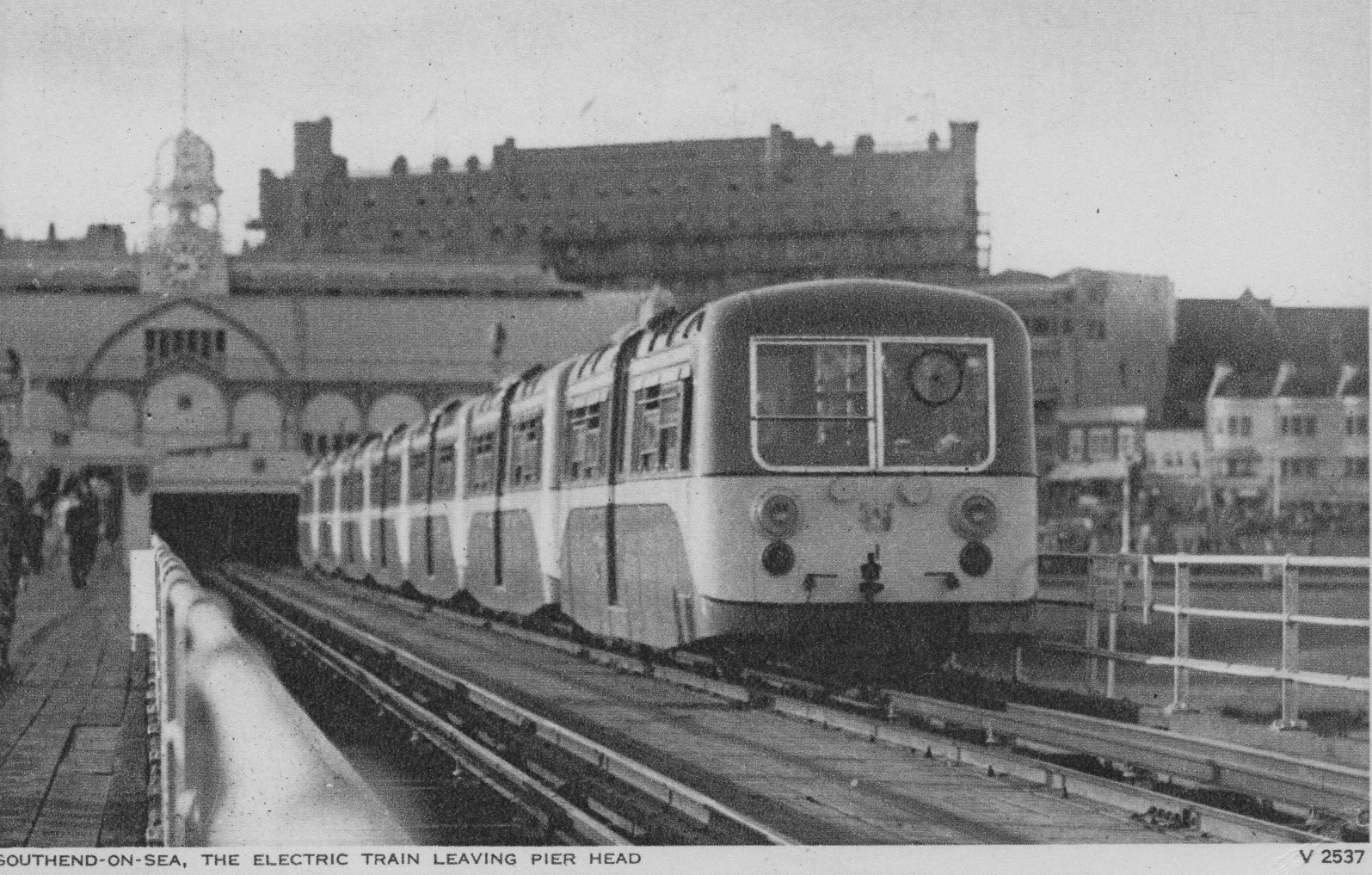
The Southend Pier Railway opened in 1890 and operated toast-rack style electric tram cars along it's length. After the pier and railway was re-opened following a period of closure during the Second World War passenger numbers greatly increased and the need was felt to replace the original cars with a more modern design. AC Cars of Thames Ditton were contracted to built four trains of seven cars each (in total twelve motor cars and sixteen trailers) for the 1,067mm gauge railway, each using design and technology similar to London Underground tube trains of the time including air operated sliding doors and rheostatic electric brakes [1]. The cars had four wheel trucks (made by Maley and Taunton [2]) with a 4.4m long wheelbase, somewhat long for four wheel vehicles though the pier railway lacked any tight curves and the long wheelbase aided stability.

Information
Number built: 28 (4 7-car trains)
Built: 1949
Builder: AC Cars
Formation: Driving Motor (DM)+Trailer(T)+T+DM+T+T+DM

The new rolling stock proved reliable in service though passengers numbers gradually dropped during the 1950s and 1960s. The pier was also beginning to become in serious need of refurbishment. Much of the pier head was damaged in a fire in 1976 though the railway was undamaged [3] and had proved highly useful in evacuating the pier, it was finally closed in 1978. The pier remained railway-less until 1986 when a new diesel railway began operation [4]. Several electric cars have been preserved at the pier railway's own museum and at Leigh-on-Sea.
Car #21 preserved at Leigh-on-Sea

Postcard view of pier railway seen from the pier head end (KD Collection)

Another postcard view, this time at the shore end (KD Collection)

Another view of #21, it now lives on in an art gallery cafe!

[1] Keith Turner, Pier Railways & Tramways of the British Isles (Oakwood Press, 1999) p. 55
[2] Robert Harley, Southend-on-Sea Tramways (Middleton Press, 1994) Fig. 115
[3] Turner p. 61
[4] Dr Edwin Course, Barking to Southend (Middleton Press, 2002) Fig. 117