The Class 69 is a rebuild of the Class 56 with an EMD 710 engine and updated controls and some equipment (similar to those used on the Class 66). GB Railfreight ordered the rebuilds from sixteen Class 56s they bought in 2018, some of which had been out of service for some time. Ten were rebuilt in the initial batch with an option for six more added later on.
The first Class 69 began trials on the Severn Valley Railway in early 2021. The locomotives began to enter service in 2022. The first seven locomotives were withdrawn from service in early 2023 to address some issues but following modifications were returned to service.
As well as GB Railfreight livery, a number of Class 69s have been completed in versions of heritage liveries.
69 010 on test at Derby, still in undercoat, later it was finished in GB Railfreight blue
69 005 approaches Kidderminster hauling two Class 73s
After purchasing a number of small fleets of privately built diesel mechanical shunters, British Railways finally decided to build a "standard" type, the resulting Class 03 ended up being very similar to the Drewry built Class 04 [1].
03 066 at Barrow Hill Roundhouse
Information
Number built:
230
Built:
1957-61
Builder:
BR Swindon and Doncaster
Engine:
Gardner 8L3 diesel
Power:
204 hp (152 kW)
Wheel arrangement:
0-6-0
The Class 03s served with British Rail for many years, outlasting all other shunters except for the standard diesel-electrics (Class 08/09). Although much of their work disappeared in the 1970s and 1980s, as the nature of the freight sector changed, they continued to have a role on the network in places where larger and heavier locomotives were unsuitable and the last was not withdrawn until 2008 [2].
A good number of Class 03s have seen further use after British Rail with industrial users and no fewer than fifty-five have been preserved. Although primarily intended for shunting (and trip work) Class 03s did occasionally haul passenger trains, though these tended to be special workings such as taking Channel Island boat trains up to Weymouth harbour where the line ran through the streets [3] and unadvertised special services for workers [4].
03 073 at Crewe Heritage Centre
D2059 at Havenstreet, Isle of Wight Steam Railway
Another view of 03 073 at Crewe Heritage Centre
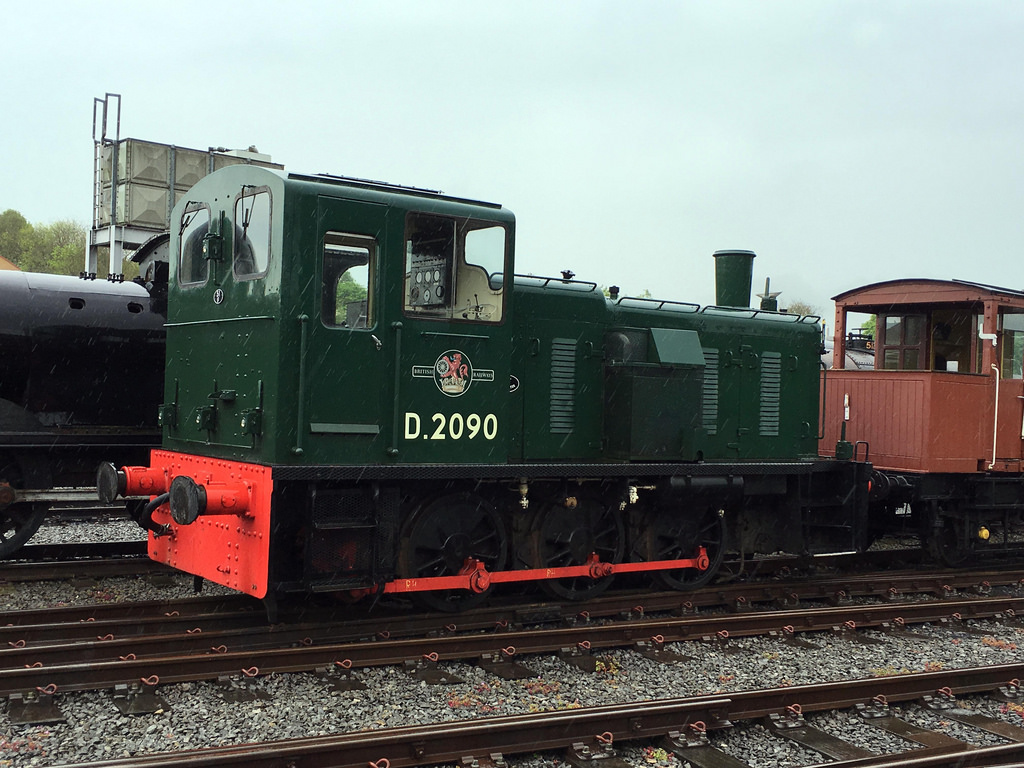
D2090 at NRM Shildon in original BR green
03 099 at Rowsley South, Heritage Shunters Trust
[1] Brian Haresnape, Diesel Shunters (Ian Allan, 1984) p. 56 [2] Colin J. Marsden (ed.), "BR Class 03 0-6-0 DMs", Modern Locomotives Illustrated No 217 February-March 2016 (SR, GW, LNER, LMS & Trial Shunters & Class 03s), p. 67 [3] Haresnape, Shunters p. 20 [4] Michael Welch, Diesels on the Western (Capital Transport, 2013) p. 18
The Class 86 AL6 was the production class of AC electrics built for the West Coast Main Line following on from the pilot-scheme AL1-5 (Classes81 to 85). The AL6 took advantage of experience gained from the earlier locomotives including the fitting of only one pantograph and with changes to equipment. The AL6 is very similar to the Class 85 AL5 technically except for the stub nose cab ends.
Freightliner 86 622 at Crewe Heritage Centre
Information
Number built:
100
Built:
1965-66
Builder:
BR Doncaster / English Electric
Engine:
4 AEI 282AZ or GEC G412AZ (86/1) traction motors (25kV AC OHLE)
Power:
(86/0) 5, 900 hp (4, 400 kW) max output
Wheel arrangement:
Bo-Bo
The AL6 was designed for mixed traffic including travelling at up to 100mp/h on West Coast Main Line expresses. Unfortunately this caused some problems with the original axle-hung traction motors, with troublesome riding qualities and damage caused to the track and to bogies. Following research at BR Derby, a "flexicoil" suspension system was adopted for fifty eight of the class which were designated Class 86/2 [1]. Another early sub-class was the 86/1, a trio rebuilt to help develop the follow-on Class 87 and able to reach 110mp/h [2][3].
A later sub-class was the 86/3 which were fitted with SAB resilient wheels for improved high speed running and reducing track wear, and with equipment for multiple-working. The Class 86/4 were fitted with flexicoil suspension and SAB wheels for mixed-traffic duties. The 86/5 was a trial locomotive to test ways of improving performance on heavy freights. The 86/6 were a sub-class used on Freightliner trains, finally the 86/9s were a couple of locomotives used as load banks by Network Rail.
Despite their advancing years the Class 86 can still be seen on the network, they have recently been withdrawn from hauling Freightliner trains though can appear on some passenger charters (86 259 as shown below has been returned to it's original Electric Blue livery [4]). Some have also been exported to Eastern Europe.
86 259 at Tyseley
Freightliner 86 639 and friend head through Stafford
Also heading through Stafford is 86 259
Most Freightliner 86 hauled duties uses pairs of locomotives
Another Freightliner 86 pair head through Rugeley Trent Valley
[1] Brian Haresnape, Electric Locomotives (Ian Allan, 1983) p. 64 [2] Gavin Morrison, AC Electric Locomotives in Colour (Ian Allan, 2013) p. 25 [3] Pip Dunn, British Rail Main Line Locomotives Specification Guide (Crowood Press, 2013) p. 161 [4] David Lawrence, British Rail Designed 1948-97 (Ian Allan, 2016) p. 155
The Class 10 was a variation of the standard Class 08 diesel shunter built for British Railways that had a Lister Blackstone diesel instead of an English Electric 6KT and two GEC WT360 traction motors [1]. One hundred and forty six were built, the vast majority at BR Darlington though six were also built at BR Doncaster.
D4092 preserved at Barrow Hill
Information
Number built:
146
Built:
1955-62
Builder:
BR Darlington and Doncaster
Motor:
Lister Blackstone ER6T diesel
Power:
360 hp (261 kW)
Wheel arrangement:
0-6-0
They had the same performance as the Class 08 and, apart from the traction package, were pretty identical. However, due to being non-standard they were withdrawn between 1967 and 1972. None carried their TOPS numbers. Four have survived into preservation.
Another view of D4092
[1] Brian Haresnape, Diesel shunters (Ian Allan, 1984) p. 68
British Railways, in it's wisdom, split an order for 100 AC electric locomotives for the West Coast Main Line five ways. The largest share however, was kept in house with 40 of the locomotives built at BR's Doncaster Works using AEI electrical equipment. The Class 85 was similar to the BRCW Class 81, having the same AEI equipment. However, the Class 85 had semiconductor based rectifiers (at first a mixture of germanium and silicon, later retrofitted to be all silicon) and rheostatic braking [1].
Information
Number built:
40
Built:
1961-64
Builder:
Associated Electrical Industries / BR Doncaster
Motor:
4 AEI 189 traction motors (25kV AC OHLE)
Power:
3, 200 hp (2, 400 kW)
Wheel arrangement:
Bo-Bo
The Class 85 (along with the 81) proved to be the best of the prototype AC electrics, their only real issue being ride quality at top speed. They were displaced from expresses by the Class 86 but remained in service on secondary passenger services and freight until the early 1990s when they were finally withdrawn. One has been preserved.
85 006 preserved at Barrow Hill
[1] Brian Haresnape, Electric Locomotives (Ian Allan, 1983) p. 61
In the wake of the early 1970s oil crisis, British Rail had a need for a new generation of more powerful diesel locomotives in the Type 5 classification (rated for over 3, 000 hp) for what was expected to be a much greater demand for heavy coal haulage. The Class 56 was the first of these new locomotives and when the first arrived in 1976 it was the new class of diesel locomotive for nearly a decade [1].
Colas 56 096 and 302 at Stafford
It was based on the successful Class 47 but with a more powerful engine (a development of the successful English Electric CSVT engines used in many classes of diesel like the Class 50) and was fitted with slow speed control for Merry-Go-Round coal trains when they were loaded and unloaded [2].
Information
Number built:
135
Built:
1976-84
Builder:
Brush Traction/Electroputere (first 30)
Brush Traction/BREL Doncaster and Crewe
Engine:
Ruston Paxman 16RK3CT diesel
Power:
3, 250 hp (2, 424 kW)
Wheel arrangement:
Co-Co
Because of a lack of manufacturing capacity at the time at Brush Traction, who had designed the Class 56, the first thirty were built by Electroputere in Romania with the rest being built at BR Doncaster and Crewe. The Romanian examples unfortunately suffered from a number of problems said to be due to poor workmanship which delayed their entry into service for over a year [3]. The decision to build the first batch in Romania and the urgency with which the locomotives were needed saw the locomotive have bogies of a Swiss design as these were widely used in Romania at the time and were easily available.
The Class 56 worked on heavy freights throughout the 1980s and into the privatisation era but most were withdrawn in the early 2000s. Some were later reinstated into traffic and undertook heavy refurbishment as the Class 56/3 [4].
Many have been scrapped, some sold for use on the continent and three have been preserved. Today around thirty remain in service. A project is ungoing to re-engine at least ten Class 56s with an EMD 12N-710G3B-T2 diesel (as fitted to some Class 66s) along with some other new equipment. The re-built locomotives are known as the Class 69.
56 078 at Kidderminster Town
DCR 56 103 and 191 at Derby
Colas 56 302 at Derby
56 302 again, this time at York
DCR 56 303 at Derby
[1] Chris Heaps, BR Diary 1968-1977 (Ian Allan, 1988) p. 104 [2] Brian Haresnape, Production Diesel-Electrics Types 4 and 5 (2nd Edition) (Ian Allan, 1984) p. 75 [3] Ibid p. 75 [4] Colin J Marsden, Traction Recognition (2nd Edition) (Ian Allan, 2011) p. 51
The Class 08 was a development of earlier diesel shunters built during the last few years of the "Big 4" railway companies such as the LNER J45 and especially the LMS Class 11 [1]. The Class 08 became the standard diesel heavy shunter for British Railways and over 1,000 of it and the related Classes 09 and 10 were built over a ten period.
08 911 at NRM Shildon
Information
Number built:
996
Built:
1952-62
Builder:
British Railways Derby, Crewe, Darlington, Doncaster, Horwich
Engine:
English Electric 6KT diesel
Power:
350 hp (261 kW)
Wheel arrangement:
0-6-0
The Class 08 could be seen nearly everywhere on the British Rail network, only restricted where their axle-load prohibited them. The Class 08s were built with vacuum brakes for trains (they have air brakes for their own use) but the introduction of air braked freight stock such as Freightliner trains in the 1960s saw a large number of Class 08s either fitted with air or dual brakes [2]. Some were also fitted with radio telephones for use in larger marshalling yards.
Despite the need for dedicated shunters having reduced considerably over the years there are still plenty of Class 08s in service, they are a fairly common sight on national rails in motive power depots and freight yards, plus over sixty have been preserved and others sold to private companies. The vast majority of the class were of the standard 08/0 sub-class with a small number having cut down cab heights for operating in South Wales known as the 08/9 [3].
One interesting development was the Class 13 which consisted of pairs of Class 08s permanently coupled, the cab on one of the 08s removed, to form a 700hp shunter for the Tinsley Marshalling Yard, unfortunately none of these survived withdrawal.
D3586 (08 471) at Bridgnorth MPD
08 704 approaches Wirksworth
08 825 at Chinnor
08 830 at Rowsley South
Another view of 08 704 at Wirksworth
[1] Colin J. Marsden, Traction Recognition (Second Edition) (Ian Allan, 2009) p. 6 [2] Brian Haresnape, Diesel Shunters (Ian Allan, 1984) p. 66 [3] Colin J Marsden, Motive Power Recognition: 1 Locomotives 3rd Edition (Ian Allan, 1988) p. 10
All of the "Big 4" railway companies were experimenting with diesel shunters by the late 1930s and 1940s for economic and operational reasons. The LNER was the last to join the party with an order for four locomotives based on the LMS/EE design which led to the Class 08 (and would soon become very familiar indeed). The LNER J45 differed in cab design, had vacuum brakes and had a slightly longer wheel base [1]. The shunters were numbered 8000-8003 but within a couple of years were renumbered 15000-15003 by BR. Later they were given class names DES1, DEJ1, D3/9 and 3/10 but never received TOPS numbers.
Information
Number built:
5
Built:
1944
(15004) 1947
Builder:
LNER Doncaster
(15004) Brush
Engine:
English Electric 6KT diesel
(15004) Brush Petter S54 diesel
Power:
350 hp (261 kW)
(15004) 360hp (268 kW)
Wheel arrangement:
0-6-0
A fifth shunter was built by Brush for the LNER to a similar design but with Brush equipment. 15004 (it was delivered after Nationalisation so received a BR number) had some external differences including the lack of a battery box on the side as it used compressed air to start the engine [2]. The shunter operated under trial for a couple of years before being accepted into BR service in 1949. It was given the original class name DES2, later DEJ2, D3/14 and 3/2.
The shunters were originally sent to work at Whitemoor yard though also could be seen working elsewhere [3]. LNER had planned to build one hundred and sixty seven more of these shunters (either with EE or Brush equipment) though Nationalisation put paid to these plans. The four original locomotives continued in BR service until 1967 when they were withdrawn. 15004, having a slightly less successful time with reliability and being a one-off, was withdrawn in 1962.
LNER liveried 8003 at Whitemoor in 1949 (KD Collection)
15004 at Whitemoor in 1949, note the lack of the battery box on the side (KD Collection)
[1] Brian Haresnape, Diesel Shunters (Ian Allan, 1984) p. 30 [2] Ibid. p. 31 [3] Colin J Marsden, Diesel & Electric Locomotive Recognition Guide (Ian Allan, 2011) p. 14
The Class 71 DC electric locomotive was built for the expansion of the Southern Region third-rail DC network into Kent. They were designed with an emphasis on a good power/weight ratio [1] with inspiration taken from best practice on the continent.
Information
Number built:
24
Built:
1958-60
Builder:
BR Doncaster / English Electric
Engine:
4 EE432/A traction motors (750/650v DC third rail, 650v DC OHLE)
English Electric 836 DC booster
Power:
2, 552 hp (1, 900 kW) (maximum)
2, 300 hp (1, 720 kW) (continuous)
Wheel arrangement:
Bo-Bo
The Class 71 (originally known as HA in the Southern Region's pre-TOPS classification scheme) operated off DC third rail. However the Class 71 was also equipped with a pantograph for use in yards such as Hither Green which had light-weight tram style DC overhead catenary as this was considered safer for staff walking about the yard than live rails [2]. The Class 71 worked boat trains, prestigeous expresses like the Golden Arrow and freights.
The Class 71 was equipped with a flywheel booster to handle gaps in the electric supply and could travel for short distances "off juice". However the Class 71's role was reduced as the sort of trains it was intended for were withdrawn or switched to multiple-units and using diesel or electro-diesel traction was more flexible. They had to be carefully diagrammed so they only worked yards and routes which had been electrified, an extra problem at night time and at weekends was where the power was turned off due to engineering work necessitating lengthy detours or replacement by diesel locomotives.
Withdrawals began in the 1960s with 10 removed from service to be converted into the Class 74 electro-diesel. The bulk of the fleet was laid up in late 1976 and withdrawn in 1977 [3]. One has been preserved.
71 001 preserved at NRM Shildon
[1] Brian Haresnape, Electric Locomotives (Ian Allan, 1983) p. 41 [2] Alan Williams, Southern Electric Album (Ian Allan, 1977) p. 90 [3] Pip Dunn, British Rail Main Line Locomotive Specification Guide (Crowood Press, 2013) p. 145
Following the conventional Class 56 heavy freight locomotive British Rail went much more radical for the next design. The Class 58 dispensed with a lot of traditional British monocoque locomotive building practice with the aim of producing a highly exportable locomotive. It had a modular design with the main structural load bearer being the underframe with major components fitted to the frame[1]. The design made the Class 58 around 14% cheaper to build than the 56 [2].
Information
Number built:
50
Built:
1983-87
Builder:
BREL Doncaster
Engine:
Ruston Paxman 12RK3ACT diesel
Power:
3, 300 hp (2, 460 kW)
Wheel arrangement:
Co-Co
The Class 58 also followed common US style in that it dispensed with a walkway through the locomotive, the body being narrower than the cabs. This was done because of the space problems with the Class 56 trying to fit a larger engine into what was essentially a Class 47 shell. The bonnet design has access doors all along the side[3]. In the event no export orders were received and only 50 were built (as opposed to 135 Class 56s), the last Class 58 was also the last diesel locomotive to be built at BREL Doncaster.
The Class 58 was built for heavy coal trains though also could be seen on other freight types. Most Class 58s were withdrawn at the turn of the millennium, surplus to requirements as the Class 66 began to arrive in numbers. While a small number have been scrapped most of the class has seen further use in the 2000s on the continent especially in France working on TGV construction though some of these have now returned home or been put into storage both home and abroad [4].
58 022 will be used to build a replica LMS 10000 class diesel locomotive
[1] Colin J Marsden, Motive Power Recognition: Locomotives (3rd Edition) (Ian Allan, 1988) p. 92 [2] Brian Harsenape, Production Diesel Electrics Types 4 and 5 (Ian Allan, 1984) p. 80 [3] Barry Edwards, Class 58s: Their Development and Introduction (Link Rail, 1984) p. 6 [4] Colin J Marsden, Traction Recognition (Ian Allan, 2011) p. 58
In the late 1960s Southern Region required some more electro-diesels for the Bournemouth electrification scheme. Instead of building more Class 73s BR decided to rebuild 10 Class 71 DC electric locomotives as these could be more powerful than the Class 73s and rebuilds were thought to be cheaper than building new locomotives [1]. As with other Southern locomotives they could work in multiple with multiple units and other SR locomotives and be used for push-pull operations.
Information
Number built:
10
Built:
1958-60 (Electric locomotives)
1967-68 (Rebuilds)
Builder:
BR Doncaster, rebuilds at BR Crewe
Engine:
4 EE532A traction motors (750v DC third rail)
Paxman 6YJXL diesel
Power:
2, 300 hp (1, 715 kW) electric
650 hp (485 kW) diesel
Wheel arrangement:
Bo-Bo
While the Class 74 seemed a great idea the execution let it down. The conversions were not simple with a lot of modifications and strengthening needed to fit the additional equipment [2]. Reliability in the early days was poor, the Paxman diesel not being as reliable as the English Electric unit in the Class 73, there were numerous problems with the complicated control equipment (the Class 74s were test beds for new thyristor controls [3]) and crews disliked the noise of the engine due to the location of the engine silencer near the cab.
By the late 1970s SR saw it had enough Class 33s and 73s to cover traffic requirements and the Class 74s were withdrawn by 1977 as non-standard. All have been scrapped though a Class 71 has been preserved.
74 009, location unknown (KD Collection)
[1] Brian Haresnape, Electric Locomotives (Ian Allan, 1983) p. 78 [2] David Brown, Southern Electric Vol 2 (Capital Transport, 2010) p. 220 [3] R.L. Vickers, DC Electric Trains and Locomotives in the British Isles (David & Charles, 1983) p. 81