The Class 08 was a development of earlier diesel shunters built during the last few years of the "Big 4" railway companies such as the LNER J45 and especially the LMS Class 11 [1]. The Class 08 became the standard diesel heavy shunter for British Railways and over 1,000 of it and the related Classes 09 and 10 were built over a ten period.
08 911 at NRM Shildon
Information
Number built:
996
Built:
1952-62
Builder:
British Railways Derby, Crewe, Darlington, Doncaster, Horwich
Engine:
English Electric 6KT diesel
Power:
350 hp (261 kW)
Wheel arrangement:
0-6-0
The Class 08 could be seen nearly everywhere on the British Rail network, only restricted where their axle-load prohibited them. The Class 08s were built with vacuum brakes for trains (they have air brakes for their own use) but the introduction of air braked freight stock such as Freightliner trains in the 1960s saw a large number of Class 08s either fitted with air or dual brakes [2]. Some were also fitted with radio telephones for use in larger marshalling yards.
Despite the need for dedicated shunters having reduced considerably over the years there are still plenty of Class 08s in service, they are a fairly common sight on national rails in motive power depots and freight yards, plus over sixty have been preserved and others sold to private companies. The vast majority of the class were of the standard 08/0 sub-class with a small number having cut down cab heights for operating in South Wales known as the 08/9 [3].
One interesting development was the Class 13 which consisted of pairs of Class 08s permanently coupled, the cab on one of the 08s removed, to form a 700hp shunter for the Tinsley Marshalling Yard, unfortunately none of these survived withdrawal.
D3586 (08 471) at Bridgnorth MPD
08 704 approaches Wirksworth
08 825 at Chinnor
08 830 at Rowsley South
Another view of 08 704 at Wirksworth
[1] Colin J. Marsden, Traction Recognition (Second Edition) (Ian Allan, 2009) p. 6 [2] Brian Haresnape, Diesel Shunters (Ian Allan, 1984) p. 66 [3] Colin J Marsden, Motive Power Recognition: 1 Locomotives 3rd Edition (Ian Allan, 1988) p. 10
A relatively tiny adjutant to the huge Class 08 shunter fleet, twenty six Class 09s were built for Southern Region. They were almost exactly the same as the 08 but had different gearing [1] to allow a top speed of 27.5 mp/h [2] (compared to the Class 08's 15 mp/h) and waist high air brake connections for working with Southern multiple-units. Because of this different gearing they have a lower tractive effort than the 08s.
Information
Number built:
38 (including 12 conversions from Class 08)
Built:
1959-62
1992-93 (09/1 and 09/2 conversions)
Builder:
BR Darlington & Horwich 09/1 and 09/2 conversions by RFS Kilnhurst
Engine:
English Electric 6KT
Power:
400 hp (268 kW)
Wheel-arrangement:
0-6-0
In the early 1990s twelve more Class 09s were built from 08s to fulfil a need for faster shunters [3]. These later conversions, known as the 09/1 and 09/2, lack the high-level air brake connections (the original locomotives became 09/0). The main difference between the two later sub-classes is that the 09/1 has an 110v electrical equipment and the 09/2 90v.
Although the Class 09s spent most of their time on shunting duties there were the odd occasions they were used for passenger duties such as deputising for a Class 33 on Clapham Junction-Kensington Olympia services! The 09s originally were largely restricted to Southern Region but in the privatised era they can be found much wider afield. Ten have been preserved including one used as the National Railway Museum's yard shunter.
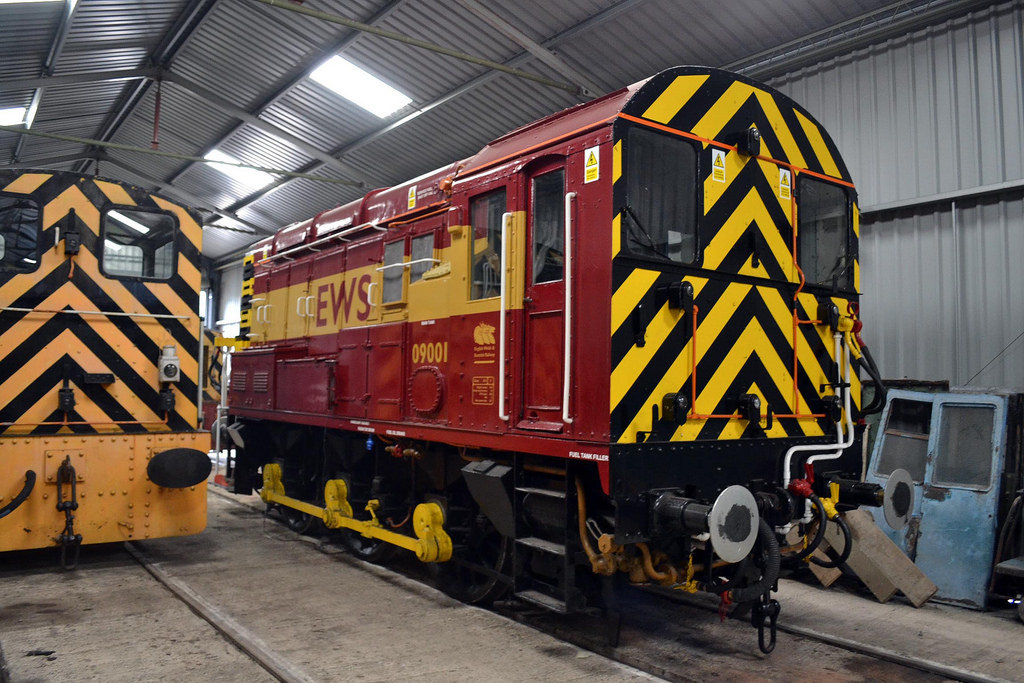
EWS liveried 09 001 at the Heritage Shunter Trust
D4100 at Kidderminster SVR
The National Railway Museum's 09 017
09 001 next to 03 099
Another view of 09 017
D4100 amid Class 50s
[1] Brian Haresnape, Diesel Shunters (Ian Allan, 1984) p. 71 [2] Colin J. Marsden, Traction Recognition (Second Edition) (Ian Allan, 2008) p. 12 [3] Colin J. Marsden, Diesel & Electric Locomotive Recognition Guide (Ian Allan, 2011) p. 90