Showing posts with label Metro-Cammell. Show all posts

Class 230 D-Train

The Class 230 is an up-cycled multiple unit made from former London Underground D78 Stock, which were withdrawn by London Underground in 2017. Vivarail bought 150 driving motors (DM) and 300 carriages (T) from London Underground with the aim of converting them into diesel multiple units for use on National Rail. As the project has progressed Vivarail also built battery and diesel-hybrid units, the latter of which were used by the second customer Transport for Wales.

Transport for Wales 230 008 at Cefn-y-bedd


Information
Number built: 26 (11 2 and 3-car sets)
Built: 1979-1983 (Original D78)
2015-2022 (Conversions)
Builder: (Original) Metro-Cammell
(Conversions) Vivarail
Motor: (DMU) 4 Ford Duratorq 3.2 TDCi diesels
Power: 789 hp (588 kW)
 

Vivarail converted the former Underground electric stock to diesel-electric multiple units which used Ford Duratorq diesels. The prototype began testing in the Summer of 2016 with mainline testing beginning later in the year. Unfortunately, in December of that year the prototype unit caught fire near Kenilworth delaying the project. However, the long-awaited breakthrough first order came for three units from London Northwestern Railway. LNWR bought three two-car sets for use on the Marston Vale line [1] between Bletchley and Bedford. The Class 230 finally entered revenue service on the line at the end of April 2019.


Vivarail began tests of a battery powered version of the Class 230 on the Bo'ness and Kinnell Railway in late 2018 [2]. The battery version had four 106kWh battery arrays and an operational range between charges of sixty four kilometres. This unit is now owned by GWR and is to be tested on the Greenford branch.

The second order for the Class 230 was for five three-car sets for the Borderlands Line (between Wrexham and Bidston) operated by Transport for Wales. These are diesel-hybrid units and will entered service in 2023 [3].

Unfortunately in 2022 Vivarail entered administration. LNWR withdrew the units from service as Vivarail were maintaining them, these units now have an uncertain future. Transport for Wales are maintaining their own Class 230s and they are continuing in service (indeed did not enter service until Vivarail had already gone under).

A sister unit to the Class 230 is the Class 484, which is a third-rail EMU converted from D78 Stock. This replaced the Class 483 on the Isle of Wight Island Line between Ryde Pier Head and Shanklin in 2021 (testing beginning in 2020) [4]. 

Another view of 230 008 at Cefn-y-bedd

LNWR 230 003 at Bletchley

230 003 at Bow Brickhill

Aboard TfW 230 008

230 008 at Wrexham General


[1] Underground News No. 688 (April 2019) p. 196
[2] Underground News No. 684 (December 2018) p. 676
[3] "Rolling stock challenges", Modern Railway (May 2019) p. 52
[4] Underground News No. 697 (January 2020) p. 40

London Underground 1972 Tube Stock

The 1972 Tube Stock fleet, which operates on the Bakerloo Line, is the oldest fleet of passenger rolling stock still operating on the London Underground and in fact any rapid transit system in the UK [1]. It is planned that the 1972 Tube Stock will finally be replaced by new rolling stock under the Deep Tube Upgrade programme though this possibly will not occur until the mid 2030s at the earliest (and as yet no replacement stock has been ordered).
3231 arrives at Willesden Junction


The fleet has undergone a refurbishment programme [2] to keep them going until then, though the 1972 Tube Stock fleet was found to be in even worse condition than first thought with a lot of work needed to repair and replace cracked and corroded parts of the structure. The interiors have also been smartened up with new moquette on the seating and improved flooring [3]. More work is being carried out on improving accessibility to the fleet.

Information
Number built: 441 (63 7-car sets, 30 Mark 1, 33 Mark 2)
Built: 1972-74
Builder: Metro-Cammell
Motor: 4 LT115A traction motors per motor car (630v DC fourth rail)
Power: 1, 680 hp (1, 264 kW)
Formation: Driving Motor (DM)+Trailer (T)+T+DM+
[Uncoupling Non Driving Motor (UNDM)+T+DM]

The 1972 Tube Stock was built to replace 1938 Tube Stock which was becoming life expired in the early 1970s. To save time, the new stock was based on the 1967 Tube Stock which had recently been built for the Victoria Line [4]. Although externally they look very similar, there are sufficient differences to mean the 1967 and 1972 fleets were not interchangeable (though surplus 1972 stock were later modified and used to augment Victoria Line services). The 72ts comprises four and three car sets which together make a seven car train. The three car sets only have a cab at one end.


The first thirty sets were known as the Mark 1, none of these sets remain in passenger service as built though a set was preserved, an ex-Northern Line 4-car set, at Aldwych disused tube station for training and filming purposes [5] though has recently been withdrawn. The second batch of thirty three cars was the Mark 2 which had a slightly different interior and some equipment and control differences. The 1972 Tube Stock initially served on the Northern (Mark I) and Jubilee (Mark II) Lines though the latter were later transferred to the Bakerloo Line and they remain in service today. Thirty six sets are operated by the Bakerloo Line, the vast majority of these are Mark IIs but with a couple of Mark Is cars converted to be compatible.

Due to their age the 72 Tube Stock fleet in many ways is unique on London Underground, they are the only tube profile trains to retain some transverse seating and the last stock to be fitted with the once standard Westinghouse air brake [6]. 
Arriving at Marylebone


3261 at Queen's Park

Post-life extension work exterior

3558 at Baker Street

3564 at North Wembley


[1] Underground News Number 654 (June 2016) p. 344
[2] "Bakerloo Line Fleet Weld Repairs" <http://content.tfl.gov.uk/fpc-160708-14-bakerloo.pdf>
[3] Underground News Number 655 (July 2016)
[4] J. Graeme Bruce, The London Underground Tube Stock (Ian Allan, 1988) p. 109
[5] Anthony Badsey-Ellis & Mike Horne, The Aldwych Branch (Capital Transport, 2009) p. 103
[6] Piers Connor, The London Underground Electric Train (Crowood Press, 2015) p. 72

London Underground F Stock

The F Stock was built for the District Railway in the early 1920s to increase capacity and to replace deteriorating B Stock [1], the construction was partly funded by the government to help British industry transition back to civil manufacture. The F Stock was built at a factory that had built armoured vehicles in the war, that and their steel construction may be why they gained the nickname of "tanks"!
F Stock on delivery [3]


Information
Number built: 100
Built: 1920-21
Builder: Metropolitan Carriage, Wagon & Finance Company
Motor: British Thomson-Houston electrical equipment
(600v DC fourth rail)

The F Stock was more powerful than earlier District Line stock which gave them a superior performance. Despite their high passenger capacity they were unpopular due to their interior appearance. This was improved in service. The F Stock had non-standard control equipment and thus could not work with other District Railway stock.

The F Stock was transferred to the Metropolitan Line in the 1950s. They were fitted with air operated doors and other enhancements including windscreen wipers [2] to the distinctive (though troublesome) oval windows. The F Stock was finally withdrawn in 1963 after replacement by A Stock. None have been preserved.
Interior view [3]


[1] Brian Hardy, Surface Stock 1933-1959 (Underground Train File) (Capital Transport, 2002) p. 38
[2] Ibid. p. 40
[3] "New District Railway rolling stock", Electrical Review Vol. 87 No. 2, 249 (December 31 1920) p. 838

LNWR Electric Units

In 1914 the London & North Western Railway introduced 3-car EMUs for its London DC electrified lines including routes from London Euston to Watford and Broad Street to Richmond. The first four sets were built with Siemens traction equipment (after Westinghouse who were originally given the order failed to deliver) with a follow-on batch of 38 sets with Oerlikon equipment, the change of supplier to a Swiss firm was needed due to the outbreak of the First World War and therefore the unavailability of equipment from German manufacturer Siemens [1]!

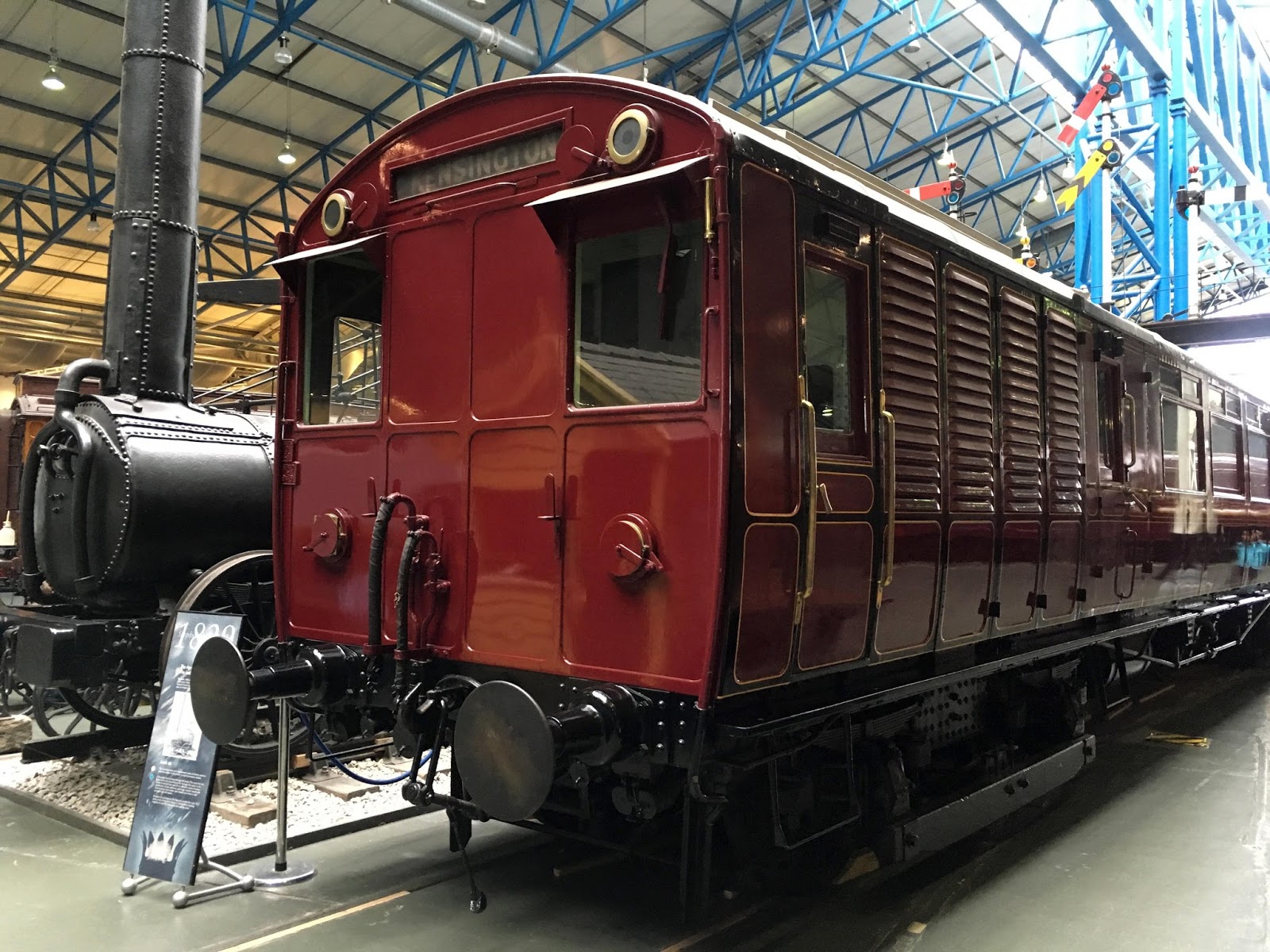
Two views of 28249 now preserved at the NRM York

As well as different traction equipment, the Oerlikon sets had other differences compared to the Siemens sets. Originally the EMUs had first and third class accommodation, the first class compartments being very luxurious, but were downgraded to third class only as a wartime economy measure. The EMUs were built as 3-car sets (with some spare motor cars) and generally operated as a 6-car train.

Information
Number built: 356 (117 3-car sets + 8 spare cars)
Built: 1914-23
Builder: Metropolitan-Cammell
Engine: 4 Siemens or Oerlikon traction motors (630v DC third/fourth rail)
Power: (Siemens) 1, 000 hp (746 kW)
(Oerlikon) 1, 040 hp (776 kW)
Formation: Driving Motor Brake Third (DMBT)+Trailer Third (TT)+
Driving Trailer Third (DTT)

After the First World War a third batch of 75 sets were built, again with Oerlikon equipment [2]. Although some of the DC routes (some of which now are part of London Overground) were run down in the 1930s and following the Second World War, the LNWR sets (later operated by the LMS and British Railways) survived in use until 1960. Some sets were converted to prototype 25kv AC OHLE EMUs as AM1. One DMBT has survived into preservation.
28249 is preserved in LMS livery

[1] R.L. Vickers, DC Electric Trains and Locomotives in the British Isles (David & Charles, 1986) p. 69
[2] Colin J. Marsden, DMU and EMU Recognition Guide (Ian Allan, 2013) p. 186

London Underground C69/C77 Stock

The C69 Stock was built to replace CO/CP Stock on the Circle and Hammersmith & City Lines [1]. The C69 Stock was a high density design with 4 pairs of double-doors per side to cope with the heavy demand on the Circle Line. The 212 C69 Stock cars operated in six car formations and thirty five such formations were formed (there were a couple of spare cars also built) [2]. 
5606 at Earls Court

Information
Number built: 279 cars (6-car sets)
Built: 1969-71, 1977-78
Builder: Metro-Cammell
Engine: 4 Brush LT117 traction motors per motor car (630v DC fourth rail)
Formation: Driving Motor (DM)+Trailer(T)+DM+T+T+DM

In the late 1970s a second batch of sixty seven cars was built to provide eleven more trains for the Edgware Road-Wimbledon branch of the District Line as the C77 Stock (an extra car was built to replace a C69 car destroyed by an IRA bomb). Although there were some technical differences between the C69 and C77s, they could operate together and following refurbishments in the early 1990s there were no longer any visual differences.

The C69 Stock was designed with Automatic Train Operation (ATO) in mind though this was never fitted [3]. They were later converted to One Man Operation (OMO) in the early 1980s and were the first London Underground stock to do so and do away with guards. As built the C Stock had longitudinal and transverse seating, though the later was removed during refurbishment in the early 1990s [4] in common with most other LU stock. Windows were also added to the non-driving ends of cars during refurbishment.

After over forty years service, the C Stock was replaced by S Stock in 2014. Three cars of C77 Stock have survived scrapping including 5721 at the London Transport Museum and the other two are at educational establishments.
C Stock cab

Aboard the preserved C Stock DM

Side view of preserved 5721

Another view of 5721

The rear of 5721 showing the added windows (see text above)


[1] John Glover, London Underground (Ian Allan, 1997) p. 56
[2] John Glover, London Underground Rolling Stock in Colour (Ian Allan, 2009) p. 5
[3] Piers Connor, The London Underground Electric Train (Crowood, 2015) p. 160
[4] John Scott Morgan, London Underground in Colour since 1955 (Ian Allan, 2003) p. 17

Class 465 Networker

The Class 465 was built in the early 1990s to replace ageing Mark 1 based EMUs such as the Class 415 on Kent suburban routes [1]. The replacement of this old stock was seen as a priority in the late 1980s by the then-new Network South East sector of British Rail [2]. The new fleet of EMUs thus became known as the Networkers. The introduction of the Class 465, and the 2-car fleet of Class 466s, bought with it driver only operation, more spacious interiors and rapid acceleration compared to the 1950s build EMUs they replaced [3].
465 191 at London Bridge


Information
Number built: 588 (147 4-car sets)
Built: 1991-93
Builder: ABB/BREL York (465/0 and 465/1)
Metro-Cammell (465/2 and 465/9)
Engine: Hitachi TIM2093A (465/0 and 465/1)
Alsthom G352AY (465/2)
Alsthom G352BY (465/9) (750v DC third rail)
Power: 3, 004 hp (2, 240 kW)
Power: (465/0, 465/1 and 465/2) Driving Motor Standard Open
(DMSO)+Trailer Standard Open (TSO)+Trailer Standard Open Lavatory (TSOL)+DMSO
(465/9) Driving Motor Composite Open (DMCO)+TSO+
TSOL+DMCO 

In 2005 thirty four 465/2s were rebuilt for longer routes and had first class seats added to the two driving cars, these became 465/9. The original Brush traction motors on the 465/0 and 465/1 were replaced with Hitachi equipment in 2009 to improve reliability.


All Class 465s were delivered in Network South East livery. Following privatisation they wore Connex South Eastern and latterly Southeastern Trains colours. Currently all are still operated by Southeastern.
465 019 passes New Cross

Aboard a 465

465 006 arrives at London Bridge

465 172 at Lower Sydenham

465 188 at London Victoria


[1] Colin J Marsden (ed.) "The Networker Family", Modern Locomotives Illustrated No. 233 February-March 2017 (Networker, Juniper & Javelin Stock) p. 4
[2] Bruce Oliver, British Railway Southern Region Electrics in Colour (Ian Allan, 2008) p. 13
[3] Colin J Marsden, DMU and EMU Recognition Guide (Ian Allan, 2013) p. 361

London Underground 1938 Tube Stock

The 1938 Tube Stock was built as part of London Underground's New Works Programme of the late 1930s, they became one of the most successful - if not the most successful - types of British train ever. They served on the underground for fifty years and, in the guise of the Class 483 remained in service on the Isle of Wight until 2020, over 80 years after their first entry in service!
Preserved 4-car set at LTM Depot Acton


Information
Number built: 1, 121 (plus 173 additional builds & conversions)
Built: 1938-47
Builder: Metro-Cammell / Birmingham Railway Carriage & Wagon Company
Engine: 2 General Electric or Crompton Parkinson LT100 traction motors
per motor car (630v DC fourth rail)
Formation: (4+3 7-car formation) Driving Motor (DM)+Trailer (T)
+Non-Driving Motor (NDM)+DM(+DM+T+DM)

In the late 1930s London Underground began an expansion programme known as the New Works Programme, new lines required new trains. Even before the huge Standard stock order had been completed London Underground were planning the next generation of tube trains. A number of experimental trains were built known as the 1935 Tube Stock. These were an advance on the Standard stock, advances in technology meaning that the switching equipment could be fitted underneath the body instead of occupying space behind the driving cabs [1]. A number of these trains were streamlined to experiment with high-speed tube trains however the streamlining idea, which was unpopular with the senior management at London Underground (though apparently popular with the public), was later dropped.

Having evaluated a number of types of equipment on the 1935 protoypes London Underground decided on a final specification and placed huge orders for new stock to be known as 1938 Tube Stock. Most stock was delivered before the Second World War called a halt to development with the final twenty-seven outstanding cars built in 1946-47. The fleet was later augmented by 173 cars - a mixture of conversion of Standard and 1935 Tube Stock cars and ninety one new builds known as the 1948 Tube Stock (though identical to the 1938s).

Initially the stock operated in 7-car formation, comprising a four and three car set semi-permanently coupled [2]. Later on 9-car formations were used on the Northern Line [3]. During their long lives the 1938 Tube Stock worked on the Bakerloo, Central, East London, Northern and Piccadilly Lines. Withdrawals began in the early 1970s [4] though the 1938 Tube Stock remained in service on the Underground until 1988 when the final five trains (which had been refurbished to augment newer trains) were withdrawn by the Northern Line. These trains however were then sold to British Rail for a new life on the Isle of Wight as the Class 483 [5].

A working 4-car set of 1938 Tube Stock has been preserved [6] as well as another Driving Motor (and a couple of cabs) in museums. A number of Class 483s have also been preserved.
Another view of the preserved 38ts alongside a preserved car of its predecessor

Preserved DM at Covent Garden

Front end destination display

The other end of the preserved set
[1] Paul Moss, London Underground (Haynes, 2014) p. 95
[2] J. Graeme Bruce, The London Underground Tube Stock (Ian Allan, 1988) p. 77
[3] Brian Hardy, Underground Train File: Tube Stock 1933-1959 (Capital Transport, 2001) p. 66
[4] Bruce p. 81
[5] Brian Hardy, Tube Trains on the Isle of Wight (Capital Transport, 2003) p. 60
[6] Kim Rennie, Underground and Overground Trains (Capital Transport, 2017) p. 36

London Underground 1973 Tube Stock

The 1973 Tube Stock fleet was ordered to replace the mixture of 1938, 1959 and 1962 Tube Stock which operated on the Piccadilly Line in the early 1970s. A large fleet was ordered so that more trains could be provided, they were also needed for the extension of the Piccadilly Line to Heathrow Airport in the late 1970s [1]. The trains entered service from 1975 and are now the second oldest stock in operation on the London Underground.
235 at Acton Town

Eighty six 6-car units were ordered with an extra three-car unit for the Aldwych branch, seventy six of these are needed for peak time operation. The trains usually operate with two Uncoupling Non Driving Motors in the middle though twenty units can operate as a complete three-car unit with a Driving Motor at either end however service trains usually contain six cars. When the Aldwych branch of the Piccadilly Line was still operating a single three-car unit was used on it [2].

Information
Number built: 519 (86.5 6-car units)
Built: 1974-77
Builder: Metro-Cammell
Engine: 4 LT118 traction motors per motor car (630v DC fourth rail)
Power: 260 hp / 196 kW per motor car
Formation: Driving Motor (DM)+Trailer (T)+Uncoupling Non Driving
Motor (UNDM)[+UNDM+T+DM] (some as DM+T+DM)

At eighteen metres in length the 1973 Tube Stock cars were longer than previous tube stock (which were usually around sixteen metres in length) this allowed for six-car trains instead of seven as was the case before with earlier tube stock but with virtually the same capacity. This resulted in a reduced operating cost due to smaller number of bogies, car bodies et cetera needed [3]. The 1973 Tube Stock was refurbished by Bombardier in the late 1990s and has regularly been London Underground's most reliable fleet of rolling stock [4].

The 1973 Tube Stock is due to be replaced in the Deep Tube Upgrade Programme in the mid 2020s. Originally replacement of the 1973 Tube Stock was planned much earlier and indeed at one time they were considered the preferred and natural replacement for the 1938 Tube Stock / Class 483 on the Isle of Wight. However now they are planned to remain in service until 2026 when they will be replaced by the 2025 Tube Stock, and the Isle of Wight had to make other plans!
Arriving at Holborn


198 at Acton Town

Arriving at Ealing Common

Approaching Acton Town

Passing through Ravenscourt Park

[1] John Glover, London Underground Rolling Stock in Colour (Ian Allan, 2009) p. 8
[2] Anthony Badsey-Ellis and Mike Horne, The Aldwych Branch (Capital Transport, 2009) p. 72
[3] J. Graeme Bruce, The London Underground Tube Stock (Ian Allan, 1988) p. 114
[4] John Hawkins, "LU Train Reliability", Underground News No. 644 (August 2015), p. 458

Class 101 (Metropolitan-Cammell General Branch Line and Local Services 2,3 or 4-car)

The Class 101 family was the largest fleet of first generation Diesel Multiple Unit (DMU) built for British Railways in the 1950s, however originally only the AEC engined DMBS and DMCL were originally classified as Class 101. Leyland engined motor cars were originally classified as the Class 102, the DTCLs were Class 144/147, the TSLs Class 162/164, the TBSLs Class 168 and the TCLs Class 171! [1]

DMBS E50253 at Duffield

Later on the various cars were reclassified as just Class 101. The DMU could operate in either two, three or four car sets with interchangeable trailers (and with trailers in other classes) depending on the needs of the service and served all over the BR network allocated to every region except the Southern [2].

Information
Number built: 637 cars in 2- 3- and 4-car sets
Built: 1956-59
Builder: Metro-Cammell
Engine: 2 BUT (AEC) or Leyland 6-cyl (Class 102) diesels per power car
Some DMBS originally fitted with Rolls-Royce diesels
Power: 300 hp (224 kW)
Formation: (Variable) Driving Motor Brake Standard (DMBS)+[Trailer Brake
Standard (TBS)/Trailer Standard Lavatory (TSL)/Trailer Composite
Lavatory (TCL)/Trailer Brake Second Lavatory (TBSL)]+Driving
Motor Composite Lavatory (DMCL)/Driving Trailer Composite
Lavatory (DTCL)

The Class 101 was one of the longest lived first generation DMUs, surviving in service until 2003 [3]. In later years many of the trailers lost their first class accommodation and were reclassified as TSLs. Some trailers also originally had buffet facilities but these later had the buffets removed and/or were withdrawn.

Originally the Class 101s were delivered in British Railways green then later BR Blue and the blue/grey white/blue variations in the 1970s. In later years the Class 101s wore sector liveries (Network SE and Regional Railways) as well as various PTE liveries. Over forty cars have been preserved although only two of these are centre car trailers. A sister class of Rolls-Royce powered DMUs was also built as the Class 111 (though a couple of 101 power cars did have Rolls-Royce engines too!)
M51188 departs Wirksworth

At Wirksworth 
DMBS 51188 and DMC 51505 at Wirksworth

M51188 at Ravenstor

At Duffield

[1] Colin J. Marsden, DMU and EMU Recognition Guide (Ian Allan, 2013), p. 36
[2] Brian Haresnape, Diesel Multiple Units: the First Generation (Ian Allan, 1985), p. 31
[3] Gavin Morrison, British Railway DMUs in Colour (Ian Allan, 2010), p. 13

Class 485 4-VEC

In the 1960s, as with other railway lines across the country, the Isle of Wight's once extensive railway system was devastated by Dr Beeching. Indeed only one line was saved which ran from Ryde Pierhead to Shanklin. BR decided to modernise and electrify this line (to the Southern Region 630V DC third rail system) in the late 1960s. The problem however was the question of which stock to run on it? Tunnels at Ryde have always precluded the use of standard gauge stock on the island due to the limited clearance. In the end there was a very British solution: use former London tube stock! [1]
Former TSO trailer from 485 044 at Acton Depot, still in NSE colours


Information
Number built: 24 cars (converted) to form 4 car sets
Built: 1923
Converted 1966-67
Builder: Metro Cammell / Union Construction Company / Cammell Laird
Converted at LT Acton / BR Stewarts Lane
Engine: 4 English Electric traction motors (630V DC third rail)
Power: 960 hp (716 kW)
Formation: Driving Motor Brake Standard Open (DMBSO)+
Trailer Standard Open (TSO)*+TSO+DMBSO

* Some TSOs had an isolated driving cab, officially DTSOs

The Class 485, and its 3-car sister the Class 486 (originally classified as Class 452 and 451 respectively), were converted from withdrawn London Underground Pre-1938 Standard Tube Stock which had already been hammered daily on the underground for over forty years. [2] After heavy refurbishment/conversion [3] which included changing from LT 4-rail to SR 3-rail (an earlier plan to convert the stock to DMUs was mooted but later abandoned [4]), the Class 485/486s ran for a further twenty-five years on the Island before being replaced by the Class 483, slightly less ancient tube stock, in 1992.

The Class 485/486 entered service in 1967, painted in BR blue with yellow ends and indeed were the first full units in BR's new corporate livery. In the 1970s they were repainted in the slightly more pleasing blue and grey livery for passenger stock and they ended their lives in Network South East colours. The Class 485 was given the SR Alpha code of 4-VEC and the 486 3-TIS. When they worked in multiple they were known as 7-VECTIS, Vectis being the Roman name for the Isle of Wight! Later in their lives they were reformed as 5 car sets (5-VEC) and the 486s 2 car 2-TIS sets.

During conversion BR considered also creating dedicated parcel traffic trailers but scrapped the idea because standard luggage cages would not fit in the cars because of their tube profile [5].

No Class 486s have survived withdrawal but two cars (a DTSO and a TSO) from the Class 485 have survived and have been reunited at the London Transport Museum with other Standard Tube Stock cars with the eventual aim of creating a working museum train of Standard Tube Stock.
DTSO trailer from 485 043

Standard Stock cab

Inside the electric switchgear compartment behind the cab

Front of Standard Stock DM

[1] Brian Hardy, Tube Trains on the Isle of Wight (Capital Transport, 2003) p. 14
[2] Brian Haresnape & Alec Swain, Third Rail DC Electric Multiple Units (Ian Allan, 1989) p. 92
[3] Colin J. Marsden, DMU and EMU Recognition Guide (Ian Allan, 2013) p. 369
[4] Colin J. Marsden (ed.), "3-TIS, 4-VEC", Modern Locomotives Illustrated No. 220 August-September 2016 (BR Southern Region Electric Multiple Units), p. 48
[5] R.J. Maycock & R. Silsbury, The Isle of Wight Railways from 1923 Onwards (Oakwood Press, 2006) p. 250