Showing posts with label Metropolitan Carriage & Wagon Company. Show all posts

London Underground B Stock

B Stock was built in 1905 for the electrification of the District Railway's Ealing/Hounslow - Whitechapel line and the branches to High Street Kensington and South Acton [1]. Working to a common design, four hundred and twenty driving cars and trailers were built by a number of manufacturers. Of each seven car set three cars were powered (400hp each) [2].
District Railway B Stock train [2]

Information
Number built: 420 (60 7-car sets)
Built: 1905
Builder: Brush Traction, Metropolitan Amalgamated,
Les Ateliers de Construction du Nord de la France
Motor: British Thomson-Houston GE69 electric motors
(600v DC fourth rail)
Power: 1, 200 hp (895 kW)
Formation: Driving Motor (DM) + Trailer (T) + T +
Middle Motor (MM) + T + T + DM

As built the B Stock had compressed air operated doors under the control of a single gateman, pioneering the use of air doors on the London Underground. However these doors proved unsuccessful in use, one problem being there was no detection system to make sure the doors had closed properly other than the gateman's eyeballs! The door edges were copper lined not rubber and the District Railway was soon getting a bad press due to the number of injuries and torn clothing of passengers. The District Railway reverted back to manual doors in 1908.

The cars were made from wood with steel underframes with General Electric motors and BTH type M controllers [3]. The so-called Motor Middle cars had driving cabs at each end to allow the trains to be reduced in size during quiet periods, some were also used as single cars on branch shuttles. The trains had a mixture of first and third class accommodation.

Some trailers were scrapped in the early 1920s due to their poor condition [4]. Some remaining B Stock trains were later reconditioned and redesignated H Stock trains, these remained in service until 1946. The final few B Stock cars remained in departmental use until 1950 before being scrapped.
Side view of B Stock car [5]

Interior [5]

B Stock car on delivery [5]

[1] Brian Hardy, Underground Train File: Surface Stock 1933-1959 (Capital Transport, 2002) p. 24 
[2] "Electrification of the District Railway", Practical Engineer (October 6 1905) p. 551 
[3] Piers Connor, The London Underground Electric Train (Crowood Press, 2015) p. 43
[4] Hardy p. 26
[5] S.B. Fortenbaugh, "The Electrification of the London Underground Electric Railway Company System", Street Railway Journal (Vol. XXV No. 9, March 4 1905) p. 388

LBSCR Elevated Electric Stock / Southern Railway 2-SL / 2-WIM

These trains were built for the London, Brighton & South Coast Railway for it's "Elevated Electric" South London Line between London Victoria and London Bridge. The trains consisted of three car sets with two motor cars at either end for third class passengers (one including a guard's van) and first class passengers in an unpowered (and thus quieter) centre car! [1] The trains used a bow collector to connect to the overhead lines which supplied 6.7 kV AC at 25Hz [2]. The centre cars were removed from the formations in 1913 to become steam hauled stock.
Elevated Electric Stock on delivery [1]


Information
Number built: 24 (8 3-car sets later 16 2-car sets)
Built: 1908
Builder: Metropolitan Amalgamated Carriage and Wagon Company
Motor: 4 Winter Eichberg compensated-repulsion motors
(6.7kV AC OHLE later 660v DC third rail)
Power: 460 hp (343 kW)
Formation: Motor Third Brake (MThB) + Trailer First (TF) + Motor Third Brake

The first trains began running on the line via Denmark Hill in early 1909 [3]. The line was an immediate success and the LBSCR slowly expanded their elevated electric network on routes from Crystal Palace, more stock was produced in longer formations and with uprated Winter Eichberg motors.

However in 1923 the LBSCR was absorbed into the Southern Railway and the decision was taken to standardise on DC third rail. By 1928 the elevated electric lines had been converted to DC and the rolling stock also rebuilt. The Southern Region referred to the former elevated electric trains as 2-SL. They remained in service until 1954.

The Trailer Firsts were also rebuilt (even though they had been used as hauled stock for years) to form extra driving motor and trailer pairs. The Southern Region termed these sets 2-WIM and used them on the Wimbledon-West Croydon Line. They also remained in service until 1954.
SL stock in operation [3] note the bow collector

Comparison of first (left) and third class [1]

Motor bogie [1]


[1] "Electric Rolling Stock for the London, Brighton and South Coast Railway", The Railway Times (March 6 1909) p. 241
[2] David Brown, Southern Electric Vol. 1 (Capital Transport, 2010) p. 14
[3] "Electrification of suburban lines on the London, Brighton and South Coast Railway", The Railway Times (March 25, 1911) p. 289

London Underground 1906 Stock (Gate Stock)

These trains were built in the early twentieth century for the "Yerkes" tube lines which later became the Bakerloo, Northern and Piccadilly Lines. The 1906 Tube Stock as they became known had gateman operated lattice gates instead of air powered sliding doors (though some were later refitted with air doors later on) and were known as Gate Stock.
Approaching Hamstead Cross-over [1]

Information
Number built: 476 (168 Driving Motors, 86 Driving Trailers, 222 Trailers)
Built: 1906
Builder: American Car and Foundry, Les Ateliers de Construction
du Nord de la France, Hungarian Railway Carriage and
Machinery Works, Metropolitan Carriage & Wagon
Company, Brush Traction
Motor: 2 British Thomson-Houston electric motors per motor car
Power: 400 hp (298 kW) per motor car

The cars came from a variety of manufacturers. The Baker Street & Waterloo Railway (later Bakerloo Line) received one hundred and eight cars from the American Car and Foundry Company with final assembly at Trafford Park in Manchester [3]. The Bakerloo fleet was split in thirty six Driving Motors, Driving Trailers and Trailers each.

The Charing Cross, Hamstead and Euston Railway (later Northern Line) received one hundred and fifty cars from the American Car and Foundry Company. Their fleet consisted of sixty Driving Motors, fifty Driving Trailers and forty Trailers [4].
Motor car at Goldens Green [2]

The Great Northern, Piccadilly and Brompton Railway (later Piccadilly Line) received two hundred and eighteen cars. These were built mostly by Les Ateliers de Construction du Nord de la France and and the Hungarian Railway Carriage and Machinery Works with a couple of trailers also built by the Metropolitan Railway Carriage & Wagon Company and Brush Traction though these were too large to fit in the tunnels! [5] The Piccadilly fleet was split into seventy two motor cars and one hundred and forty six trailers.

All motor cars were fitted with British Thomson-Houston electrical equipment [6]. As mentioned above the 1906 Tube Stock had manually operated gates instead of sliding doors. This greatly increased the number of staff required on a train as each gate required a gateman. Typically a train might be crewed by a driver, guard and four gatemen. The Underground began to introduce sliding doors in the early 1920s [7] and the Gate Stock was quickly replaced by more modern trains, a small number of French built Driving Motors were fitted with sliding doors to operate in trains of 1920 Tube Stock. Some of these remained in service long after the rest of the 1906 Tube Stock was withdrawn, a couple remaining on the Aldwych branch until 1953.
1906 Stock at Golders Green station

[1] "Charing Cross Hamstead and Euston Railway", Railway Times (June 15 1907) p. 604
[2] "Charing Cross Hamstead and Euston Railway", Railway Times (June 22 1907) p. 628
[3] Mike Horne, The Bakerloo Line (Capital Transport, 2001) p. 13
[4] Mike Horne, The Northern Line (Capital Transport, 2009) p. 22 
[5] Desmond F. Croome, The Piccadilly Line (Capital Transport, 1998) p. 16 
[6] Piers Connor, The London Underground Electric Train (Crowood Press, 2015) p. 45
[7] Ibid. p. 83

District Railway Electric Locomotives

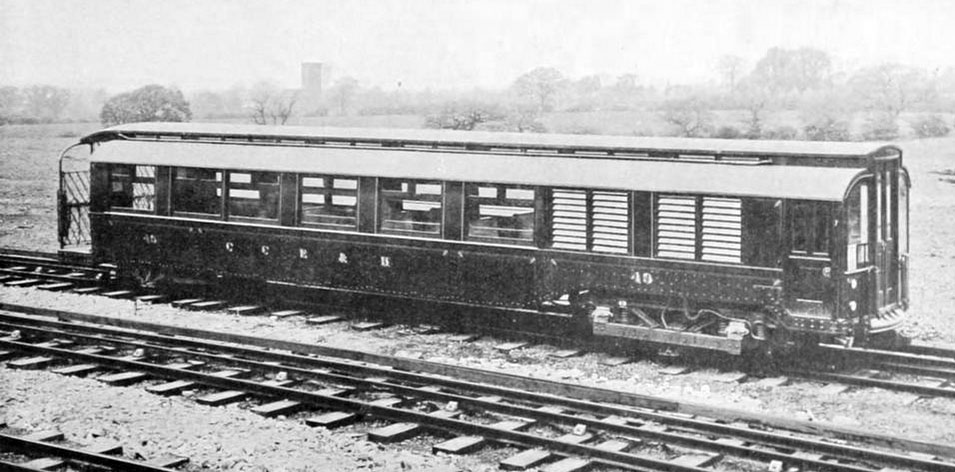
The District Railway bought ten of these locomotives from the Metropolitan Carriage & Wagon Company of Birmingham to haul London & North Western Railway and later London, Tilbury & Southend Railway services along the electrified section of its outer circle route between Earl's Court and Mansion House [1] and later onto Barking (the District Railway no longer wanted steam locomotives operating through these tunnels). The locomotives operated in pairs and only had a cab at one end. They were based on the railway's then-current fleet of B Stock EMUs and had wooden bodies and clerestory roofs [2].

Information
Number built: 10
Built: 1905
Builder: Metropolitan Carriage and Wagon Company
Engine: 4 British Thomson-Houston GE69 traction motors
(600v DC fourth rail)
Power: 800 hp (597 kW)
Wheel arrangement: Bo-Bo

The locomotives were equipped with British Thomson-Houston traction equipment though in 1922 the traction motors were replaced by GE260 from F Stock. Three locomotives were scrapped in 1911 though the rest remained in service until 1939 when the LTSR service was withdrawn.
Model of locomotive at London Transport Museum

Public domain image [3]

Public domain image [3]
[1] "Electric Locos for London & North Western Cars in London", Street Railway Journal (1906) Vol XXVII No. 1, p. 46
[2] R.L. Vickers, DC Electric Trains & Locomotives in the British Isles (David & Charles, 1986) p. 29
[3] Street Railway Journal p. 46