Showing posts with label Withdrawn. Show all posts

Class 50 (English Electric 2,700hp Type 4 Diesel-Electric)

The Class 50 was built in the late 1960s, and initially hired by British Rail from English Electric, to power the remaining non-electrified portions of the West Coast Main Line from Crewe to Scotland [1] on passenger trains and freight. The Class 50, a development of the English Electric DP2 prototype, often worked these WCML trains in pairs (though they could also work in multiples of three) to provide sufficient performance to match the timings of the electric locomotives that they shared their trains with. The locomotives were bought outright by BR in 1973 but by the mid-1970s were being displaced from the WCML due to the completion of electrification and the arrival of the Class 87. The Class 50s were sent to Western Region to work in the south and south west of England.

GB Railfreight liveried 50 049 at Kidderminster Town


Information
Number built: 50
Built: 1967-68
Builder: English Electric, Vulcan Foundry
Motor: English Electric 16CSVT diesel
Power: 2, 700 hp (2, 013 kW)
Wheel arrangement: Co-Co

At first the reliability of the Class 50 was poor with failures often due to problems with the then-novel electronic systems fitted. Crews joked that they were called the Class 50 as there was only a 50:50 chance that they would make it to their destinations! [2] The Class 50 received a full refurbishment in the late 1970s/early 1980s to improve reliability by removing little used and redundant equipment such as the slow speed control.

Much of the locomotives' time was spent on west of England express passenger trains out of London Paddington and London Waterloo and other passenger services. This made them vulnerable as multiple units became the favoured mode of people mover in the late 1980s and early 1990s and the supply of work dried up. There were attempts to utilise the class for slower freights and one locomotive was modified with lower geared bogies though the experiment was not a success.

The Class 50 was withdrawn from BR service by 1994, though no less than eighteen have been preserved (thirty six percent of the fleet) and several are mainline certified. The Class 50s were the first class of diesel locomotive to only carry BR blue livery (and later variations) though one preserved locomotive has been given a "what might have been" BR green livery. One British Rail exception came in the 1980s when one Class 50 was renamed Sir Edward Elgar and repainted in Brunswick Green to commemorate the 150th anniversary of the GWR.

Also in GBRf livery, 50 007 at Bewdley

Network South East livery is carried by 50 026 at Kidderminster Town

50 049 when it carried BR large logo livery

50 007 approaches Highley

50 034 at Kidderminster Town


[1] Brian Haresnape, Production Diesel-Electrics Types 4 and 5 (Ian Allan, 1984) p. 67
[2] Michael Welch, Diesels on the Western (Capital Transport, 2013) p. 107

Class 487 Waterloo & City Stock

The Class 487 electric multiple unit spent the entirely of it's revenue earning service running underground. They were operated on the Waterloo & City Line, which nowadays is part of London Underground but originally was a separate line to the majority of London's subterranean railways and owned by a succession of mainline railway companies until nationalisation and British Rail. In 1994 the line was transferred to London Underground to become an Underground line proper.

At LT Museum Acton in restored NSE livery

Information
Number built: 28 cars (12 DMBSO driving cars and 16 TSO trailers)
Built: 1940
Builder: English Electric Dick Kerr works
Engine: 2 English Electric EE500 traction motors (660v DC third rail)
Power: 380 hp (283 kW) per driving car
Formation: (Variable) Driving Motor Brake Standard Open (DMBSO)+
Trailer Standard Open (TSO)+DMBSO

Designed by O.V.S. Bulleid, the Class 487s (originally TOPS classified Class 453) were built for the Southern Railway during World War 2 and entered service from 1940 [1]. The units consisted of driving motor cars (with cabs at both ends - and hence could operate singly) and trailers. In off-peak periods the Waterloo & City Line trains often ran with just a pair of motor cars until the 1960s when this was thought to be unsafe due to the excess of power [2]). In peak times up to three trailers could be marshalled between two motor cars.

The Class 487 remained in service until being replaced by the Class 482 in 1993 seeing out it's final days in Network South East livery. Before that, the units wore Southern Railway green and BR Blue (though uniquely without yellow ends) [3]. The Class 487s operated on 660v DC third rail and spent all of it's working life on the short underground line though the units did see sunlight now and then when they needed heavy maintenance and had to be bought up to the surface. For test purposes to develop a new speedometer, one driving car was operated above ground in the late 1970s for a short period [4]. As it did not have windscreen wipers the tests had to be curtailed immediately if it rained!

One DMBSO has been saved from the scrap man and has being restored at the London Transport Museum to its final Network South East livery.

Interior

Cab view
Restored condition
A photo taken in May 2015 during the restoration

The preserved car in under coat, what a difference a livery makes!

[1] Colin J Marsden, DMU and EMU Recognition Guide (Ian Allan, 2013) p. 370
[2] Colin J Marsden & Christopher G Perkins (ed.) "The Waterloo & City Line", Modern Locomotives Illustrated Annual No. 2 (RailwayCentre, 2010) p.82
[3] John Glover, London Underground Rolling Stock in Colour (Ian Allan, 2009) p. 31
[4] Marsden, DMU p. 371

Class 119 (Gloucester Railway Carriage & Wagon Company Cross-Country 3-car)

The Class 119 diesel multiple unit was built for cross-country services by the Gloucester Railway Carriage & Wagon Company to a BR Swindon and Derby influenced design, and is similar mechanically to the company's single-car Class 122. The Class 119 three-car sets included toilets, buffet facilities and first class compartments though the buffets were later removed [1].

W51073 at Duffield on the EVR


Information
Number built: 81 cars (in 27 3-car sets)
Built: 1958
Builder: Gloucester Railway Carriage & Wagon Company
Engine: 2 BUT AEC 6-cyl later 2 Leyland 680-1595 diesels per power car
Power: 600 hp (447 kW)
Formation: Driving Motor Brake Composite (DMBC)+
Trailer Brake Second (Lavatory) (TBS(L))+
Driving Motor Standard (Lavatory) (DMS(L))

The Class 119 originally worked throughout Western Region, later on working on Reading-Guildford services plus the extension through to Gatwick Airport (where extra luggage space was provided) and services around south west London. They were withdrawn in 1992.

On Southern Region the Class 119 were known as "glasshouses" by SR drivers as the large cab windows were unlike those usually found on SR allocated multiple units [2]. Three cars have been preserved including Driving Motor Brake Composite W51073 on the EVR.

Luggage area on W51073

W51073 has a first class area behind the cab

W51073 at Wirksworth

Class 119 cab

Another view of W51073 at Duffield


[1] Colin J Marsden, DMU & EMU Recognition Guide (Ian Allan, 2013) p. 76
[2] Brian Haresnape, Diesel Multiple Units: The First Generation (Ian Allan, 1985) p. 53

Class 03 (British Railways 204hp Diesel-Mechanical)

After purchasing a number of small fleets of privately built diesel mechanical shunters, British Railways finally decided to build a "standard" type, the resulting Class 03 ended up being very similar to the Drewry built Class 04 [1]. 

03 066 at Barrow Hill Roundhouse


Information
Number built: 230
Built: 1957-61
Builder: BR Swindon and Doncaster
Engine: Gardner 8L3 diesel
Power: 204 hp (152 kW)
Wheel arrangement: 0-6-0

The Class 03s served with British Rail for many years, outlasting all other shunters except for the standard diesel-electrics (Class 08/09). Although much of their work disappeared in the 1970s and 1980s, as the nature of the freight sector changed, they continued to have a role on the network in places where larger and heavier locomotives were unsuitable and the last was not withdrawn until 2008 [2].

A good number of Class 03s have seen further use after British Rail with industrial users and no fewer than fifty-five have been preserved. Although primarily intended for shunting (and trip work) Class 03s did occasionally haul passenger trains, though these tended to be special workings such as taking Channel Island boat trains up to Weymouth harbour where the line ran through the streets [3] and unadvertised special services for workers [4].

03 073 at Crewe Heritage Centre

D2059 at Havenstreet, Isle of Wight Steam Railway

Another view of 03 073 at Crewe Heritage Centre

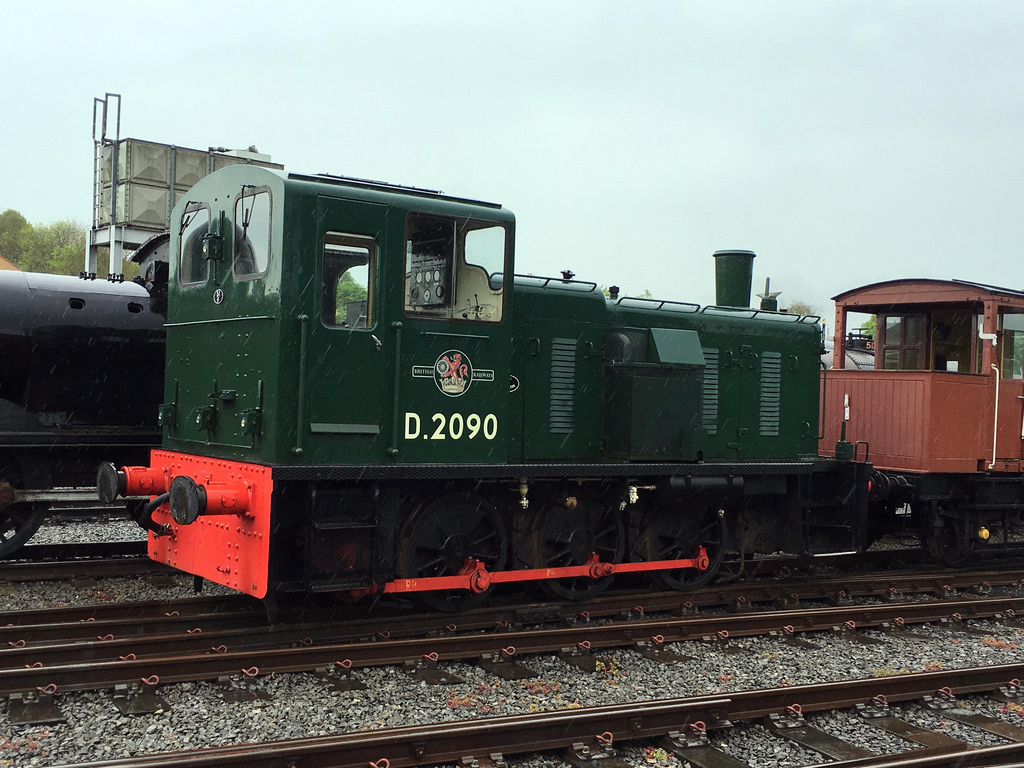
D2090 at NRM Shildon in original BR green

03 099 at Rowsley South, Heritage Shunters Trust

[1] Brian Haresnape, Diesel Shunters (Ian Allan, 1984) p. 56
[2] Colin J. Marsden (ed.), "BR Class 03 0-6-0 DMs", Modern Locomotives Illustrated No 217 February-March 2016 (SR, GW, LNER, LMS & Trial Shunters & Class 03s), p. 67
[3] Haresnape, Shunters p. 20
[4] Michael Welch, Diesels on the Western (Capital Transport, 2013) p. 18

Class 89

With new electrification of British Rail routes continuing in the 1980s, especially the East Coast Main Line (ECML), a new generation of electric locomotives would be required. The Class 89 was a prototype locomotive, with a Co-Co wheel arrangement unlike earlier AC electric locomotives which had all been Bo-Bos. The Class 89 was also fitted with advanced power control systems with a maximum power output of nearly 8,000 hp (and a continuous output of over 5, 748 hp). It is capable of travelling at 125 mp/h.

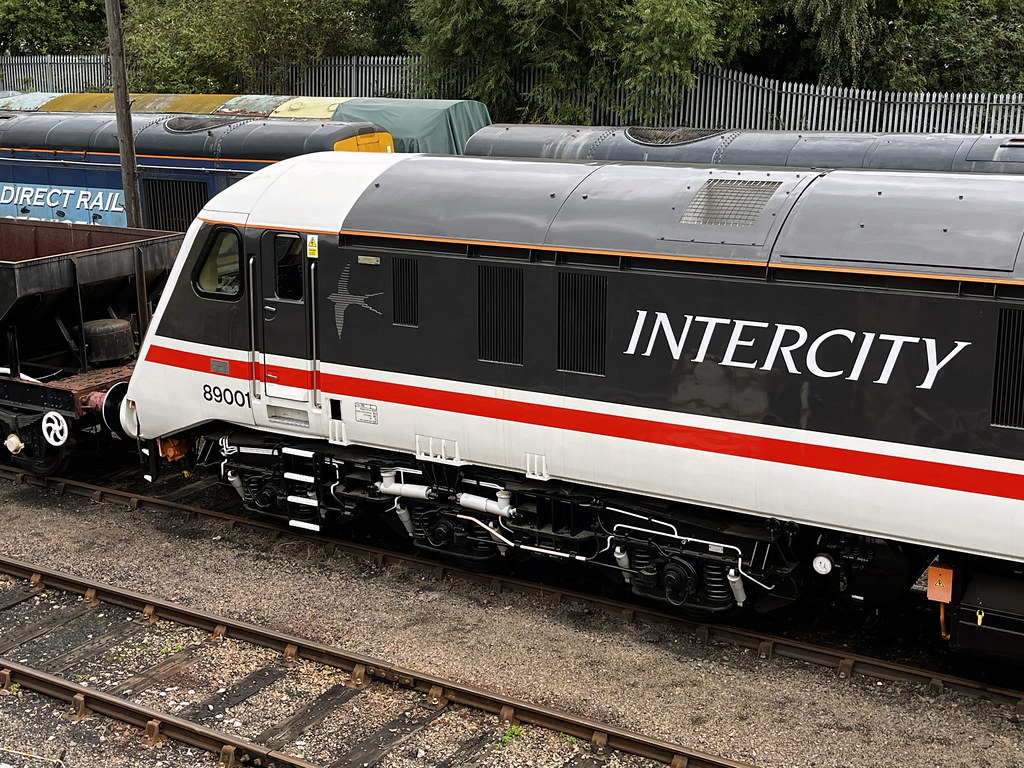
89 001 at Barrow Hill Roundhouse


Information
Number built: 1
Built: 1986
Builder: BREL Crewe / Brush Traction
Motor: 6 Brush TM2201A traction motors (25kV AC OHLE)
Power: 5, 748 hp (4, 286 kW)
Wheel arrangement: Co-Co

The locomotive was designed by Brush Traction and built by BREL Crewe in 1986. Early in the programme the Class 89 was considered as potential traction for the East Coast Main Line [1] and an eventual fleet of 33 to be built though by the time the Class 89 was built the specification for the ECML had changed (to be filled by the Class 91) and only one Class 89 ended up being built.

The Class 89 was used on test trains on both the West Coast Main Line and ECML in the late 1980s. Operations continued until 1992 when the locomotive suffered a serious failure, it was withdrawn by BR as being surplus to requirements (by then) and non-standard [2].

The Class 89 was saved by the privatising railway in 1996. The new operator on the ECML, Great North East Railway bought it back into service [3] and paid for an overhaul to help cover a shortage of motive power at the time. The Class 89 was withdrawn due to another failure in 2000 and again surplus to requirements. The locomotive was purchased for preservation in 2006, after a long overhaul and refurbishment it is planned for the Class 89 to return to the mainline for charter work.

89 001 front profile

89 001 wears Intercity swallow livery

Another photograph of 89 001


[1] Brian Haresnape, Electric Locomotives (Ian Allan, 1983) p. 20
[2] Gavin Morrison, AC Electric Locomotives (Ian Allan, 2013) p. 57
[3] Colin J. Marsden, Diesel & Electric Locomotive Guide (Ian Allan, 2011) p. 234
English Electric NZR E Class

The E Class battery electric locomotive was ordered by New Zealand Railways to accompany the five EO class locomotives built for the Otira to Arthurs Pass section of the Midland Line. The locomotive was intended for engineering and maintenance work on the line (when the juice would most likely be turned off). The locomotive had a four wheeled battery tender.

E Class locomotive [1]


Information
Number built: 1
Built: 1922
Builder: English Electric
Motor: 4 DK30 traction motors (battery electric)
Power: 176 hp (131 kW) 
Wheel arrangement: Bo-Bo-2 (including battery tender)

The locomotive unfortunately did not last very long, it was withdrawn from service in 1930 and written off due to problems maintaining the batteries. The locomotive was scrapped though parts of the locomotive were reused elsewhere including the battery tender as a general purpose wagon.

E Class locomotive, notice the battery tender [2]


[1] English Electric Journal (1924 Vol 4) p. 278
[2] "Midland Railway of New Zealand", English Electric Journal (1923 Vol 4) p. 171

English Electric Battery Electric Locomotive for Ribble Power Station

Ribble Power Station near Preston began operating in 1924 and operated until 1976. It was a coal powered station and therefore needed a lot of coal bought in, which came in largely by boat. A railway line handled wagons of coal and spent ash, as is usual with coal powered stations using steam traction was considered dangerous due to sparks which could ignite the coal. Many stations used fireless steam locomotives but in the case of Ribble English Electric built this battery electric locomotive.

Information
Number built: 1
Built: 1924
Builder: English Electric
Wheel arrangement: 4wBE

The locomotive [1]


[1] "Electricity supply developments in Preston", English Electric Journal (October 1925) p. 115

KTMB Class 20

These diesel locomotives were built by English Electric for the Malaysian Railways (Keretapi Tanah Melayu Berhad) in 1957. They were the first main line diesel locomotives to be introduced in Malaysia. They were used for the main passenger express services but also could be used on some freights. They had a bonnet nose like other English Electric diesel locomotives such as the Classes 37 and 40 though had the same engine which was fitted to re-engined Class 31s! The locomotives were built for metre gauge.

A Class 20 on delivery (right), with it is another EE built loco, a class 15 shunter [1]


Information
Number built: 26
Built: 1957
Builder: English Electric Vulcan Foundry
Motor: English Electric 12SVT diesel
Power: 1, 500 hp (1, 119 kW) 
Wheel arrangement: Co-Co

The locomotives were withdrawn from services in the late 1980s. One has been preserved.


[1] "Export orders", Board of Trade Journal Vol. 199 Issue 3831 (19 August 1970) p. 416

English Electric / Cravens Motor Cars for the La Guaira and Caracas Railway

The La Guaira and Caracas Railway was a narrow gauge (914mm gauge) line that linked Caracas to the port of La Guira. The line was electrified in the 1920s and used a combination of Swiss built locomotives and British built passenger motor cars. The latter were built by Cravens with electrical equipment by English Electric. The motor cars could carry passengers and also haul other carriages.

One of the motor cars [1]


Information
Number built: 4
Built: 1927
Builder: Cravens / English Electric
Motor: 4 DK109 traction motors (1500v DC OHLE)
Power: 264 hp (197 kW) 
Wheel arrangement: Bo-Bo

The motor cars served into the 1940s but the line suffered from competition with road transport, and was a different gauge to other railways in Venezuela, after a period of financial difficulty it was nationalised. After storm damage in 1951 the railway was not repaired due to a lack of government finance and closed. The motor cars managed to survive stored at Caracas until the end of the 1950s but were scrapped. Little trace of the railway now remains.

[1] "Electrification of the La Guaira and Caracas Railway", English Electric Journal (4/1928) p. 74

Ruston and Hornsby 223741 (20DL)

Ruston & Hornsby built many 20DLs over a lengthy period. The example here, with the works number 223741 is now preserved at Crich Tramway Museum. The 20DL refers to the power rating (20hp) and DL means narrow gauge. However, 223741 is now a standard gauge locomotive having been converted from 600mm gauge in 1963. A similar locomotive at Crich is 326058.

223741 at Crich


Information
Number built: 1
Built: 1944
Builder: Ruston & Hornsby
Motor: Ruston & Hornsby 2VSHL diesel
Power: 20 hp (15 kW) 
Wheel arrangement: 4wDM

The locomotive was formerly operated by the Accrington Corporation.

English Electric Battery Locomotives for the Rhodesia and General Asbestos Corporation

English Electric built hundreds of electric and battery electric locomotives for industrial and commercial customers. These two locomotives were built for the Rhodesia & General Asbestos Corporation for work at it's Shobani mine. The locomotives worked in tropical conditions at altitude both above and below ground.

The two locomotives [1]
Information
Number built: 2
Built: 1928
Builder: English Electric
Motor: 2 DK51F electric motors
Power: 15 hp (11.2 kW) 
Wheel arrangement: 4wBE

The locomotives could maintain maximum power for an hour with their 95v batteries. The locomotives were not very powerful perhaps though they were pretty small (though weighed four and a half tons), they operated on a 1 foot 6 inch gauge (457mm minimum gauge) railway.

[1] "A recent industrial locomotive installation", English Electric Journal Vol. 4 Issue 2 (1928) p. 60

Class 508 (BREL York Suburban Services 3-car)

The Class 508, part of the 1972 Standard PEP family like the Class 313 and 507, was built for the Merseyrail DC third rail network. However, as there was a desperate need for new stock on Southern Region in the late 1970s they served there initially until the new Class 455 could be built [1].

Merseyrail 508 125 at Ellesmere Port


Information
Number built: 172 cars (as built 4-car sets later 3-car sets)
Built: 1979-80
Builder: BREL York
Motor: 8 GEC G380AZ traction motors per unit (750v DC third rail)
Power: 880 hp (657 kW)
Formation: As built: Driving Motor Standard Open (DMSO)+Trailer Standard
Open (TSO)+TSO+Battery Driving Motor Standard Open (BDMSO)

Later:
DMSO+TSO+BDMSO

Not all sets went North, some remained in the South East as Class 508/2 though none of these are still in service. In the early 2000s three sets worked alongside the Class 313 on the London Euston-Watford route [3] as Class 508/3 but in recent years the only 508s in service have been the twenty seven Class 508/1s sets operated by Merseyrail on it's DC third rail network alongside the Class 507.

Merseyrail replaced them with the new Class 777 [4] though there were delays in introducing the new units, the Class 508 finally left service at the start of 2024. Some ex-Class 508 cars do still exist, having been part of strengthened Class 455/7 formations since the 1980s.

508 130 at New Brighton

508 108 at Bank Hall

508 103 at Liverpool Lime Street Low Level

Aboard 508 123

508 120 at Hooton


[1] Brian Haresnape & Alec Swain, Third Rail DC Electric Multiple Units (Ian Allan, 1989) p. 74
[2] Bruce Oliver, Southern EMUs Before Privatisation (Ian Allan, 2010) p. 86
[3] Colin J Marsden, DMU and EMU Recognition Guide (Ian Allan, 2013) p. 389
[4] "Five shortlisted for new Merseyrail trains", Today's Railways UK No. 171 (March 2016)

Southend-on-Sea Corporation Tramways

Southend-on-Sea's first tramway was a horse drawn tram that ran along the pier (this was later replaced by a dedicated railway which has used a variety of rolling stock over the years). An electric tram for the town itself began operation in 1901 which used 1, 067mm gauge like the pier railway did at the time. The initial trams for the corporation were built by Brush Traction in a variety of types, some double decker and other single decker and four or eight wheels.

English Electric tram [1]


Information for original Brush cars
Number built: 14
Built: 1901
Builder: Brush Traction

More trams were built by G.F. Milnes, Brush and the United Electric Car Company in subsequent years. The network continued to expand in the 1910s and at it's greatest extent was nearly fifteen kilometres long. The final trams built for the corporation were by English Electric in 1923. Earlier trams with open top decks were refurbished to add top covers.

By the mid-1920s the corporation was already looking at replacing the tram with electric trolleybuses. Replacement began as lines required track renewal. The final trams ran in 1942.

[1] English Electric Journal Vol 3 Issue 6 (1926) p. 248

JNR Class 1040 / ED50 / ED17 / ED18

In the early 1920s the Imperial Government Railways of Japan began electrification of the Tokaido and Yokosuka Lines. The railway imported electric locomotives from the UK, US and Switzerland to provide the motive power and also to give the Japanese experience with the locomotive type before they pursued their own designs. By far the largest class of locomotives to be built was the seventeen strong Class 1040 which were constructed by English Electric and North British Locomotive Company (two examples of the earlier and similar Class 1030 were also built). The locomotives arrived in Japan between 1924 and 1925 and were put into use hauling passenger trains, the locomotives were built for 1, 067mm gauge. After 1928 they were classified as the ED50.
Class 1040 [1]


Information
Number built: 17
Built: 1923
Builder: English Electric / North British Locomotive
Motor: 4 DK86 electric motors (1500v DC OHLE)
Power: 1, 200 hp (865 kW) 
Wheel arrangement: B-B

Between 1930 and 1931 the locomotives were rebuilt as the ED17, they were regeared for their new role hauling mostly freight traffic along the Chuo Line. Two locomotives (classified as ED18) were later modified with A1A-A1A bogies to reduce the axle load on the Iida Line which was more lightly built than other lines. Most of the ED17 fleet survived the war and continued to be used on the Chuo Line but were gradually replaced by more modern types by in mid-1960s. The final ED17s and ED18s were retired from service in 1972. One ED17 has been preserved.
Another view of a Class 1040 locomotive [1]


[1] "Electric locomotives of the Imperial Government Railways of Japan", English Electric Journal Vol. 2 Issue 6 (1924) p. 294

Yorkshire Engine Company Taurus

Taurus was a diesel-hydraulic locomotive developed by the Yorkshire Engine Company trip freight work and heavy shunting. It had two Rolls Royce diesel engines, only one being used at very slow speeds. Taurus was demonstrated on British Railways in 1961-2 though no orders arised, but in any event the kind of duties a locomotive such as Taurus could be used for were soon to disappear.

Taurus on test [1]


Information
Number built: 2
Built: 1961-63
Builder: Yorkshire Engine Company
Motor: 2 Rolls Royce C8SFL diesels
Power: 600 hp (450 kW) 
Formation: 0-8-0DH

With a glut of ex-BR shunting locomotives entering the market in the late 1960s, the Yorkshire Engine Company found it difficult to sell Taurus to any industrial users. A second Taurus was built however, this was for the Spanish railway operator RENFE and was to 1668mm gauge. No other orders were forthcoming though the Spanish Taurus has survived into preservation.

A similar type built by the Yorkshire Engine Company was the Indus. This was very similar to the Taurus though had a similar gearbox (the differential compound gearbox of Taurus having proved to be problematical - indeed the Spanish Taurus was given the Indus gearbox). Two Indus were built for industrial users and survived into the 1980s.
Taurus under construction [1]


[1] "The Taurus multi-purpose locomotive", International Railway Journal Vol. 1 Issue 5 (1961) p. 16

CIE A Class / 001 Class

These locomotives were built for the Córas Impair Éireann (Irish Railways) in the 1950s and became the backbone of the CIE locomotive fleet performing mixed traffic duties for several decades. However, as built they had Crossley 2-stroke diesel engines which turned out to be very unreliable. Finally in the late 1960s, CIE had the fleet rebuilt with EMD engines which proved much better, though had to be downrated from 1, 650 hp due to stresses on the cooling and transmission systems.

CIE A3 in service [1], this locomotive is now preserved


Information
Number built: 60
Built: 1955-56
Builder: Metropolitan-Vickers
Motor: Crossley HSTV8 diesel
(rebuild) EMD 12-645E diesel
Power: (Crossley) 1, 200 hp (890 kW)
(EMD) 1, 325hp (988 kW)
Wheel arrangement: Co-Co

The locomotives remained in service until final withdrawal in 1995. Four have been preserved.

A10 in the workshop [1]


[1] "New look for Irish transport", International Railway Journal Vol. 1 Issue 4 (1961) p. 28

Huddersfield Corporation Tramways

Huddersfield Corporation Tramways operated between 1883 and 1940 to 1,416mm gauge. The trams were initially horse and steam powered but electric trams began operating from 1901. The first trams built for the corporation were twenty five double bogie double deckers built by G.F. Milnes. These had open top decks initially.
English Electric built 121 [1]


Information for original tramcars
Number built: 25
Built: 1900
Builder: G.F. Milnes

A second batch of thirty six tramcars built by the British Electric Car Company were built as the electrified network expanded. These tramcars were single bogie cars though were also double deckers. More trams were built in the following decades by the United Electric Car Company which later became part of English Electric. The corporation also operated a couple of dedicated coal trams.

Despite much of the tram fleet still being fairly young the corporation began converting over to trolleybuses in the early 1930s. The trams ran for the final time in June 1940. All trams were scrapped.

[1] English Electric Journal 1923-04 Vol 2 Issue 4 p. 175

F. C. Hibberd Planet Industrial Locomotives

F.C. Hibberd began building petrol and diesel locomotives for industrial purposes in 1927. Their locomotives had the name Planet, though this name was also used by the company's road tractors. The origin in the name came from the Kent Construction & Engineering Company who built industrial locomotives after World War 1 under the Planet name. In 1926 the company closed but two of the directors set up F.C. Hibberd and continued the Planet name.
Planet locomotive [1]


Information for typical late model Planet
Built: 1960
Builder: F. C. Hibberd
Motor: BUT 680 series 6-cyl diesel
Power: 163 hp (122 kW) 
Wheel arrangement: 4wDH

F.C. Hibberd continued building Planet locomotives in a variety of configurations and gauges until 1968, by then the company was part of Butterley Engineering. Many examples of Planet locomotives have been preserved.

[1] "Products of interest", International Railway Journal (December 1961) p. 54