Showing posts with label GEC. Show all posts

Class 87 (BR/GEC Traction 5,000hp AC Electric)

The Class 87 was built for the extension of the electrification of the West Coast Main Line into Scotland and was Britain's first 5, 000hp locomotive [1]. The Class 87 was a development of the then standard AC electric locomotive, the Class 86. It shared the same body shell though had redesigned bogies with Flexicoil suspension to reduce track wear [2] and frame mounted traction motors. The Class 87s were cleared to travel at up to 110 mp/h (177 kp/h).
87 035 in the process of being repainted into Virgin livery


Information
Number built: 36
Built: 1973-75
Builder: BREL Crewe / GEC Traction
Engine: 4 GEC G412AZ traction motors
Power: 5, 000 hp (3, 728 kW)
Wheel arrangement: Bo-Bo

Thirty five Class 87/0s were built with a 36th locomotive built as the solo Class 87/1, this locomotive tested a thyristor control system. The later Class 90 was a development of the 87 and indeed was at one stage to have been the Class 87/2.

One one is now still in operation on the main line and two have been preserved. Quite a few have been exported to the continent and continue to operate in Bulgaria [3].
Preserved 87 001 in original BR blue at NRM York

Inside the cab

Front view of 87 035

Another view of 87 001

87 035 in BR Intercity livery at Crewe Heritage Centre

[1] Chris Heaps, BR Diary 1968-1977 (Ian Allan, 1988), p. 70
[2] Brian Haresnape, Electric Locomotives (Ian Allan, 1983), p. 69
[3] Colin J. Marsden, Traction Recognition (Ian Allan, 2008), p. 88

Class 466 Networker

The Class 466 is part of the Networker family and the companion to the 4-car Class 465. The Class 466 was built for Network South East's lines in Kent. The 466 is a 2-car version of the 465 for lower patronage branch lines and also to augment other services in peak times [1]. Unlike the 465 production which was split between BREL York and GEC, the 466 was built entirely by GEC Alstom and thus the fleet has a standard traction package [2].
Southeastern 466 012 at Lower Sydenham


Information
Number built: 86 (43 2-car sets)
Built: 1993-94
Builder: GEC Alstom Birmingham
Engine: 4 Alstom G352AY traction motors (750v DC third rail)
Power: 1, 500 hp (1, 120 kW)
Formation: Driving Motor Standard Open (DMSO)+
Driving Trailer Standard Open (DTSO)

Following privatisation the Class 466s were taken over by Connex South Eastern, then South Eastern Trains and currently is operated by Southeastern. Withdrawals of some 466s and 465s began in 2021 to make space for transferred Class 707s.
466 020 at Waterloo East


466 006 at Grosvenor Road Sidings

466 030 passing through Peckham Rye

[1] Colin J. Marsden, DMU and EMU Recognition Guide (Ian Allan, 2013) p. 363
[2] Colin J Marsden (ed.) "The Networker Family", Modern Locomotives Illustrated No. 233 February-March 2017 (Networker, Juniper & Javelin Stock) p. 4

London Underground 1996 Tube Stock

The Jubilee Line Extension in the 1990s (at the time the largest construction project in Europe) extended the Jubilee Line out into East London out to Stratford. The 1996 Tube Stock was designed for this extension, initially the idea was to refurbish and augment the Jubilee Line's existing 1983 Tube Stock fleet but London Underground calculated that a fleet of brand new trains would cost about the same [1] and last much longer. The new trains were designed to avoid some of the shortcomings of the 1983TS including the passenger bottle necks caused by the single doors [2].
96110 and friend at the Northern terminus Stanmore

The 1996 Tube Stock looks very similar to the Northern Line's 1995 Tube Stock and indeed the two fleets were built alongside each other. However the 1996TS is technically less advanced than the 1995TS as the specification was locked down earlier. Although both have AC motors the 1996TS controls them using a Gate Turn-Off (GTO) Thyristor [3] derived from the one used on the Class 465 EMU (the 1995TS uses the more advanced Insulated Gate Bi-polar Transistor (IGBT) drive). They also have different cab designs, electrical systems, bogies and interiors.

Information
Number built: 441 (63 7-car sets)
Built: 1996-98, 2005
Builder: Metro-Cammell, GEC Alsthom, Alstom (2005 build)
Motor: 4 GEC Alsthom LT200 three-phase induction motors
per motor car (630v DC fourth rail)
Power: 480 hp (360 kW) per motor car
Formation: Driving Motor (DM)+Trailer (T)+Uncoupling Non-Driving Motor
(UNDM)+UNDM+T+T+DM

The 1996TS entered service before the Jubilee Line Extension had been completed and was originally a 6-car set (made up of 2 3-car units) [4]. In 2005 London Underground ordered more cars in order to lengthen the trains up to 7-cars and also bought 4 new complete sets. While the original 1996TS final assembly was at the former Metro-Cammell factory in Birmingham, by 2005 that factory was in the process of closing down. The new cars and trains were built at an Alstom factory in Spain instead.

The 1996TS is currently receiving a mid-life refresh which includes improved and more accessible interiors and better passenger information [5]. London Underground at one stage planned to add some new build to augment the fleet though these plans have now been put on hold.
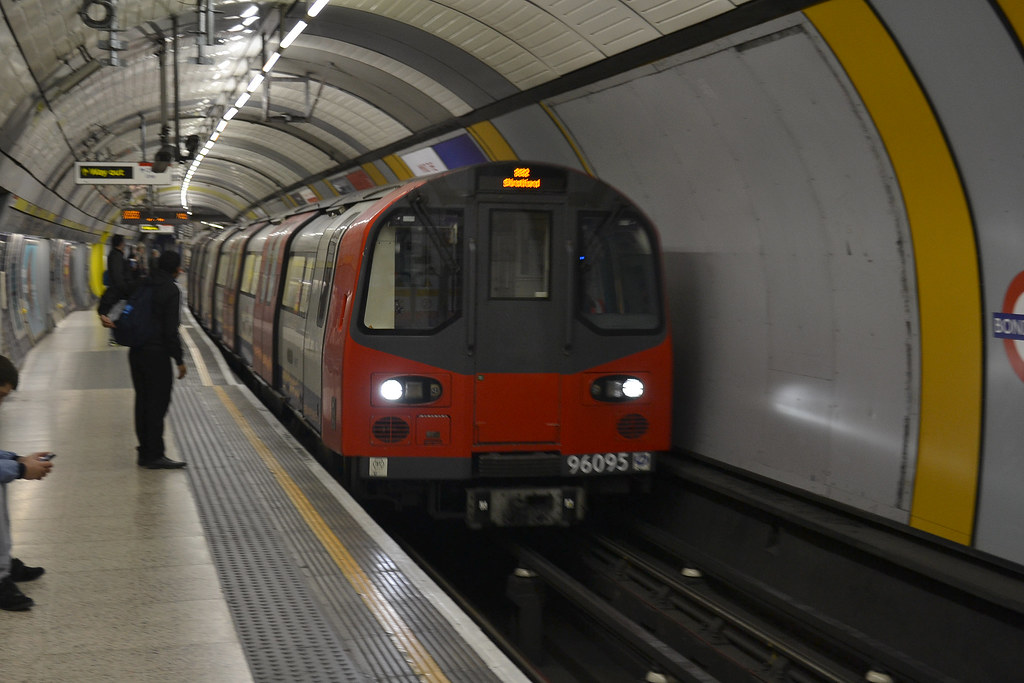
96095 heads into Bond Street

96007 arrives at Finchley Road

96103 at Kilburn

96075 and friend at the Eastern terminus Stratford

96066 at West Ham

[1] Paul Moss, London Underground (Haynes, 2014) p. 167
[2] Mike Horne, The Jubilee Line (Capital Transport, 2000) p. 63
[3] Piers Connor, The London Underground Electric Train (Crowood Press, 2015) p. 175
[4] Ben Muldoon, London Underground Rolling Stock Guide (Ian Allan, 2014) p. 38
[5] Modern Railways (March 2017) p. 13