Showing posts with label Light Rail. Show all posts

West Midlands Metro Urbos 3

The Urbos 3 fleet is the second generation of light rail rolling stock built for the West Midlands Metro from Wolverhampton to Birmingham, replacing the earlier T-69 fleet [1].

Tram 31 on Corporation Street


Information
Number built: 42
Built: 2012-15, 2021-23
Builder: CAF
Motor: 12 traction motors (750v DC OHLE)
Power: 1, 320 hp (960 kW)

The Urbos is a successful type of modern tram built by CAF, used in dozens of light rail systems across the world though the West Midlands Metro fleet is the only Urbos 3 stock used in England (the type is also used in Edinburgh).

The trams were introduced for the extension of the West Midlands Metro from Birmingham Snow Hill to Birmingham New Street railway station. They are slightly wider than the T-69s they replaced (about seventeen centimetres) thus the line had to be closed for a few weeks to allow for platform modifications before the Urbos 3 could enter service. 

The trams are also nine metres longer and can carry up to 210 passengers per tram compared to 156 on the T-69 (though the actual number of seats is almost the same). All of the trams were given the pink and white livery of the Midlands Metro as it was originally known though all now carry the blue livery of the re-branded West Midlands Metro.

CAF have developed rechargable batteries for fitting to the fleet to allow them to operate on extensions to the metro where there are no overhead wires [2] such as around Birmingham town hall. Twenty one more trams were built in the early 2020s to strengthen the fleet as the West Midlands Metro expands.

Tram 38 (the first in the second batch) arrives at Loxdale

The original livery carried by the trams

Tram 48 at Edgbaston Village, the current terminus of Line 1

Look Ma no wires! A tram passes Birmingham Town Hall on battery power

Tram 51 heads towards West Bromwich


[1] Colin J Marsden, Rail Guide 2016 (Ian Allan, 2016) p. 280
[2] Colin J Marsden (ed.), Light Rail (Key Publishing, 2018) p. 63

Class 399 Citylink

The Class 399 was built to augment the existing rolling stock on the Sheffield Supertram and enable an extension to Rotherham Central. The extension requires travel over the mainline and thus the Class 399s are built as tram trains with a dual voltage capability, higher crash worthy standards than other trams and fitted for dual-signalling to operate on the mainline tracks. The trams are fitted with mainline protection systems such as TPWS and are compatible with both mainline and Supertram signalling systems.

Supertram 399 203 at Hyde Park


Information
Number built: 7
Built: 2014-15
Builder: Vossloh Espana
Motor: ABB traction system (6 motors) (750c DC / 25kv AC OHLE)
Power: 1, 170 hp (870 kW)

The Class 399 entered service in 2017. To operate on both tram tracks and the mainline, a new wheel profile was designed for these vehicles.

Three or four trams are dedicated at any one time for the Tram-train route of Supertram with the other Class 399s being used on other lines.

399 203 departs Attercliffe

399 203 again, at Fitzalan Square/Ponds Forge

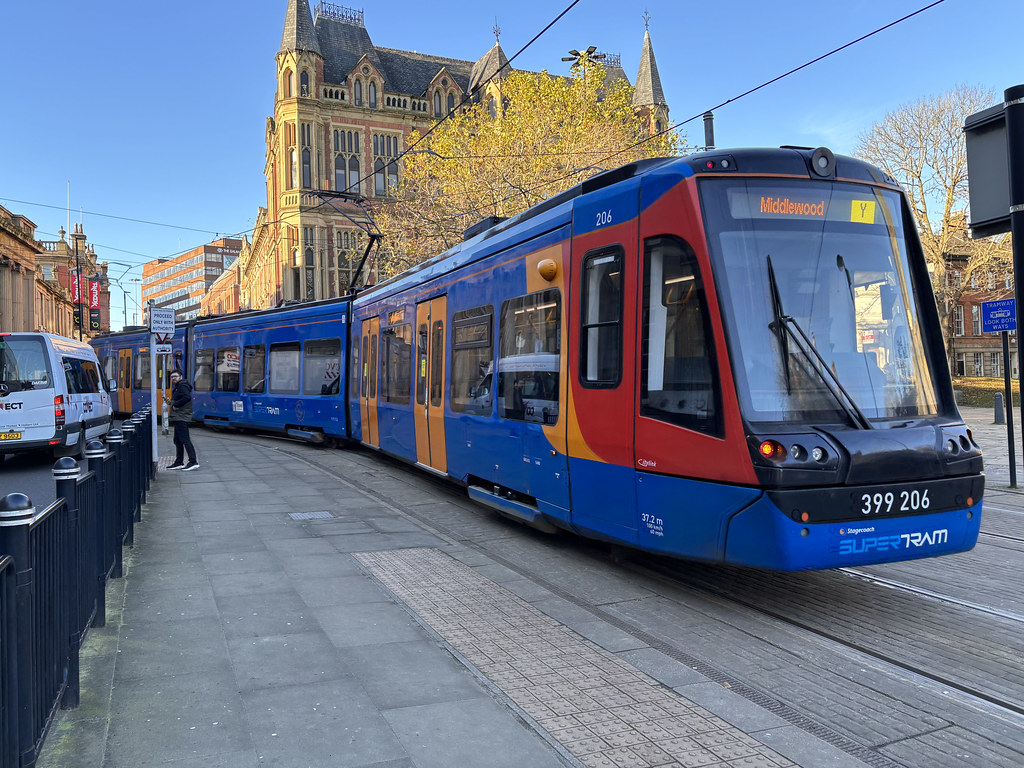
399 206 at Cathedral, Tram train services terminate here but this tram is on the Yellow Line

The two types of Supertram rolling stock together

399 203 at Rotherham Central


Stadler Variobahn (London Trams)

Six of these trams were ordered from Stadler to augment the existing fleet of Flexity Swift CR4000s on what was at the time called Croydon Tramlink (now called London Trams). These trams entered service in 2012. Four more trams were ordered in 2015 and the final two in 2016 [1]. The Variobahn trams are slightly longer than the CR4000s (with a slightly higher capacity) and have five sections instead of three.

2564 at Morden Road


Information
Number built: 12
Built: 2011-16
Builder: Stadler
Motor: 8 Stadler traction motors
Power: 480 hp (360 kW) 
Wheel arrangement: Bo-2-Bo

Although the Variobahn trams can be seen through the London Tram network, the preference is to use them on the longer Line 2 route.

2562 departs Morden Road

2562 arrives at Mitcham

Both types of tram operated by London Trams meet at Morden Road


[1] Robert Prichard & Alan Yearsley, UK Metro & Light Rail Systems (Platform 5, 2019) p. 130

Nottingham Express Transit Incentro AT6/5

These trams were the first built for the Nottingham Express Transit (NET) metro which began operations in 2004. The trams are a variant of the Bombardier Incentro design, this was originally an ADtranz design but by the time production began Bombardier has taken ADtranz over.

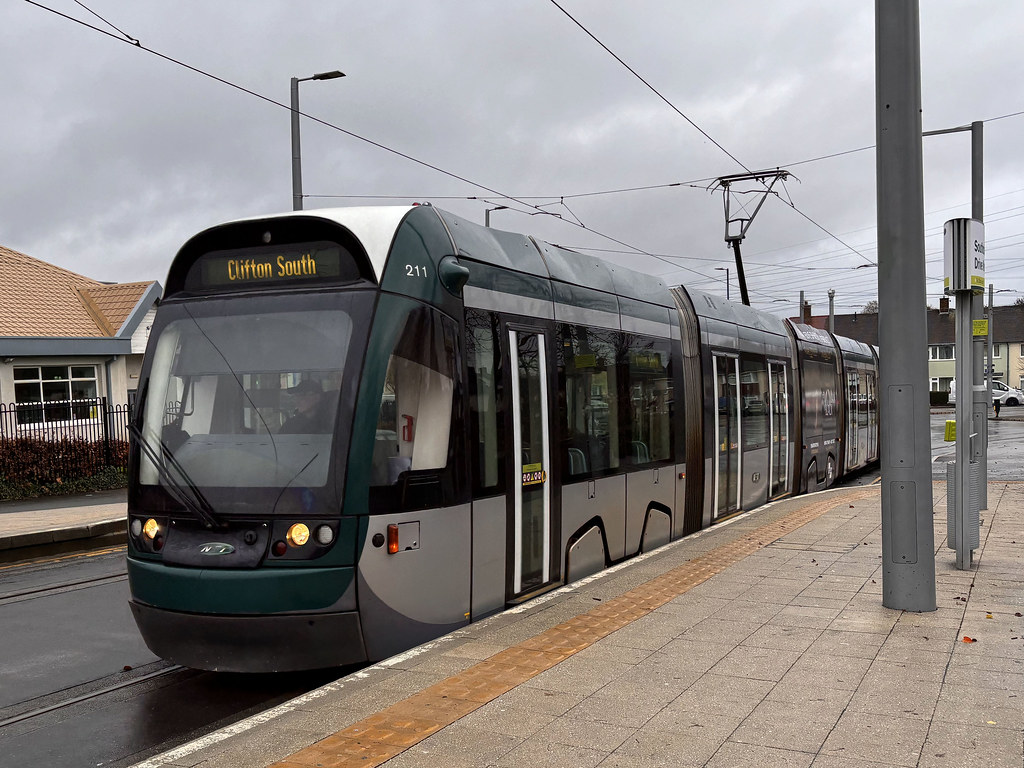
Tram 211 at Southchurch Drive North


Information
Number built: 15
Built: 2002-3
Builder: Bombardier Derby
Motor: 8 Bombardier asynchronous electric motors (750v DC OHLE)
Power: 480 hp (360 kW) 

The trams have five short articulated sections. The trams were refurbished in 2012-13 and have been supplemented by a fleet of Alstrom Citalis trams as the NET has expanded.

204 at Nottingham Station

Behind one of the driver cabs

214 at Compton Acres

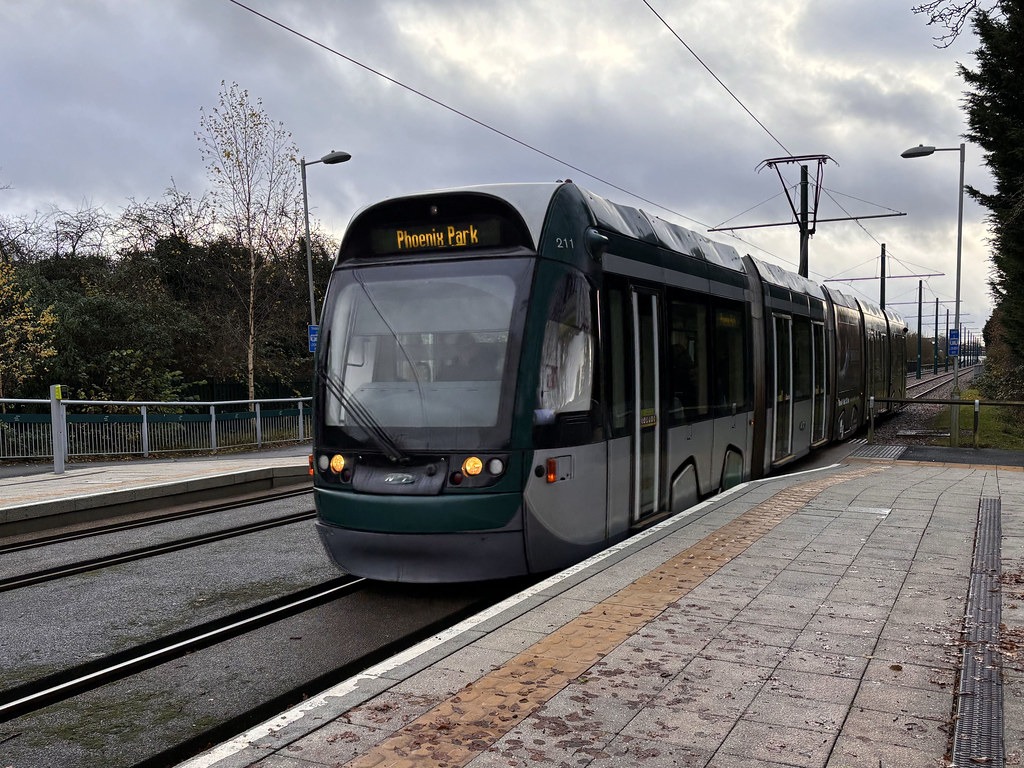
In the other direction, 211 arrives at Compton Acres

211 stands at Nottingham Station


Nottingham Express Transit Citadis 302

The launch stock for the Nottingham Express Transit light rail system was the Bombardier Incentro. For phase two of NET with extensions to Beeston and Clifton, NET needed more trams and ordered a fleet of twenty-two Alstom Citadis 302s, a very successful type of tram used throughout the world.

Tram 237 departs Compton Acres


Information
Number built: 22
Built: 2013-14
Builder: Alstom
Motor: Alstom traction system (4 motors) (750v DC OHLE)
Power: 480 hp (358 kW)
Wheel arrangement: Bo-2-Bo

Deliveries of the trams began in 2013 with an entry into service in 2014. The Citadis introduced a new livery for NET trams which the older Incentros also received when they were refurbished.

Like the Incentros, the Citadis trams are made up of five short articulated sections. The trams have seats for fifty eight passengers [1].

Arriving at Clifton Centre

One of the driver's cab

Tram 224 departs Bulwell

Tram 226 arrives at Nottingham Station

A tram arrives at Southchurch Drive North

[1] Robert Prichard & Alan Yearsley, UK Metro & Light Rail Systems (Platform 5, 2019) p. 134

Sheffield Supertram (Siemens-Duewag)

The Supertram is a fleet of trams built for the Sheffield Supertram light rail network which began operation in 1994. At nearly thirty five metres long the Supertrams are one of the longest articulated vehicles built for public transport in the UK [1].

Supertram 120 departs Spring Lane


Information
Number built: 25
Built: 1993-4
Builder: Siemens-Duewag
Engine: 4 Three-Phase Siemens traction motors (750v DC OHLE)
Power: 1, 420 hp (1, 060 kW)
Wheel arrangement: B-B-B-B

The trams were built at Siemens-Duewag and first tested on Düsseldorf's Rheinbahn network before being shipped over. The Supertrams consist of three articulated sections [2] and have all powered axles due to the steep gradients on part of the network [3].

The Supertrams underwent a full refurbishment in 2006-08 which included interior an exterior changes including the replacement of the original destination boards with LEDs to comply with the Disability Discrimination Act.

Tram 117 arrives at Attercliffe

Aboard a Supertram behind the cab

Tram 118 at Fitzalan Square / Ponds Forge

Tram 119 at Hyde Park

Tram 118 again, passing a sister tram at Woodbourn Road


[1] Supertram Vehicle Information <https://www.stagecoachbus.com/supertram/vehicle-information>
[2] Colin J. Marsden, Rail Guide 2016 (Ian Allan, 2016) p. 282
[3] Robert Pritchard & Alan Yearsley, UK Metro & Light Rail Systems (Platform 5, 2019) p. 138

Metrolink T-68/T-68A

These trams were the first built for the Manchester Metrolink which began operations in 1992. Twenty six T-68s were built by Ansaldo Breda based on their Firema design. The trams are high-floor (due to Metrolink reusing a number of former heavy rail lines and stations) and articulated. Six more trams were built in 1999 for use on the Eccles Line, these T-68As had a number of differences including AC motors.
1023 preserved at Crewe Heritage Centre


Information
Number built: 32
Built: 1991-92, 1999
Builder: Ansaldo Breda
Motor: (T-68) 4 DC motors
(T-68A) 4 Three Phase AC motors (750v DC OHLE)
Power: (T-68) 564 hp (400 kW)
(T-68A) 640 hp (480 kW) 

The T-68 trams were supplemented on the fast growing Metrolink system by Bombardier M5000 trams from 2009. The M5000s were found to be more reliable and, as they were lighter, reduced track wear and were more efficient. It was decided to replace the T-68s and standardise on the M5000 despite the fleet only recently having received a mid-life refurbishment. The last T-68s were withdrawn in 2014. Two have been preserved.
Cab end of 1023

Articulated section of 1023


Docklands Light Railway B90/B92/B2K Stock

The Docklands Light Railway is a growing light rail network in the East of London which has supported the redevelopment of the former docklands area. Unlike other lines which have been built in response to demand, the DLR was built to attract people to a previously run down area [1]. The B90/B92/B2K fleet is the a second generation of trains on the DLR, which supplemented and then replaced the original P86/89 Stock.

77 at West India Quay


All DLR trains are automatically controlled though carry a Passenger Service Agent (PSA) who can control the train if necessary via a locked console. The trains do not have cabs and so are popular with passengers who can get a great front view of travel! The PSA can control a train in emergencies via controls locked away at the front of the train. The DLR trains consist of a single articulated car [2] though can operate in multiples of up to three. The DLR operates off 750v DC third rail like many railways in London, though in the DLR's case power is picked up from the underside of the conductor rail, the top and sides having plastic covers.

Information
Number built: 94 (23 B90, 47 B92, 24 B2K)
Built: 1991-2002
Builder: Bombardier
Engine: Brush TM2111A traction motors (750v DC third rail bottom contact)
Power: 375 hp (280 kW)

The B2K cars differ from the two earlier batches in that they have been modified to adhere to accessibility regulations and have contrasting colour doors and handrails and internal LCD screens. The earlier cars have being bought up to the same standard during refurbishment. However, the fleets are worked hard and the B90 and B92 are showing signs of being worn out, they are due to replaced by new build vehicles in the early 2020s [3][4].
53 at Shadwell

30 at West India Quay

The ever popular front seats

48 at Tower Gateway

36 at Canning Town


[1] Oliver Green, The London Underground (Ian Allan, 1987) p. 67
[2] Colin J Marsden, Rail Guide 2013 (Ian Allan, 2012) p. 256
[3] Roger Ford, "Rolling stock factories over-capacity threat", Modern Railways (December 2017) p. 25 
[4] DLR Rolling Stock Replacement Programme, Transport for London <http://content.tfl.gov.uk/08-dlr-rolling-stock.pdf>

Maglev

Maglev stands for "magnetic levitation". Unlike most railway systems where the train maintains contact with the rails, on a Maglev system the train hovers above the track which of course negates the friction effect from the rails. British Rail's Research Department began investigating the concept in the early 1970s. A test track was built at Derby [1] with an experimental vehicle (Mag-Lev) built in 1974. Eight electro-magnets were used to lift the three ton vehicle about 15mm above the track. The vehicle was tested on a 100m track which included a number of curves and gradients. The test vehicle and track were in use for ten years.

Maglev in operation (KD collection)

Information
Number built: 3
Built: 1983
Builder: Metro Cammell
Motor: Electro-magnetic levitation and propulsion system

The experience from the BR Mag-Lev project was applied to the first commercial use of mag-lev technology at the new Birmingham International Airport in the early 1980s [2]. A 600m track was built connecting Birmingham International railway station to the airport [3]. An eight-ton development of the BR Mag-Lev operated on the track, also being elevated at 15mm. Maglev entered service in 1984 and was popular with passengers, however by the 1990s it was becoming unreliable and spare parts were becoming hard to find. Maglev was shut down in 1995. Three carriages have been preserved.
Coach 3 preserved at NRM York


[1] Colin J Marsden, Twenty Five Years of Railway Research (Oxford Publishing, 1989) p. 23
[2] Colin J Marsden, Departmental Stock (Ian Allan, 1984) p. 36
[3] Colin J Marsden (Ed.), Light Rail (Key Publishing, 2018) p. 113

Docklands Light Railway B07 Stock

The third generation of Docklands Light Railway stock, known as the B2007 or B07 Stock, was ordered for network extensions and to increase capacity on the Bank-Lewisham route. The initial order was for twenty-four twin sets though another thirty-one were added to the order to increase capacity in East London ahead of the London Olympics in 2012.
B92 #132 (right) next to B07 #77 at West India Quay


Information
Number built: 55 twin cars
Built: 2007-10
Builder: Bombardier
Engine: 4 VEM AC electric motors (750v DC third rail bottom contact)
Power: 696 hp (520 kW)

The B07 was delivered betwen 2009 and 2010. They have a different front end design compared to earlier DLR stock like the B90, the B07s have a slightly curved profile. They also have larger windows and improved interiors compared to older stock and improved acceleration and braking. The stock has had most transverse seating changed to longitudinal (like a tube train) to enable more standing space [1]. The B07 introduced the recent modification to the DLR livery with a black front end [2], older stock has also now had this change also.
#137 at South Quay

#155 at Canary Wharf

Interior of #142 (B end)

#146 at Canary Wharf
[1] Robert Prichard & Alan Yearsley, UK Metro & Light Rail Systems (Platform 5, 2019) p. 103
[2] Colin J. Marsden, Rail Guide 2016 (Ian Allan, 2016) p. 277