Showing posts with label Bombardier. Show all posts

Class 387 Electrostar

The Class 387 is the final development of the Electrostar family having a higher top speed of 110mp/h. When the final carriages were built in November 2017 [1] it bought to an end eighteen years of continuous Electrostar production with a grand total of 2,805 carriages built of the Classes 357, 375, 376, 377, 378, 379 and 387 [2].

GWR 387 156 at Theale


Information
Number built: 428 (107 4-car sets)
Built: 2014-17
Builder: Bombardier Derby
Engine: Bombardier MITRAC DR1000 traction system
(750v DC third rail and 25kv AC OHLE)
Power: 2, 250 hp (1, 900 kW)
Formation: Driving Motor Composite Open (DMCO)+Motor Second Open
(MSO)+Trailer Second Open (TSO)+DMCO

The Class 387 is in service with Great Northern, Great Western Railway, Gatwick Express and Heathrow Express. They were also in service with Thameslink until being transferred to Great Northern after being replaced by Class 700s and also c2c for a time.

Extermally Class 387s look the same as the likes of the Class 377. Class 387/1s are in service with Great Northern, Heathrow Express and GWR. 387/2s with Gatwick Express and Great Northern and 387/3s with Great Northern.

GWR 387 164 at Aldermaston

GWR 387 170 at Newbury

Back in Thameslink days, 387 103 at Bedford

Gatwick Express 387 223 passes Stafford on test

GWR 387 133 at Ealing Broadway

[1] Roger Ford, "Rolling stock factories over-capacity threat", Modern Railways (December 2017) p. 25
[2] "Last-ever Electrostar finished in Derby as 18 years of production come to an end" <http://www.railtechnologymagazine.com/rail-news/last-ever-electrostar-finished-in-derby-as-18-years-of-production-come-to-an-end>

Class 172 Turbostar

The Class 172 diesel multiple unit is a member of the Turbostar family (which also includes the Classes 170 and 171). It is similar to the Class 170 but has diesel-mechanical transmission and a more austere interior to suit inner-suburban routes. They also have lighter bogies than other Turbostars.

WMR 172 214 arrives at Old Hill


Information
Number built: 117 (39 2 or 3 car sets)
Built: 2010-11
Builder: Bombardier Derby
Engine: MTU 6H1800R83 diesel per vehicle
Power: 968hp (720kW) / 1, 449hp (1, 080kW)
Formation: Driving Motor Standard (DMS)+DMS or
DMS+Driving Motor Standard Lavatory (DMSL) or
DMSL+Motor Standard (MS)+DMS

They were ordered for London Overground, Chiltern Railways and London Midland (now West Midlands Railway). [1] The London Overground sets (Class 172/0) were cascaded to West Midlands Railway once electrification of the Gospel Oak-Barking Line which they operated on was completed. Chiltern's 172s (Class 172/1) were also transferred to strengthen the West Midlands Railway fleet, so all Class 172s are now operated by the same company.

The 172/3s are 3-car sets with the other sub-classes being 2-car. Most Class 172s have gangway doors (like most Electrostars) though some have a standard Class 170 style Turbostar front-end.

In London Midland days, 172 335 arrives at Earlswood

Inside a WMR 172

172 337 at Acocks Green

172 008 (ex-London Overground) at Nuneaton

172 218 at Wilmcote

[1] Colin J Marsden, DMU and EMU Recognition Guide (Ian Allan, 2013) p. 162

Nottingham Express Transit Incentro AT6/5

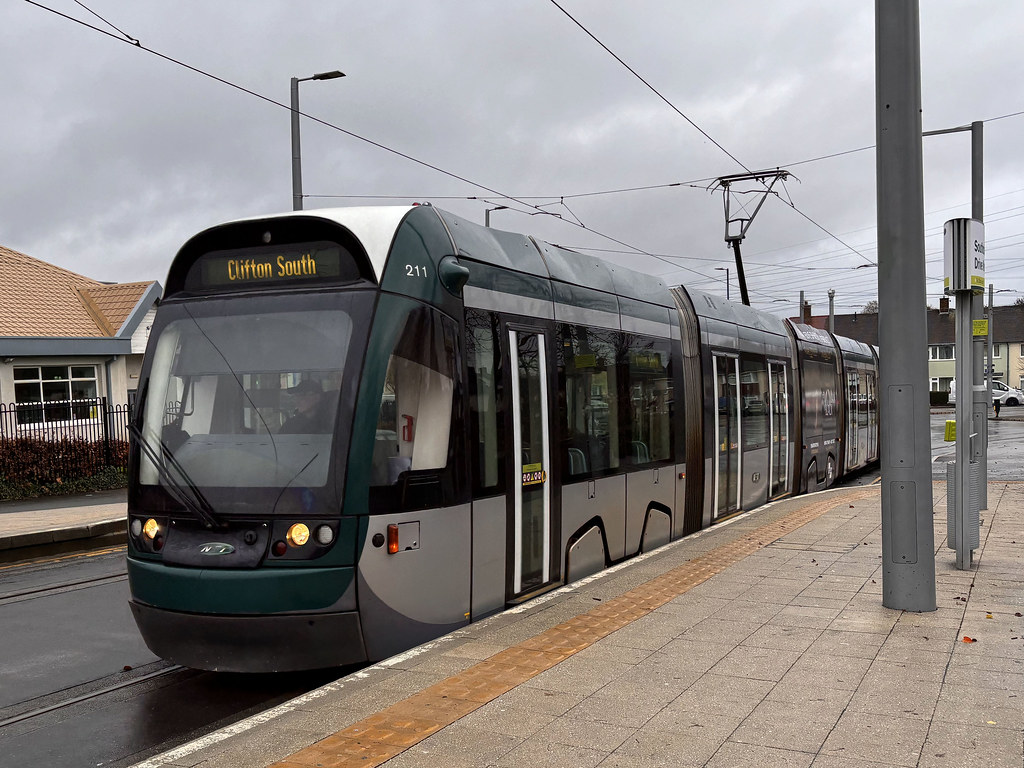
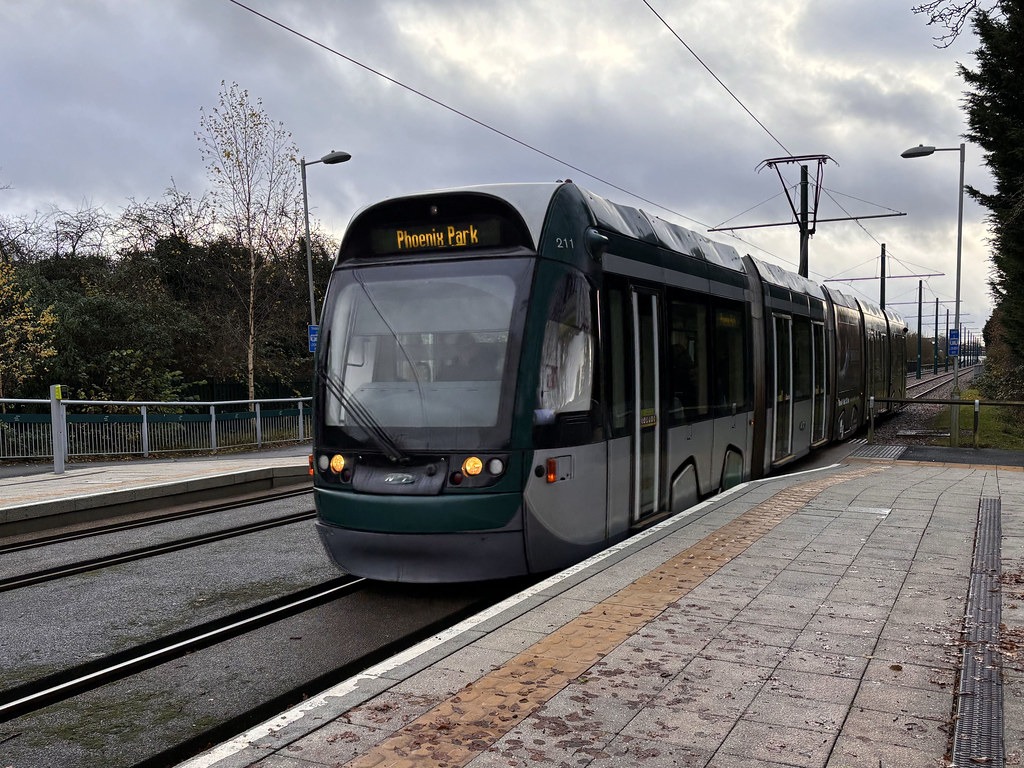
These trams were the first built for the Nottingham Express Transit (NET) metro which began operations in 2004. The trams are a variant of the Bombardier Incentro design, this was originally an ADtranz design but by the time production began Bombardier has taken ADtranz over.

Tram 211 at Southchurch Drive North


Information
Number built: 15
Built: 2002-3
Builder: Bombardier Derby
Motor: 8 Bombardier asynchronous electric motors (750v DC OHLE)
Power: 480 hp (360 kW) 

The trams have five short articulated sections. The trams were refurbished in 2012-13 and have been supplemented by a fleet of Alstrom Citalis trams as the NET has expanded.

204 at Nottingham Station

Behind one of the driver cabs

214 at Compton Acres

In the other direction, 211 arrives at Compton Acres

211 stands at Nottingham Station


Class 345 Elizabeth Line Aventra

The Class 345 is the rolling stock built for the Elizabeth Line, a major new railway project originally known as Crossrail - as it crosses London - which finally opened in 2022. The Class 345 was the first of the Bombardier Aventra family of electric multiple units to enter service on the network.

345 040 at Abbey Wood


Information
Number built: 630 (70 9-car sets)
Built: 2015-19
Builder: Bombardier Derby
Motor: Bombardier traction system (25kV AC OHLE)

No Class 341 was built but
it did appear on a carrier bag!

The Elizabeth Line (Crossrail) is a 117 kilometre long line stretching from the west (as far as Reading) to the east (Shenfield) of London and serving major London stations such as London Paddington, London Liverpool Street and Canary Wharf. The line has a new deep level tunnel section through the centre of London. Unlike other deep level tunnels in London, the Crossrail tunnels are large enough for standard gauge trains and not tube sized stock. The Crossrail project was first mentioned in 1974 though no serious plans or proposals took place until the 1980s and early 1990s. If the project had begun under British Rail then the rolling stock could have been the Networker derived Class 341.

Finally, concrete proposals were formed up in the early 2000s with construction beginning in 2009, twenty one kilometres of new tunnels were needed under London. The Class 345 entered service in the Summer of 2017, operating under the TfL Rail brand until the Elizabeth Line was opened officially. 

The Class 345 is designed to be able to move a lot of people very quickly. The train is designed to be able to carry up to 1, 500 passengers at up to 140 km/h (90 mp/h).

Front end comparison at London Liverpool Street, 345 015 in the centre

Preparing to leave Custom House

In TfL Rail days, 345 007 at London Liverpool Street

Front end of 345 040

345 014 at Stratford


Class 170 Turbostar

The Class 170 Turbostar was one of the largest fleets of new generation diesel multiple units which was built post-privatisation. The Class 170 typically operates on regional and long-distance (cross country) services and is a development of the Class 168 Clubman diesel multiple unit [1]. Indeed later built 168s and 170s have a very close resemblance (some Class 170s have been re-classified as Class 168/3s). The follow-on Turbostar DMUs Classes 171 and 172 also look near identical, meaning the Turbostar "look" is a very common one on British rails.

ScotRail 170 403 at Nairn


Information
Number built: 331 (122 2 and 3-car sets)
Built: 1998-2005
Builder: ABB Derby / Bombardier Derby
Motor: MTU 6R 183TD13H diesel per car
Power: 1, 266 hp (945 kW) / 844 hp (630 kW)
Formation: Typically Driving Motor Standard Lavatory (DMSL)+Motor
Standard (MS)+Driving Motor Composite Lavatory (DMCL)
or DMSL+DMCL
(170/3): DMCL+Motor Standard Lavatory Restaurant Buffet
(MSLRB)+DMSL
(170/4): DMCL+MS+DMCL

The Class 170 is used throughout the rail network, operated by ScotRail, Cross Country, Transport for Wales and East Midlands Railway. Previous operators include South West Trains [2], West Midlands Railway, Hull Trains and First TransPennine Express.

There are a number of sub-classes though all share the same specification and equipment. The differences being in seating arrangements.

Cross Country 170 521 and friend at Melton Mowbray

Transport for Wales 170 203 at Gloucester

East Midlands Railway 170 419 passes through Spondon

Cross Country 170 116 at Beeston

EMR 170 417 approaches Barrow-upon-Soar


[1] Colin J Marsden, DMU and EMU Recognition Guide (Ian Allan, 2013) p. 154
[2] John Balmforth, South West Trains (Ian Allan, 2011) p. 58

Class 375 Electrostar

The Class 375 is part of the huge Electrostar family of electric multiple units built in the early 2000s to replace the likes of slap-door stock such as the Class 411 4-CEP on the ex-Southern region third rail DC routes [1]. Most of the Class 375 fleet is third-rail only, though the 375/6 sub-class also has provision for AC overhead electric collection. Twenty eight trainsets have been converted to the Class 377/3 sub-class. 
Southeastern 375 629 departs Headcorn


Information
Number built: 438 (10 3- and 102 4-car sets)
Built: 1999-2004
Builder: Adtranz/Bombardier
Engine: 6 or 4 Adtranz traction motors (750v DC third rail / 25kV AC OHLE)
Power: 375/3 : 1, 341 hp (1, 000 kW)
Other subclasses : 2, 012hp (1, 500kW)
Formation: 375/3 : Driving Motor Composite Open (DMCO)+Trailer Standard
Open (TSO)+DMCO
375/6 : DMCO+Motor Standard Open (MSO)+Pantograph
Trailer Standard Open (PTSO)+DMCO
Other subclasses : DMCO+MSO+TSO+DMCO

There are five sub-classes. As mentioned above, the 375/6 is dual-voltage with all others being DC third rail only, the 375/3 are 3-car sets with the other sub-classes all being 4-cars though space has been retained for a pantograph if needed in future.


The 375/9 are high-density sets for outer suburban services with the 375/7 and 375/8 being officially designated as express stock. All Class 375s serve with Southeastern and forms the backbone of their fleet. Southern also did operate the type at one stage though these 375s were converted to Class 377s.
375 603 at London Bridge


375 702 (and 376 023) at Sevenoaks

375 817 at Sevenoaks

375 815 at London Victoria

375 603 at London Victoria

[1] Colin J Marsden, DMU and EMU Recognition Guide (Ian Allan, 2013) p. 283

London Underground S7/S8 Stock

The S Stock fleet is a standard fleet of trains for London Underground's sub-surface lines, the order for just over 1, 400 cars is probably the biggest single order for rolling stock for a British railway [1]. S Stock has replaced A Stock on the Metropolitan Line, C Stock on the Circle and Hammersmith & City Lines and finally D Stock on the District Line in early 2017.
A District Line S7 at Eastcote


Information
Number built: 1, 403 (192 7 and 8 car sets)
Built: 2009-17
Builder: Bombardier Derby
Engine: Bombardier MITRAC traction system (750v DC fourth rail)
Formation: (S7) Driving Motor (DM)+Non Driving Motor (NDM)
+NDM+NDM+NDM+NDM+DM
(S8) DM+NDM+NDM+NDM+NDM+NDM+NDM+DM

There are two variants, the S7 which is a 7-car unit for the Circle, District and Hammersmith & City Lines and the 8-car S8 for the Metropolitan Line. The S8 also has some transverse seating while the S7 is all longitudinal. There are 133 S7 trains and 58 S8s. There is also a single S7+1 train which is an 8-car set but has all longitudinal seating. This could be used on the Metropolitan Line's future extension to Watford Junction if that ever happens. The S Stock has "walk-through" open gangways throughout the train to ease passenger movement, an insulated gate bipolar transistor (IGBT) traction system [2] and regenerative braking.


The S Stock is capable of Automatic Train Operation and this was phased in from 2018 depending on signalling upgrades which started with the Western end of the Hammersmith & City [4]. The S Stock entered service on the Metropolitan from 2010, the District, Circle and Hammersmith & City from 2013 [3]. All trains were in service by the end of 2017.
A Metropolitan S7 at Chalfont & Latimer

Aboard a Metropolitan Line train

At Chesham terminus of the Metropolitan Line

A District Line train at Ealing Common

A Hammersmith & City S7 at Hammersmith, the C Stock it replaced on the left


[1] Paul Moss, London Underground (Haynes, 2014) p. 174
[2] Piers Connor, The London Underground Electric Train (Crowood Press, 2015) p. 175
[3] Ben Muldoon, London Underground Rolling Stock Guide (Ian Allan, 2014) p. 21
[4] "D Stock bows out", Modern Railways (April 2017) p. 14

Class 377 Electrostar

The "Electrostar" Class 377 is the largest fleet of electric multiple unit (EMU)s built since rail privatisation in the late 1990s. The Class 377 was built to replace "slam door" stock, most notably 4-CIG and 4-VEP EMUs on commuter services around London and rural services in the South East [1].

Southern 377 327 at Leigh


The Class 377 usually operates off the former Southern Railway/Region 750v DC 3rd rail system though some have pantographs and can operate 25kV AC overhead lines for cross-London services and can venture up as far as Milton Keynes Central and St. Albans. Some Class 377s have been converted from the similar Class 375 as detailed below.

Information
Number built: 211 sets (plus 28 sets converted from Class 375)
Built: 2002-14
Builder: Bombardier Derby
Motor: 6 or 4 Bombardier traction motors
Power: 2, 120 hp (1, 500 kW) or 1, 341 hp (1, 000 kW)
Formation: Driving Motor Composite Open (DMCO)+Motor Second
Open (MSO)+Trailer Second Open (TSO)+DMCO

They are in service with Southern and Southeastern, having also been used by Thameslink. The fleet is split into a number of sub-classes with various detail changes and in a variety of train lengths as detailed below.

Sub-class Details
377/1 Original, third-rail DC 4-car operated by Southern
377/2 Dual voltage 4-car operated by Southern and Thameslink
377/3 Third rail DC 3-car units converted from Class 375s operated by Southern
377/4 Third rail DC 4-car operated by Southern
377/5 Dual voltage 4-car operated by Thameslink
377/6 Third rail DC 5-car operated by Southern
377/7 Dual voltage 5-car operated by Southern

As well as the Class 377 there are also similar EMUs in the Electrostar family including the Class 375 and 387.
377 316 at Reigate

377 327 at Tonbridge


Southern 377 622 at Clapham Junction

Southern 377 705 at Hemel Hempstead

Southern 377 161 at Portsmouth Harbour

[1] Colin J. Marsden, DMU and EMU Recognition Guide (Ian Allan, 2013) p. 288

Class 376 Electrostar

The Class 376 is part of the huge Electrostar family of electric multiple units built to replace life-expired slam door stock on the former Southern Region's third rail network. The Class 376 is based on the Class 375 though has a number of differences, most notably the lack of front gangway doors.
Southeastern 376 009 at Catford Bridge


Information
Number built: 180 (36 5-car sets)
Built: 2004-05
Builder: Bombardier
Engine: 8 Bombardier traction motors (750v DC third rail)
Power: 2, 682 hp (2, 000 kW)
Formation: Driving Motor Standard Open (DMSO)+Motor Standard Open
(MSO)+Trailer Standard Open (TSO)+MSO+DMSO

The Class 376 was designed for high-volume inner suburban routes between London and Kent [1]. The 376 has wider metro-style sliding doors to help speed up passenger loading and unloading (and thus reduce dwell times). All are currently operated by Southeastern.
376 009 at London Bridge


Southeastern 376 003 at London Cannon St

376 012 and 017 at Cannon St

Aboard a DMSO (376 007)

Southeastern 376 007 at New Cross

[1] Colin J Marsden, DMU and EMU Recognition Guide (Ian Allan, 2013) p. 285