The Class 165 "Network Turbo" was built for British Rail in the early 1990s to replace first generation diesel multiple units on Thames Valley and Chiltern route suburban services [1]. Seventy six 2-car and 3-car sets were built and all but one, which was destroyed in the Ladbroke Grove rail disaster, remain in service today with Chiltern Railways and Great Western Railway.
GWR 165 106 arrives at Reading West
Information
Number built:
144 (76 2- and 3-car sets)
Built:
1990-92
Builder:
BREL York
Engine:
Perkins 2006-TWH diesel (one per car)
Power:
700 / 1, 050 hp (520 / 780 kW)
Formations:
165/0: Driving Motor Standard Lavatory (DMSL)+ Motor Standard (MS)+Driving Motor Standard (DMS) or DMSL+DMS
165/1: Driving Motor Composite Lavatory (DMCL)+MS+DMS or DMCL+DMS
The Class 165 are two sub-classes. the 165/0 was originally built for Chiltern services on Network South East and remains on the same routes including services from London Marylebone to Birmingham, to Aylesbury and to Stratford-upon-Avon. Trip-cock equipment has been fitted to Chiltern units as they travel on London Underground track between Harrow-on-the-Hill and Amersham.
The 165/1 was built for services out of London Paddington along the Great Western main line. They are still in service on Thames Valley services to destinations such as Oxford and Banbury. They have bogie modifications to allow for a higher top speed (90 mp/h as opposed to 75 mp/h on the 165/0).
GWR 116 at Basingstoke
Chiltern 165 035 at Little Kimble
GWR 165 018 at Reigate
GWR 165 117 and friend at Oxford
Chiltern 165 011 at Haddenham & Thame Parkway
[1] Colin J Marsden, DMU and EMU Recogition Guide (Ian Allan, 2013) p. 149
The Class 508, part of the 1972 Standard PEP family like the Class 313 and 507, was built for the Merseyrail DC third rail network. However, as there was a desperate need for new stock on Southern Region in the late 1970s they served there initially until the new Class455 could be built [1].
Merseyrail 508 125 at Ellesmere Port
Information
Number built:
172 cars (as built 4-car sets later 3-car sets)
Built:
1979-80
Builder:
BREL York
Motor:
8 GEC G380AZ traction motors per unit (750v DC third rail)
Power:
880 hp (657 kW)
Formation:
As built: Driving Motor Standard Open (DMSO)+Trailer Standard Open (TSO)+TSO+Battery Driving Motor Standard Open (BDMSO) Later: DMSO+TSO+BDMSO
Not all sets went North, some remained in the South East as Class508/2 though none of these are still in service. In the early 2000s three sets worked alongside the Class 313 on the London Euston-Watford route [3] as Class 508/3 but in recent years the only 508s in service have been the twenty seven Class 508/1s sets operated by Merseyrail on it's DC third rail network alongside the Class 507.
Merseyrail replaced them with the new Class 777[4] though there were delays in introducing the new units, the Class 508 finally left service at the start of 2024. Some ex-Class 508 cars do still exist, having been part of strengthened Class 455/7 formations since the 1980s.
508 130 at New Brighton
508 108 at Bank Hall
508 103 at Liverpool Lime Street Low Level
Aboard 508 123
508 120 at Hooton
[1] Brian Haresnape & Alec Swain, Third Rail DC Electric Multiple Units (Ian Allan, 1989) p. 74 [2] Bruce Oliver, Southern EMUs Before Privatisation (Ian Allan, 2010) p. 86 [3] Colin J Marsden, DMU and EMU Recognition Guide (Ian Allan, 2013) p. 389 [4] "Five shortlisted for new Merseyrail trains", Today's Railways UK No. 171 (March 2016)
The Class 319 are electric multiple units (EMUs) which were built for "Thameslink" cross-London services in the late 1980s. As they were dual voltage (AC overhead and DC third rail) units so they could operate both north and south of the river Thames [1]. The 319 was based on theClass 317 EMU though had a modified front end without a gangway connection, it retained a door for emergency evacuation in the tunnels which they had to travel through when crossing under London.
Northern 319 375 at Rainhill
Information
Number built:
344 (86 4-car sets)
Built:
1987-90
Builder:
BREL York
Engine:
4 GEC G315BZ traction motors (750V DC third rail or 25kV AC OHLE)
Power:
1, 327 hp (990 kW)
Formation:
319/0: Driving Trailer Standard Open (DTSO)+Motor Standard Open (MSO)+Trailer Standard Open Lavatory (TSOL)+DTSO 319/1: Driving Trailer Composite Open (DTCO) +MSO+TSOL+DTSO
The class was built in two batches, 319/0 and 319/1, which had some first class accommodation plus an improved pantograph. During their long career there have been a number of changes to the fleet. In the 1990s some 319/0s were converted to 319/2 standard with low-density seating and a disabled toilet for London Victoria services through to Brighton. A number of 319/1s have also had their first class seating removed during refurbishment to become 319/3. Some 319/0s have also had first class seating added and a lower density seating arrangement for Bedford-Brighton services as 319/4.
A feature unique to the 319s was an area behind one of the cabs was fitted with fold down seats and made securable with a lockable door in order to carry mail [2]. This area was removed during refurbishment and the ceasing of transporting mail by train.
Class 319s were replaced on Thameslink services by the Class 700[3]. However, there was life remaining in these units and a number were cascaded to the North West (Northern) and South Midlands (London Northwestern Railway). These units have probably finally now reached the end of their service lives with the LNWR 319s leaving service in late 2023 and the Northern units in early 2024.
Work also went ahead to give some of the units a new life as electro-diesel or bi-mode multiple units. A bi-mode version of the 319 called the 319 Flex (Class 769) has been developed by Brush and Porterbrook. Diesel engines and alternators are carried under the driving cars and these feed the unit's traction motors with the electricity needed when away from third rail or overhead lines. Although the project has been much delayed due to technical difficulties and unreliability, the Class 769 entered passenger service with Northern in May 2021 and Transport for Wales in November 2020 though originally the planned service date was 2018 [4][5]. The GWR was also at one stage to use the type on the North Downs Line, though these have not entered service.
Another new role for the Class 319 is for parcels traffic operated by Orion Logistics. A bi-mode version of this has also been created as the Class 768. A Class 319 has also been converted to hydrogen operation as the Class 799!
One notable event in the life of the 319s came in 1994 when 319 008 and 319 009 became the first trains to carry passengers through the Channel Tunnel [6].
LNWR 319 457 at Milton Keynes Central
Northern 319 374 at Huyton
319 364 at Liverpool Lime Street
319 436 in Thameslink livery at Farringdon
Northern 319 368 at Manchester Piccadilly
[1] Brian Haresnape & Alec Swain, Third Rail DC Electric Multiple Units (Ian Allan, 1989) p. 85 [2] Colin J. Marsden, DMU and EMU Recognition Guide (Ian Allan, 2013) p. 251 [3] "Class 700s Branch Out", Railways Illustrated No. 161 (July 2016) [4] "B-Mode Class 319 Flex from Porterbrook", Railways Illustrated No. 169 (March 2017) [5] "Northern to get bi-modes", Modern Railways (February 2017) [6] Southern E-Group: Class 319 <http://www.semgonline.com/gallery/class319_01.html>
In the late 1970s British Rail was faced with a rather large problem. Much of the 1950-60s built first generation diesel multiple unit (DMU) fleet would reach the end of their operational lives in the 1980s. British Rail explored a number of different options for possible replacements including the Class 210 diesel electric multiple unit prototype which was regarded as an excellent train but too pricy [1]. In the end BR went for an update of the kind of mechanical transmission DMU form they were used to.
Northern 150 270 (operating for TfW) departing Wrexham General
The Class 150 Sprinter was designed to revitalise the DMU fleet and remains in service today mainly in the South West and North of England and Wales. The Class 150 had a rival in the Metro-Cammell built Class 151 [2] (and indeed made use of some work Metro-Cammell had already done on next generation DMUs) but following an extensive series of tests the 150 proved to be the more popular with BR (the fact the 151 was late didn't help matters), series production was given the go-ahead [3]. One of the 150 prototypes was fitted with the transmission from the 151 for tests, this was re-designated the Class 154 [4] though it has now been reverted to a standard 150.
Information
Number built:
276 (137 2 and 3-car sets)
Built:
1984-87
Builder:
BREL York
Engine:
Cummins NT855R4/5 diesel per vehicle
Power:
855 hp (639 kW) / 570 hp (426 kW)
Formations:
Driving Motor Standard Lavatory (DMSL)+Motor Standard (MS)+
Driving Motor Standard (DMS) (150/0)
DMSL+DMS (150/1 and /2)
The Class 150 was built in either two or three car sets, most 150s in service these days apart from the prototypes are two car though for a time some 150/1s were in three car formations [5].
The original 150/0 prototypes remain in service, the main difference with serial production 150s is that they have smaller fuel tanks and that they are three car sets. The initial series production version was the 150/1 with the 150/2 having front-end gangways. There was also for a time a small 150/9 sub-class in service with GWR which were hybrid 3-car sets with a driving car as the centre car. The Class 150 is currently in service with GWR, Transport for Wales and Northern.
An extra two-car set was built for British Rail as the Class 950 Track Recording Unit which apart from body modifications for various test equipment is mechanically the same as the rest of the Class 150 fleet.
Back when operating for London Midland, 150 109 at Bedford
Northern 150 218 at York
Northern 150 103 at York
Transport for Wales 150 240 at Wem
Northern 150 143 at Greenbank
[1] Brian Haresnape, Diesel Multiple Units - the second generation and DEMUs (Ian Allan, 1986) p. 54 [2] Colin J. Marsden (ed.), "BREL Class 150 Sprinter", Modern Locomotives Illustrated No. 211 February-March 2015 (Classes 150-156 Second Generation DMUs), p. 4 [3] Colin J. Marsden, DMU and EMU Recognition Guide (Ian Allan, 2013), p. 128 [4] Modern Locomotives Illustrated 211, p. 13 [5] Marsden, DMU and EMU Recognition Guide, p. 128
The Class 315 was built in the early 1980s for the modernisation of the Great Eastern suburban lines out of London Liverpool Street replacing the Class 306 [1]. They remain in service on services to Shenfield though the end of their time is fast approaching. They were the last EMUs built of the 1972 PEP standard design and share a lot of similarities with the likes of the Class 313 and 507.
TfL Rail 315 843 at Stratford
Information
Number built:
244 (61 4-car sets)
Built:
1980-81
Builder:
BREL York
Engine:
8 Brush TM61-53 or 8 GEC G310AZ traction motors (25kV AC OHLE)
Power:
880 hp (657 kW)
Formation:
Driving Motor Standard Open (DMSO)+Trailer Standard Open (TSO)+ Pantograph Trailer Standard Open (PTSO)+DMSO
Twenty of the Class 315s had GEC traction motors and the rest Brush from new, however the traction motors are pretty interchangeable and nowadays a mixture can be found on a given unit. The Class 315s began life in British Rail blue and grey before being repainted in Network South East livery.
Following privatisation they have worn Greater Anglia and NXEA liveries but currently are operated by London Overground and TFL Rail. They will be replaced on these services by Class 345s and will be likely scrapped despite being refurbished in the mid-2000s [2].
In Greater Anglia days 315 822 at Cambridge Heath
315 828 and three friends at London Liverpool Street
315 859 at Stratford
[1] Alec Swain, Overhead Line Electric Multiple Units (Ian Allan, 1990) p. 66 [2] Colin J. Marsden, DMU and EMU Recognition Guide (Ian Allan, 2013) p. 240
The Class 465 was built in the early 1990s to replace ageing Mark 1 based EMUs such as the Class 415 on Kent suburban routes [1]. The replacement of this old stock was seen as a priority in the late 1980s by the then-new Network South East sector of British Rail [2]. The new fleet of EMUs thus became known as the Networkers. The introduction of the Class 465, and the 2-car fleet of Class 466s, bought with it driver only operation, more spacious interiors and rapid acceleration compared to the 1950s build EMUs they replaced [3].
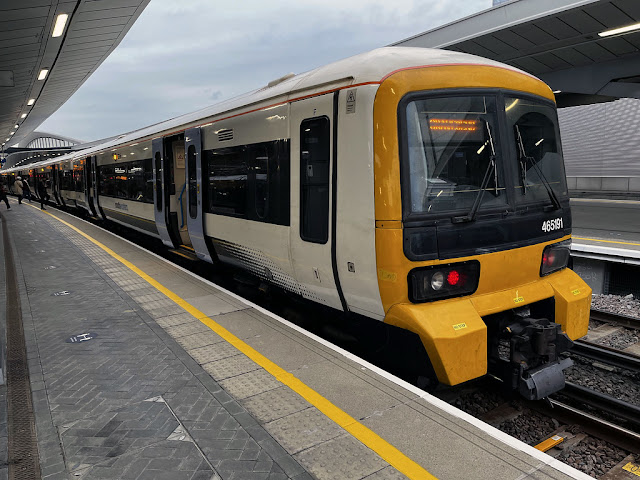
465 191 at London Bridge
Information
Number built:
588 (147 4-car sets)
Built:
1991-93
Builder:
ABB/BREL York (465/0 and 465/1)
Metro-Cammell (465/2 and 465/9)
Engine:
Hitachi TIM2093A (465/0 and 465/1)
Alsthom G352AY (465/2)
Alsthom G352BY (465/9) (750v DC third rail)
Power:
3, 004 hp (2, 240 kW)
Power:
(465/0, 465/1 and 465/2) Driving Motor Standard Open (DMSO)+Trailer Standard Open (TSO)+Trailer Standard Open Lavatory (TSOL)+DMSO (465/9) Driving Motor Composite Open (DMCO)+TSO+ TSOL+DMCO
In 2005 thirty four 465/2s were rebuilt for longer routes and had first class seats added to the two driving cars, these became 465/9. The original Brush traction motors on the 465/0 and 465/1 were replaced with Hitachi equipment in 2009 to improve reliability.
All Class 465s were delivered in Network South East livery. Following privatisation they wore Connex South Eastern and latterly Southeastern Trains colours. Currently all are still operated by Southeastern.
465 019 passes New Cross
Aboard a 465
465 006 arrives at London Bridge
465 172 at Lower Sydenham
465 188 at London Victoria
[1] Colin J Marsden (ed.) "The Networker Family", Modern Locomotives Illustrated No. 233 February-March 2017 (Networker, Juniper & Javelin Stock) p. 4 [2] Bruce Oliver, British Railway Southern Region Electrics in Colour (Ian Allan, 2008) p. 13 [3] Colin J Marsden, DMU and EMU Recognition Guide (Ian Allan, 2013) p. 361
The Class 322 was a variation of the Class 321 built for the Stansted Express between London Liverpool Street and Stansted Airport. The chief difference between the 322 and the 321 is that the former has a larger first class seating area in the DTCO with different windows. They were fitted with low density seating and given extra luggage space [1]. The Class 322 was the last class of electric multiple unit to be based on the Mark 3 coach.
Greater Anglia 322 482 at Stratford
Information
Number built:
20 (5 4-car sets)
Built:
1990
Builder:
BREL York
Motor:
4 Brush TM2141C traction motors (25kV AC OHLE)
Power:
1, 438 hp (1, 072 kW)
Formation:
Driving Trailer Composite Open (DTCO)+Trailer Standard Open Lavatory (TSOL)+Motor Standard
Open (MSO)+ Driving Trailer Standard Open (DTSO)
Following their replacement on Stansted Express duties, the Class 322 has seen work elsewhere including in Scotland, with Northern Rail and currently with Greater Anglia. However, they are due to replaced by the Class 720.
[1] Colin J Marsden, DMU and EMU Recognition Guide (Ian Allan, 2013) p. 260
The Class 456 was built to replace the Class 416 2-EPB and to give operational flexibility to Network South East [1]. The two car trains allow for reinforcement of services and a variety of train lengths. They are usually seen working in multiple with Class 455s.
SWR 456 010 at Guildford
Information
Number built:
48 (24 2-car sets)
Built:
1990-91
Builder:
BREL York
Engine:
2 GEC507-20J traction motors (750v DC third rail)
Power:
500 hp (370 kW)
Formation:
Driving Motor Standard Open (DMSO)+Driving Trailer Standard Open (DTSO)
The Class 456 share the same front end design as the Classes 320 and 321 though with nose mounted control and air connections for multiple use with 455s. They were introduced into the Southern division of Network South East and eventually settled down after a period of technical and reliability problems.
The Class 456s were delivered in Network South East livery [2]. Following privatisation they were operated by Connex South Central later Southern. In 2014 the fleet transferred to South West Trains to strengthen London commuter services and are now operated by South Western Railway. They are due to be replaced by the Class 701 within the next couple of years.
SWT 456 012 at Guildford
Coupled up to a Class 455 (left) - notice the different profiles
Another view of 456 012 at Guildford
456 012 arrives at Guildford with a 455
[1] Colin J Marsden, DMU and EMU Recognition Guide (Ian Allan, 2013) p. 354 [2] Bruce Oliver, Southern EMUs Before Privatisation (Ian Allan, 2010) p. 95
The Class 312 Electric Multiple Unit was based on the earlier Class 310 and built for the Great Northern Line from London Kings Cross to Royston, the Great Eastern and also four sets for the West Coast Main Line [1]. The Class 312 was the last Mark 2 based EMU to be built by British Rail. It was also the last new build with slam doors to be built.
Battery Driving Trailer Standard Open Lavatory (BDTSOL)+
Motor Brake Standard Open (MBSO)+Trailer Standard Open (TSO)+Driving Trailer Composite Open Lavatory (DTCOL)
Twenty six sets were initially allocated to the Great Northern as 312/0 but they were transferred to the Great Eastern due to their unsuitability for driver only operation [2]. Sets for Great Eastern London Liverpool Street services were fitted for dual voltage (6.25 as well as 25 kV AC) as 312/1. The WCML sets (312/2) were restricted to 75mp/h running so they could run in multiple with the Class 310. When they were later transferred to join the rest of the fleet on the Great Eastern the speed restriction was removed.
By the end of the 1980s the fleet was concentrated on the Great Eastern and London, Tilbury & Southend Railway. In the privatised era some returned to the WCML and were operated by Central Trains, the rest were operated by c2c, First Great Eastern and LTS Rail.
At the turn of the century they were gradually withdrawn from service with the last being withdrawn in 2004, the fact they were Mark 2 based and having slam doors meaning they had shorter lives than some EMUs have had. Two cars have been preserved.
The other preserved car 71205
[1] Colin J Marsden, DMU and EMU Recognition Guide (Ian Allan, 2013) p. 232 [2] Alec Swain, Overhead Line Electric Multiple Units (Ian Allan, 1990) p. 59
The Class 321 was built for Network South East for services out of London Liverpool Street into Essex along the Great Eastern Main Line. A second batch was built for semi-fast services between London Eustonand Birmingham New Streeton the West Coast Main Line [1]. A third and final batch was built for West Yorkshire PTE services between Doncaster and York. Two sister classes were also built, the Class 320 for services in the Strathclyde area and the Class 322 for the Stansted Express [2]. The DC EMU Class 456 also has a similar appearance.
321 408 heads off Colchester bound
Following the negative reaction in some quarters to earlier EMUs built in the 1980s the Class 321 had a deal of attention paid to its external appearance with the aim to produce a train "eye catching" on the outside and comfortable on the inside [3].
Information
Number built:
468 (117 4-car units)
Built:
1988-90
Builder:
BREL York
Motor:
4 Brush TM2141B traction motors (25kV AC OHLE)
Power:
1, 438 hp (1, 072 kW)
Formation:
(321/3) Driving Trailer Composite Open (DTCO)+Motor Standard
Open (MSO)+Trailer Standard Open Lavatory (TSOL)+
Driving Trailer Standard Open (DTSO)
The original NSE batch became known as the 321/3 with the London Midland batch the 321/4 (theese haved more first class seats than the 321/3s [4]). The Yorkshire units were designated 321/9, unlike the other sub-classes these units did not have first class seating and so had 2 DTSOs instead of a DTCO and a DTSO.
The Class 321 is now only still in service with Greater Anglia on the Great Eastern route, thirty of the units receiving a "Renatus" refurbishment and upgrade which included new air conditioning, seating and wi-fi. However, despite the upgrade Greater Anglia are replacing the Class 321 with the Class 720.
Some Class 321s are to be converted for hydrogen fuelled operation and will be known as the Class 600.
Greater Anglia 321 434 and 339 at London Liverpool Street
Inside a Greater Anglia 321
Greater Anglia (but in Great Northern livery) 321 408 at Romford
Renatus refurbished 321 at Southend Victoria
Greater Anglia 321 339 at Stratford
[1] Colin J Marsden, DMU and EMU Recognition Guide (Ian Allan, 2013) p. 256 [2] David Lawrence, British Rail Designed 1948-97 (Ian Allan, 2016) p. 236 [3] Alec Swain, Overhead Line Electric Multiple Units (Ian Allan, 1990) p. 76 [4] John Glover, Eastern Electric (Ian Allan, 2001) p. 131
The Class 166 "Networker Turbo Express" was built alongside its DMU sister class the Class 165 for longer distance routes between London Paddington, Oxford and Newbury. The Class 166 is very similar to the 165 but has a more luxurious interior including first class seating, two toilets, carpeted flooring, air conditioning and more luggage space [1]. They are capable of one hundred and forty five kp/h unlike some 165s which are limited to one hundred and twenty kp/h.
GWR 166 219 at Cheltenham Spa
Information
Number built:
63 (21 3-car units)
Built:
1992-93
Builder:
BREL York
Motor:
Perkins 2006TWH diesel per car
Power:
1, 050 hp (780 kW)
Formation:
Driving Motor Composite Lavatory (DMCL)+Motor Standard Open (MSO)+Driving Motor Standard Lavatory (DMSL)
They were originally operated by Network South East, all 166s are now operated by Great Western Railway (formerly First Great Western).
Originally both driving cars had first class accommodation but in 2014 one DMCL was declassified in order to increase the overall capacity [2].
GWR 166 202 at Oxford in First Great Western livery
GWR 166 215 at Ealing Broadway
GWR 166 218 at Reading
GWR 166 219 at Cheltenham Spa
GWR 166 203 at Dorking Deepdene
[1] Colin J. Marsden, DMU and EMU Recognition Guide (Ian Allan, 2013) p. 152 [2] Colin J. Marsden (ed.), "Class 166 'Networker Express'", Modern Locomotives Illustrated No. 216 December 2015-January 2016 (Second Generation DMUs Classes 165-185). p. 14