Showing posts with label Hunslet Engine Company. Show all posts

Hunslet Engine Company 8975

Hunslet 8975 is typical of the kind of narrow gauge diesel shunters which were built for colliery use by the Hunslet Engine Company in the late 1970s. The diesel-hydraulic locomotive worked at the 762mm gauge surface stockyard at Parkside Colliery, Newton-le-Willows and was withdrawn in 1993 with the closure of the colliery.
8675 at the Statfold Barn Railway


Information
Number built: 1
Built: 1979
Builder: Hunslet Engine Company
Motor: Perkins 4-cyl diesel
Power: 52 hp / 39 kW
Wheel arrangement: 4wDH

The locomotive was preserved at the Lancashire Mining Museum at Astley Green and has helped with the building of a line at the museum, and now hauls passenger trains. During preservation it has been converted to 610mm gauge at the Statfold Barn Railway.
The locomotive carries the name Newton

Another view of 8975


Hunslet 1697 (LMS 7051)

In 1932 the Hunslet Engine Company built a small diesel-mechanical shunter as a demonstrator. It was unveiled at the British Industries Fair in that year and for a time worked at the colliery. It was given a trial by the LMS in 1933. They liked it so much they bought it a few months later! The shunter, given the LMS number 7051, had an eventful life. It was loaned to the War Department in 1940. After the war it was sold back to Hunslet who used it as a works shunter and was hired out to industry. Since 1960 the shunter has been preserved by the Middleton Railway.
The shunter's early days on the Middleton Railway [1]


Information
Number built: 1
Built: 1932
Builder: Hunslet Engine Company
Motor: (original) MAN WV16/22 diesel
Power: 150 hp (112 kW)
Wheel Arrangement: 0-6-0DM

The shunter has a four speed pre-selector gearbox. The original MAN diesel was replaced by a 132 hp (98 kW) McLaren Ricardo MR6.

[1] Arthur Gaunt, The World's Oldest Railway (Meccano Magazine November 1963) p. 451

Hunslet Engine Company 9409-9429 (Channel Tunnel)

Many locomotives were required for the construction of the Channel Tunnel, one of the largest engineering projects in history. The Hunslet Engine Company built these narrow gauge (900mm) electric locomotives for hauling spoil trains during the construction.
RA36 (9423/1990) now preserved at NRM York


Information
Number built: 20
Built: 1989-90
Builder: Hunslet Electric Company
Motor: Electric motors (battery or OHLE)
Wheel arrangemnt: 4wBE/WE

Twenty locomotives were built. They could operate by getting their electricity from overhead lines or using their own batteries.
Another view of RA36


Hudson Hunslet RNAD Broughton Moor Shunters

Royal Naval Armaments Depot (RNAD) Broughton Moor in Cumbria had an extensive railway network, including an internal system in 762mm gauge. These four shunters were amongst those operated at the depot and were built in 1939.
HH 2019 preserved at the Statfold Barn Railway


Information
Number built: 4
Built: 1939
Builder: Hunslet for Robert Hudson
Motor: Ailsa Craig CF2 diesel
Power: 50 hp (37 kW)
Wheel arrangement: 0-4-0DM

The diesel shunters had diesel mechanical transmission and were flameproof (obviously due to the presence of explosives and combustible materials!) The railway system was closed down in 1932 and the remaining railway stock (standard and narrow gauge sold off).
Cab view of 2019, the maker's plate can also be seen

Rear view of 2019


Hunslet Engine Company 9321-9338

Hunslet built these 610mm gauge locomotives, to the Jenbach DH25 design, for export to Singapore in the mid-1990s. They were operated by the Jan-Pan hire fleet. Some worked in the UK on the Jubilee Line Extension before heading back out to Singapore.
9332 at Statfold Barn

Information
Number built: 18
Built: 1994
Builder: Hunslet Engine Company
Motor: Kubota diesel
Wheel arrangement: 4wDH

A number have now returned to the UK and can be found on preserved narrow gauge lines such as Statfold Barn and Fairbourne. Some of the preserved locomotives have been regauged and fitted with enclosed cabs [1].
9332 is as built with an open cab

9332 wears SBR livery

[1] Royston Morris, Miniature Railway Locomotives & Rolling Stock (Amberley, 2018) p. 78

Hudson Hunslet 4wDM Shunters

Robert Hudson began producing narrow gauge locomotives for industrial use in 1911, at first steam locomotives in partnership with Hudswell Clarke. Later locomotives with internal combustion engines were built, these in partnership with the likes of Kerr Stuart. From 1937 Hudson went into partnership with the Hunslet Engine Company and the locomotives began to carry a Hudson Hunslet badge. These were simple locomotives usually powered by a 20 hp/15 kW) Alisa Craig diesel with chain drive.
Hudson Hunslet 3621 (1947) at the Statfold Barn Railway

Information for typical Hudson Hunslet 4wDM
Builder: Robert Hudson / Hunslet Engine Company
Motor: Alisa Craig CF2 diesel
Power: 20 hp (15 kW)
Wheel arrangement: 4wDM

The locomotives were simple in design without any enclosed cabs though there were options to add these if the customer required. Later versions, built in the 1950s, had more powerful engines, up to 50 hp (37 kW) and were slightly more refined in design though largely unchanged. A number of these shunters have been preserved both in the UK and abroad.
Atlas, Hudson Hunslet 2463 (1944) served with the MOD at Long Marston

Cab of Atlas

Another view of 3621

Rear view of Atlas, both this and 3621 are 610mm gauge locomotives

Hunslet Engine Company NCB 4wDH shunters

The Hunslet Engine Company built a number of small narrow gauge diesel hydraulic shunters in the late 1970s and early 1980s for use by the National Coal Board at pits across the country.
HE8819 at the Statfold Barn Railway

Information
Builder: Hunslet Engine Company
Motor: Diesel
Wheel arrangement: 4wDH

HE8819 is an example of one of these shunters. It was built in 1979 and used at Nantgarw Colliery in Wales, running on the 914mm gauge network there. Now it is preserved at the Statfold Barn Railway and has been re-gauged to 610mm.

Another preserved example is HE8812, built in 1978 it also worked in Wales at Cefn Coed Colliery it has now been restored to operational condition at the museum built on the Cefn Coed site [1]. Also preserved is HE8816 which worked at Killoch Colliery in Scotland and is now preserved by the Ayrshire Railway Preservation Group [2].
Another view of HE8819

[1] Industrial Railway Society, Industrial Loocomotives (18th Edition) (Industrial Railway Society, 2019) p. 293
[2] Ibid. p. 259

Post Office Railway 1980 Stock

The Post Office Railway operated under the streets of London linking London Paddington and London Liverpool Street with Royal Mail sorting offices. Unmanned electric trains, consisting of two motor units either end of post carrying compartments, carried post under London from 1927 until the network was shut down in 2003 [1]. The 1980 Stock was built to replace older trains built by English Electric in the 1930s.
A preserved 1980 Stock train at the Postal Museum

Information
Number built: 34
Built: 1980-82
Builder: Greenwood & Batley, Hunslet Engine Company
Motor: English Electric (440v DC third rail)
Power: 22 hp (16 kW)
Wheel arrangement: 2w-2-2-2wRE

The origin of the 1980 Stock goes back to the 1960s and two prototypes built as the 1962 Stock. These were updated versions of the 1930/1936 Stock with new motors for better acceleration, disc brakes and improvements for loading and unloading mail [2]. These prototypes were extensively tested though the decision to built a series fleet based on the prototypes did not come about until the late 1970s [3].

The new fleet was an updated version of the prototypes. An order was placed with Greenwood & Batley though the manufacturer went into administration in 1980 after just three were built. Hunslet Engine Company, who took over Greenwood & Batley, built the bulk of the fleet despite that the 1980 Stock are often referred to as Greenbats.

The 1980 Stock formed the backbone of the Post Office Railway (which was re-branded as Mail Rail) along with some 1930/1936 Stock until the system was shut down. Some 1980 Stock was fitted with aerodynamic covers to reduce air resistence in the tunnels.

A number of 1980 Stock trains have been officially preserved, it is thought the rest are also still extant stored on the Mail Rail network which is closed (apart from the Postal Museum tourist attraction at Mount Pleasant - a Museum Train now runs on some of the track) but mostly intact.
Number 30 at Mount Pleasant

The system was renamed Mail Rail in it's latter years

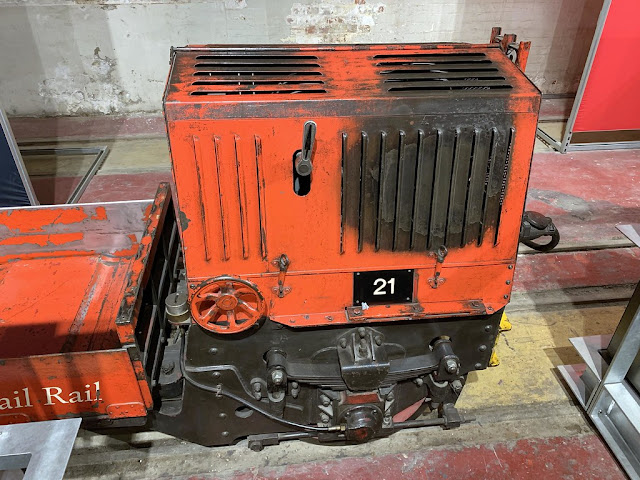
Side view of the motor compartment of 21

How the post was carried on the trains, the trollies transferred at stations

Number 30 at Mount Pleasant, dwarfed by the station tunnel

[1] Peter Johnson, Mail by Rail (Ian Allan, 1995) p. 115
[2] Mike Sullivan, Mail Rail (Red Shank Books, 2019) p. 24
[3] Johnson p. 122
Hunslet Engine Company 7010-7013 (MOD Lydd Ranges)

These four diesel-hydraulic shunters were built by the Hunslet Engine Company for use on the Ministry of Defence's Lydd Ranges in Kent replacing earlier Ruston & Hornsby locomotives [1]. The ranges had an extensive railway network (610mm gauge) and these locomotives were used to transport personnel and equipment.

Information
Number built: 4
Built: 1971 (rebuilds 1988)
Builder: Hunslet Engine Company, rebuilds Andrew Barclay
Motor: Diesel
Power: 40 hp (30 kW)
Wheel arrangement: 4wDH

Several of the locomotives were rebuilt by Andrew Barclay in 1988 (HE 7010 as HAB 6941 and HE 7012 as HAB 6014). They were withdrawn from use at Lydd in 2007. All four were sold into preservation at the Old Kiln Light Railway in Farnham, one was subsequently sold to the Statfold Barn Railway near Tamworth.
Hunslet 7010 rb Andrew Barclay 6941

Hunslet 7010 is at the Statfold Barn Light Railway where it carries the number 35

[1] Ian Dean, Andrew Neale and David Smith, Industrial Railways of the South-East (Middleton Press, 1984) Fig. 88

Hunslet Engine Company 9346-9351

These industrial narrow gauge shunters were the last locomotives built at the Hunslet Engine Company's Jack Lane Works. The works in Leeds had, since 1864, built thousands of steam and later diesel shunters mostly for industrial use. These final locomotives were built for the tunnelling of the Jubilee Line Extension project in East London. The Jack Lane Works closed in 1995.

Information
Number built: 6
Built: 1994
Builder: Hunslet Jack Lane Works
Motor: Deutz diesel
Power: 90 hp (67 kW)
Wheel arrangement: 4wDH

They were 4 wheel diesel hydraulic narrow gauge shunters to 610mm gauge. A couple have been preserved. 9347, named Peter Wood, is preserved at the Leighton Buzzard Light Railway as one of the line's diesel "thunderbirds" ready to take over if one of the steam locomotives has a problem, as well as perform other duties on the line. 9351 is preserved at the Statfold Barn Railway in original condition.
9351 at the Statfold Barn Railway

9347 Peter Wood at Stonehenge Works
The narrowness of the locomotive can be seen in this frontal view

Cab of 9351

Peter Wood is #81 in the Leighton Buzzard Light Railway fleet
Rear view of 9351

Class 05 (Hunslet Engine Co. 204hp Diesel-Mechanical)

The Class 05 was yet another type of small shunter built for British Railways in the late 1950s (the Class 05 designation was shared with the Andrew Barclay DJ14 class of 0-6-0DM shunter [1]). This Class 05 (also known as the DJ13, D2/8, 2/15A, D2/9 and 2/15 at various times) was built in two distinct batches, the second batch being somewhat larger with deeper bufferbeams and larger cab windows [2].

However all were withdrawn in 1966-68 along with hundreds of other surplus to requirements shunters except a couple which went into departmental service.

Information
Number built: 120
Built: 1955-61
Builder: Hunslet Engine Co.
Engine: Gardner CLP 8L3 diesel
Power: 204 hp (152 kW)
Wheel arrangement: 0-6-0

One of these was sent to the Isle of Wight to run engineering trains on the newly electrified Island Line. It arrived in 1966 and became the last survivor of the class on BR metals (and indeed any Hunslet loco) serving until 1984 and gaining TOPS numbers. It was replaced by a Class 03 following gearbox problems - though has been preserved by the Isle of Wight Steam Railway [3]. Four Class 05s in total have been preserved [4].
Two views of D2587 preserved at the Heritage Shunters Trust, Rowsley South


[1] Brian Haresnape, Diesel Shunters (Ian Allan, 1984) p. 50
[2] Haresnape p. 48
[3] R.J. Maycock & R. Silsbury, The Isle of Wight Railways from 1923 Onwards (Oakwood Press, 2006) p. 256
[4] Heritage Shunters Trust Stock List p. 8