The Class 69 is a rebuild of the Class 56 with an EMD 710 engine and updated controls and some equipment (similar to those used on the Class 66). GB Railfreight ordered the rebuilds from sixteen Class 56s they bought in 2018, some of which had been out of service for some time. Ten were rebuilt in the initial batch with an option for six more added later on.
The first Class 69 began trials on the Severn Valley Railway in early 2021. The locomotives began to enter service in 2022. The first seven locomotives were withdrawn from service in early 2023 to address some issues but following modifications were returned to service.
As well as GB Railfreight livery, a number of Class 69s have been completed in versions of heritage liveries.
69 010 on test at Derby, still in undercoat, later it was finished in GB Railfreight blue
69 005 approaches Kidderminster hauling two Class 73s
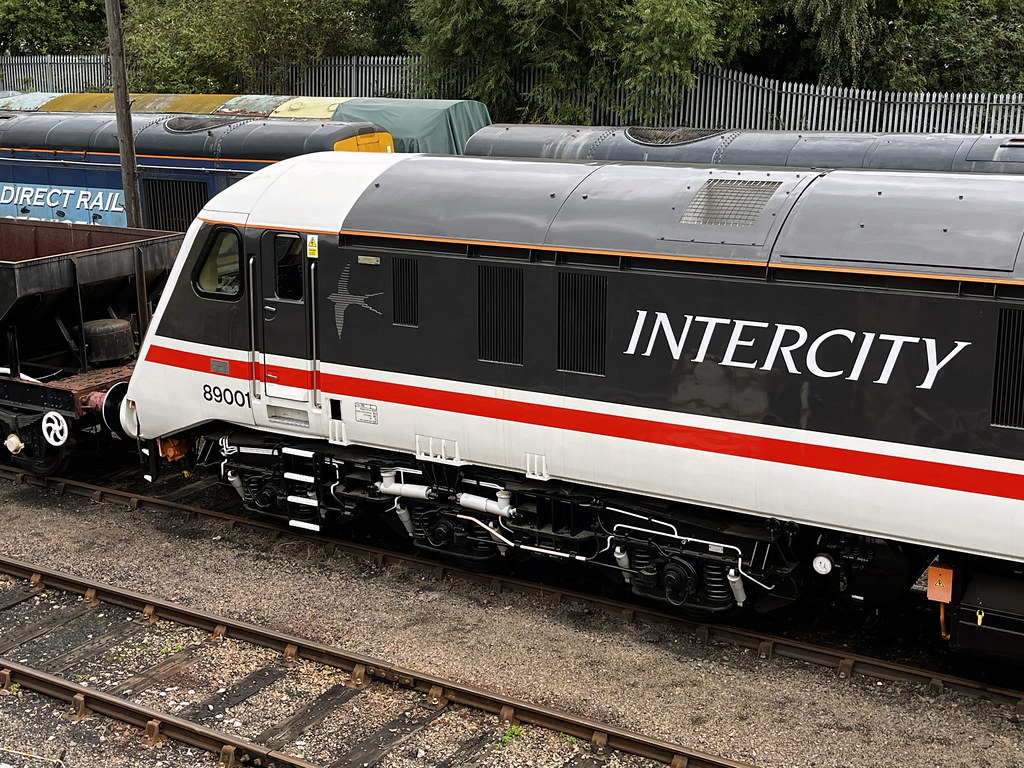
With new electrification of British Rail routes continuing in the 1980s, especially the East Coast Main Line (ECML), a new generation of electric locomotives would be required. The Class 89 was a prototype locomotive, with a Co-Co wheel arrangement unlike earlier AC electric locomotives which had all been Bo-Bos. The Class 89 was also fitted with advanced power control systems with a maximum power output of nearly 8,000 hp (and a continuous output of over 5, 748 hp). It is capable of travelling at 125 mp/h.
89 001 at Barrow Hill Roundhouse
Information
Number built:
1
Built:
1986
Builder:
BREL Crewe / Brush Traction
Motor:
6 Brush TM2201A traction motors (25kV AC OHLE)
Power:
5, 748 hp (4, 286 kW)
Wheel arrangement:
Co-Co
The locomotive was designed by Brush Traction and built by BREL Crewe in 1986. Early in the programme the Class 89 was considered as potential traction for the East Coast Main Line [1] and an eventual fleet of 33 to be built though by the time the Class 89 was built the specification for the ECML had changed (to be filled by the Class 91) and only one Class 89 ended up being built.
The Class 89 was used on test trains on both the West Coast Main Line and ECML in the late 1980s. Operations continued until 1992 when the locomotive suffered a serious failure, it was withdrawn by BR as being surplus to requirements (by then) and non-standard [2].
The Class 89 was saved by the privatising railway in 1996. The new operator on the ECML, Great North East Railway bought it back into service [3] and paid for an overhaul to help cover a shortage of motive power at the time. The Class 89 was withdrawn due to another failure in 2000 and again surplus to requirements. The locomotive was purchased for preservation in 2006, after a long overhaul and refurbishment it is planned for the Class 89 to return to the mainline for charter work.
89 001 front profile
89 001 wears Intercity swallow livery
Another photograph of 89 001
[1] Brian Haresnape, Electric Locomotives (Ian Allan, 1983) p. 20
[2] Gavin Morrison, AC Electric Locomotives (Ian Allan, 2013) p. 57
[3] Colin J. Marsden, Diesel & Electric Locomotive Guide (Ian Allan, 2011) p. 234
The High Speed Train (HST), powered by a Class 43 powercar at either end of the train, is arguably the most successful diesel powered high speed train in the world. The HST bought 125mp/h speeds to British Rail Inter City expresses in the late 1970s, helping to revitalise long-distance rail travel when it was at a low ebb. Indeed, it is not an exaggeration to say the HST changed the face of rail travel in the UK once and for all and helped stem a seemingly unstoppable decline. The futuristic streamlined shape of the power cars (which can surely be considered a British design classic) quickly became the face of BR publicity [1]. The HST was an instant hit with the public with passenger numbers on the HST services rising by fifteen percent within the first two months of operation. The HST still holds the official speed record for a diesel hauled passenger train of 148 mp/h.
43 185 in Intercity livery (operated by GWR) at London Paddington
Information
Number built:
197
Built:
1976-82
Builder:
BREL Crewe
Refurbished by Brush Traction (2006-9)
Engine:
(Original) Paxman Valenta 12RP200L diesel
(Refurbished) Paxman 12VP185 or MTU 16V4000 R41R diesels
Power:
(Valenta) 2, 250 hp (1, 678 kW)
(12VP185) 2, 100 hp (1, 565 kW)
(MTU) 2, 250 hp (1, 676 kW)
Wheel arrangement:
Bo-Bo
The Intercity 125 High Speed Train was introduced in October 1976 [2] following trials earlier in the decade with the prototype HST Class 41/252. Originally, the HST was designated a diesel electric multiple unit with units allocated to Western Region numbered Class 253 and those on Eastern Region Class 254.
However, in the 1980s the power cars were allocated the TOPS number Class 43 (the original Class 43 was the "Warship" diesel-hydraulic locomotive), they are after all proper locomotives capable of independent operation (though this is fairly rare in practice), the Mark 3 coaches they haul/propel differ from loco-hauled Mark 3s with different electric systems and a lack of buffers and can only work properly with Class 43s. The Class 43 only has a driving cab at the streamlined end, the prototype Class 41 also had auxiliary cab controls for shunting at the other end but this was not continued with the production power cars.
Ironically, the HST only came about because of a lack of funds for electrification of more main line routes after the completion of the West Coast Main Line [3]. The HST was devised as a stop-gap... that has so far lasted over forty years! Although they have been slowly replaced from some of their original routes they have been cascaded onto other routes and should continue to serve well into the 2020s. In the mid to late 2000s the fleet was heavily refurbished with the original Paxman engines replaced mostly by MTU units [4] though some have also been fitted with Paxman VP185 diesels since the early 1990s.
The Class 43 has also been exported to Australia where power cars heavily based on the Class 43s powered the XPT which is still in service [5]. In the late 1980s a small number of Class 43s were taken out of service, fitted with buffers, and formed driving van trailers for the new Class 91 which replaced the HST on the newly electrified East Coast Main Line. Once purpose built DVTs had been built the modified Class 43s were returned to service [6]. Withdrawn power cars have been exported to Mexico and Nigeria.
The Class 43 currently serves with ScotRail and has served with a number other companies in the privatised era including GWR and Cross Country. The ScotRail sets are shorter than older sets to enable improved acceleration. There are also a number of full-length HST sets in use for rail holidays and tours. Some cars are also in service with Network Rail in the New Measurement Train and other departmental uses.
Colas operated 43 272 hauls a test train through Chepstow
Cross Country 42 239 at Birmingham New Street
43 018 preserved in original BR livery at Crewe Heritage Centre
GWR 43 029 at Newport
The New Measurement Train at Sheffield
[1] Chris Heaps, BR Diary 1968-1977 (Ian Allan, 1988) p. 99 [2] Brian Haresnape, High Speed Trains (Ian Allan, 1983) p. 51 [3] Colin J. Marsden (ed.), "The Production HSTs", Modern Locomotives Illustrated No. 208 August-September 2014 (The HST Part 1: The BR Days) p. 28 [4] Colin J. Marsden, Traction Recognition (Second Edition) (Ian Allan, 2009) p. 34 [5] Marsden, MLI 208 p. 71 [6] Marsden, Traction p. 36
The Class 47 is the largest single class of mainline diesel locomotive built for British railways with a total of 512 built in the 1960s [1]. They became the standard Type 4 diesel locomotive and have operated over all parts of British railways on passenger, freight and engineering services. Most have now been withdrawn but there are still around thirty in mainline service plus others in preservation. Thirty-three have also been rebuilt and re-engined as Class 57s.
47 580 at Crewe
Information
Number built:
512
Built:
1962-68
Builder:
Brush / BR Crewe
Motor:
Sulzer 12LDA28-C diesel
Power:
2, 580 hp (1, 920 kW)
Wheel arrangement:
Co-Co
The Class 47 was built to allow British Railways to finally withdraw steam traction on mainline services by 1968 and became the definitive second generation diesel locomotive for BR.
Originally they were a follow-on from the Class 45/46 Peaks and indeed the first twenty Class 47s replaced the last twenty Class 46s on order [2] with some of the equipment used (and in subsequent locomotives) was chosen because it was left over from the "Peak" production. The Class 47 had an uprated version of the Sulzer 12LDA28 powerplant but had a flat front as mandated by British Rail and took advantage of improvements in technology especially in terms of weight savings to be a Co-Co not a 1Co-Co1.
There were some teething problems as might be expected with such a big class, the Sulzer diesels needed to be derated to 2, 580hp to reduce wear and tear on the engine, but the Class 47 soon became the mainstay of heavy duty services. Five locomotives were fitted with the Sulzer V12 12LVA24 engine and classified as Class 48 though were later converted back into "normal" Class 47s.
Sub-class
Details
47/0
Original with train steam heating boilers
47/3
Dedicated freight locos with no train heating
47/4
Fitted with electric train heating
47/6
Single loco fitted with Rushton 16RK3CT engine testing for later Class 56
47/7
Fitted for push-pull services
47/8
Fitted with extra fuel tanks
47/9
47/6 loco later fitted with engine to test for Class 58
Surviving Class 47s are still used on a variety of services such as charters, spot-hires and engineering services. Over thirty have been preserved to date many in working order. One Class 47 has even worked charters in Hungary. When the class was being built in the 1960s few would have suspected that might happen! [3]
West Coast 47 237 at Tyseley
ROG 48 813 at Derby
47 773 in BR green livery at Tyseley
West Coast 47 804 at Birmingham New Street
GBRf 47749 (with 56081) at Derby
[1] Colin J Marsden, Traction Recognition (Ian Allan, 2011) p. 40 [2] Brian Haresnape, Production Diesel-Electrics Types 4 and 5 (2nd Edition) (Ian Allan, 1984) p. 52 [3] "47 375 named Falcon", Railways Illustrated No.166 (December 2016) p. 10
In the wake of the early 1970s oil crisis, British Rail had a need for a new generation of more powerful diesel locomotives in the Type 5 classification (rated for over 3, 000 hp) for what was expected to be a much greater demand for heavy coal haulage. The Class 56 was the first of these new locomotives and when the first arrived in 1976 it was the new class of diesel locomotive for nearly a decade [1].
Colas 56 096 and 302 at Stafford
It was based on the successful Class 47 but with a more powerful engine (a development of the successful English Electric CSVT engines used in many classes of diesel like the Class 50) and was fitted with slow speed control for Merry-Go-Round coal trains when they were loaded and unloaded [2].
Information
Number built:
135
Built:
1976-84
Builder:
Brush Traction/Electroputere (first 30)
Brush Traction/BREL Doncaster and Crewe
Engine:
Ruston Paxman 16RK3CT diesel
Power:
3, 250 hp (2, 424 kW)
Wheel arrangement:
Co-Co
Because of a lack of manufacturing capacity at the time at Brush Traction, who had designed the Class 56, the first thirty were built by Electroputere in Romania with the rest being built at BR Doncaster and Crewe. The Romanian examples unfortunately suffered from a number of problems said to be due to poor workmanship which delayed their entry into service for over a year [3]. The decision to build the first batch in Romania and the urgency with which the locomotives were needed saw the locomotive have bogies of a Swiss design as these were widely used in Romania at the time and were easily available.
The Class 56 worked on heavy freights throughout the 1980s and into the privatisation era but most were withdrawn in the early 2000s. Some were later reinstated into traffic and undertook heavy refurbishment as the Class 56/3 [4].
Many have been scrapped, some sold for use on the continent and three have been preserved. Today around thirty remain in service. A project is ungoing to re-engine at least ten Class 56s with an EMD 12N-710G3B-T2 diesel (as fitted to some Class 66s) along with some other new equipment. The re-built locomotives are known as the Class 69.
56 078 at Kidderminster Town
DCR 56 103 and 191 at Derby
Colas 56 302 at Derby
56 302 again, this time at York
DCR 56 303 at Derby
[1] Chris Heaps, BR Diary 1968-1977 (Ian Allan, 1988) p. 104 [2] Brian Haresnape, Production Diesel-Electrics Types 4 and 5 (2nd Edition) (Ian Allan, 1984) p. 75 [3] Ibid p. 75 [4] Colin J Marsden, Traction Recognition (2nd Edition) (Ian Allan, 2011) p. 51
As built, the Intercity 125 High Speed Train were originally classified as diesel electric multiple units. They of course had two power cars, one at either end, sandwiching unpowered coaching stock. Class 253 was used for trains allocated to Western Region and Class 254 for Eastern Region (the prototype set was classified Class 252). Later on, the power cars were reclassified as locomotives (because they are) as Class 43. The DEMU class numbers are still used in some Network Rail documents though the unit numbers are no longer carried except on historical liveries.
Carrying set number 253 001 under the nose, 43 002 at London Paddington
Information for Class 255
Number built:
12 sets
Built:
1975-82
Builder:
BR Crewe & Derby
Motor:
2 Paxman 12VP185 or MTU 16V4000 R41R diesels
Power:
(12VP185) 4, 200 hp (3, 130 kW)
(MTU) 4, 500 hp (3, 352 kW)
Class 255 has been given to GWR's short formed (four coaches instead of seven or eight in a traditional HST) sets which entered service in 2019.
Class 255 including 43 029 at Newport
Preserved power car 43 018 at Crewe Heritage Centre carrying set number 253 009
The Class 87 was built for the extension of the electrification of the West Coast Main Line into Scotland and was Britain's first 5, 000hp locomotive [1]. The Class 87 was a development of the then standard AC electric locomotive, the Class 86. It shared the same body shell though had redesigned bogies with Flexicoil suspension to reduce track wear [2] and frame mounted traction motors. The Class 87s were cleared to travel at up to 110 mp/h (177 kp/h).
87 035 in the process of being repainted into Virgin livery
Information
Number built:
36
Built:
1973-75
Builder:
BREL Crewe / GEC Traction
Engine:
4 GEC G412AZ traction motors
Power:
5, 000 hp (3, 728 kW)
Wheel arrangement:
Bo-Bo
Thirty five Class 87/0s were built with a 36th locomotive built as the solo Class 87/1, this locomotive tested a thyristor control system. The later Class 90 was a development of the 87 and indeed was at one stage to have been the Class 87/2.
One one is now still in operation on the main line and two have been preserved. Quite a few have been exported to the continent and continue to operate in Bulgaria [3].
Preserved 87 001 in original BR blue at NRM York
Inside the cab
Front view of 87 035
Another view of 87 001
87 035 in BR Intercity livery at Crewe Heritage Centre
[1] Chris Heaps, BR Diary 1968-1977 (Ian Allan, 1988), p. 70 [2] Brian Haresnape, Electric Locomotives (Ian Allan, 1983), p. 69 [3] Colin J. Marsden, Traction Recognition (Ian Allan, 2008), p. 88
In the 1960s the Western Region of British Rail was allowed to experiment with diesel hydraulic transmission as opposed to the rest of BR which used diesel electric transmission for mainline locomotives. The experiment was ultimately a failure with the non-standard diesel hydraulic locomotives being withdrawn from the late 1960s onwards after (in some cases very) short working lives. The Type 4 Class 52 "Western" was the flagship of the Western Region diesel hydraulic fleet and suitably was the last diesel hydraulic locomotive class to survive, it managed to hang on in BR service into early 1977 [1].
D1062 at Kidderminster Town
Information
Number built:
74
Built:
1961-64
Builder:
BR Swindon and Crewe
Engine:
2 Maybach MD655 diesels
Power:
2, 700 hp (2, 014 kW)
Wheel arrangement:
C-C
The Westerns along with some of the other diesel hydraulic classes were heavily influenced by German diesel locomotives and indeed had a pair of German made engines, though these proved expensive to maintain and class availability was poor for some time until modifications could be made to improve reliability. A great deal of care was made to the external appearance of the Westerns [2] which included a curved body profile to match those of the Mark 1 coaches it would typically pull. A number of liveries were also proposed and experimented with on the locos including desert sand, maroon and BR locomotive green [3]. Though the class was all in standard BR blue and yellow by the late 1960s in any case.
The Westerns were built to replace the GWR Kings on Western expresses though later were displaced to secondary services and freights as diesel electric locomotives like the Class 50 were transferred to Western Region. The Westerns managed to survive until early 1977 [4], their passing saw the greatest outpouring of enthusiast interest since the demise of steam and indeed they remain one of the more popular diesel locomotive classes to this day, a lot of this popularity probably due to their stylish and distinctive looks. Seven have been preserved and most of these continue to run on preserved lines (and the occasional main line foray) to this day.
Maroon D1062 at Hampton Loade
D1062 again, now in BR blue & yellow
D1010 at Kidderminster Town
D1023 at the National Railway Museum
D1015 at Kidderminster Town in early BR blue livery
[1] Brian Haresnape, Western Region Diesel Hydraulics (Ian Allan, 1982) p. 61 [2] David Lawrence, British Rail Designed 1948-97 (Ian Allan, 2016) p. 154 [3] John Jennison & Tony Sheffield, Diesel Hydraulics in the 1960s and 1970s (Ian Allan, 2014) p. 19 [4] A. Wyn Hobson, The Last Years of the Westerns (Ian Allan, 1983) p. 70
The Class 24 was part of the original wave of diesel locomotives built as part of the British Railways Modernisation Plan in the 1950s. The initial twenty were Type B (later Type 2) pilot-scheme locomotives and the design was sufficiently successful to gain a full production run of 151. The locomotive was further developed as the follow-on Class 25.
Preserved 5081 at Kidderminster Town
Information
Number built:
151
Built:
1958-61
Builder:
BR Darlington, Derby and Crewe
Motor:
Sulzer 6LDA28 diesel
Power:
1, 160 hp (865 kW)
Wheel arrangement:
Bo-Bo
The Class 24 saw service across the network but mainly on the London Midland and Eastern Regions handling lighter freights and passenger services, and double heading on heavier trains. One problem which the locomotives had was a lack of sufficient brake force on longer loosely coupled freights which meant that diesel brake tenders were required [1]. The locomotives also served on the Southern and Scottish Regions, the latter batch having tablet catchers on the cab side for use on the Far North Line.
Compared to other Type 2s such as the Class 26, which had the same engine, the Class 24 had a number of disadvantages. The engine room air intakes and louvres were awkwardly situated making maintenance difficult [2] and filtering inefficient, they also suffered from having draughty cabs due to the little used cab end doors.
Withdrawal of the Class 24s began in earnest in the 1970s with the last withdrawal from revenue earning service in 1980. A number remained in departmental use [3] until the last was withdrawn in 1987. Four have been preserved.
Another view of 5081
5081 (24 081) was the last loco to be withdrawn from revenue service in 1980
5081 at Kidderminster Town
5081 arrives at Arley
[1] Brian Haresnape, Early Prototype & Pilot-Scheme Diesel-Electrics (Ian Allan, 1981) p. 67
[2] Brian Haresnape, Production Diesel-Electrics Types 1-3 (Ian Allan, 1983) p. 33
[3] Colin J Marsden, Departmental Stock (Ian Allan, 1984) p. 106
The Class 57 was devised as a low-cost way to create a "new" diesel locomotive [1]. Class 47s were gutted down to their body shells and then refitted with refurbished and reconditioned equipment including second-hand General Motors diesel engines and reconditioned Class 56 alternators [2]. The resulting locomotives still look like Class 47s (though some have had major modifications to the cab ends) but are completely different inside.
ROG 57 312 at Derby
Information
Number built:
33 rebuilds
Built:
1964-67 (as Class 47)
Rebuilds 1998-2005
Builder:
Brush Traction (rebuilds)
BR Crewe
Engine:
EMD 645-12E3 diesel (57/0)
EMD 645-12F3B diesel (57/3 and 57/6)
Power:
2, 500 hp (1, 864 kW) (57/0)
2, 750 hp (2, 051 kW) (57/3 and 57/6)
Wheel arrangement:
Co-Co
The initial batch of twelve (57/0) were built as freight locomotives for Freightliner and now are operated by DRS. Virgin Trains had sixteen locomotives rebuilt as Class 57/3s to haul VT and Cross Country multiple units such as the Class 390 on "Thunderbird" duties (for diversionary routes and to rescue units in the event of an overhead line failure), these have provision for electric train heating and drop-head Dellner couplers to enable working with Virgin's (now Avanti West Coast's) multiple units. DRS now operate these "Thunderbird" locomotives as well.
First Great Western (later GWR) have had four rebuilt, also with electric train heating, as Class57/6s to work sleeper trains from London Paddington to Penzance. Some Class 57s are now in service with West Coast Railways and the Railway Operations Group.
West Coast 57 313 at Derby
DRS 57 309 at Rugby
DRS 57 306 at Kidderminster Town
West Coast 57 316 at Haslemere
DRS 57 308 at Crewe
[1] Colin J. Marsden, Traction Recognition (2nd Edition) (Ian Allan, 2009) p. 52 [2] Pip Dunn, British Rail Main Line Locomotives Specification Guide (Crowood Press, 2013) p. 126