Showing posts with label Brush Traction. Show all posts

Class 69

The Class 69 is a rebuild of the Class 56 with an EMD 710 engine and updated controls and some equipment (similar to those used on the Class 66). GB Railfreight ordered the rebuilds from sixteen Class 56s they bought in 2018, some of which had been out of service for some time. Ten were rebuilt in the initial batch with an option for six more added later on.

69 005 in BR green livery, at Kidderminster


Information
Number built: 16 (conversions from Class 56)
Built: 1976-84
(Conversions 2020-)
Builder: BREL Crewe, Doncaster, Brush Traction Electroputere
(Conversions Progress Rail)
Motor: EMD 12N-710G3B-EC-T2 diesel
Power: 3, 200 hp (2, 390 kW)
Wheel arrangement: Co-Co

The first Class 69 began trials on the Severn Valley Railway in early 2021. The locomotives began to enter service in 2022. The first seven locomotives were withdrawn from service in early 2023 to address some issues but following modifications were returned to service.

As well as GB Railfreight livery, a number of Class 69s have been completed in versions of heritage liveries.

69 010 on test at Derby, still in undercoat, later it was finished in GB Railfreight blue

69 005 approaches Kidderminster hauling two Class 73s

Another view of 69 010 at Derby

69 005 at Kidderminster Town


Class 89

With new electrification of British Rail routes continuing in the 1980s, especially the East Coast Main Line (ECML), a new generation of electric locomotives would be required. The Class 89 was a prototype locomotive, with a Co-Co wheel arrangement unlike earlier AC electric locomotives which had all been Bo-Bos. The Class 89 was also fitted with advanced power control systems with a maximum power output of nearly 8,000 hp (and a continuous output of over 5, 748 hp). It is capable of travelling at 125 mp/h.

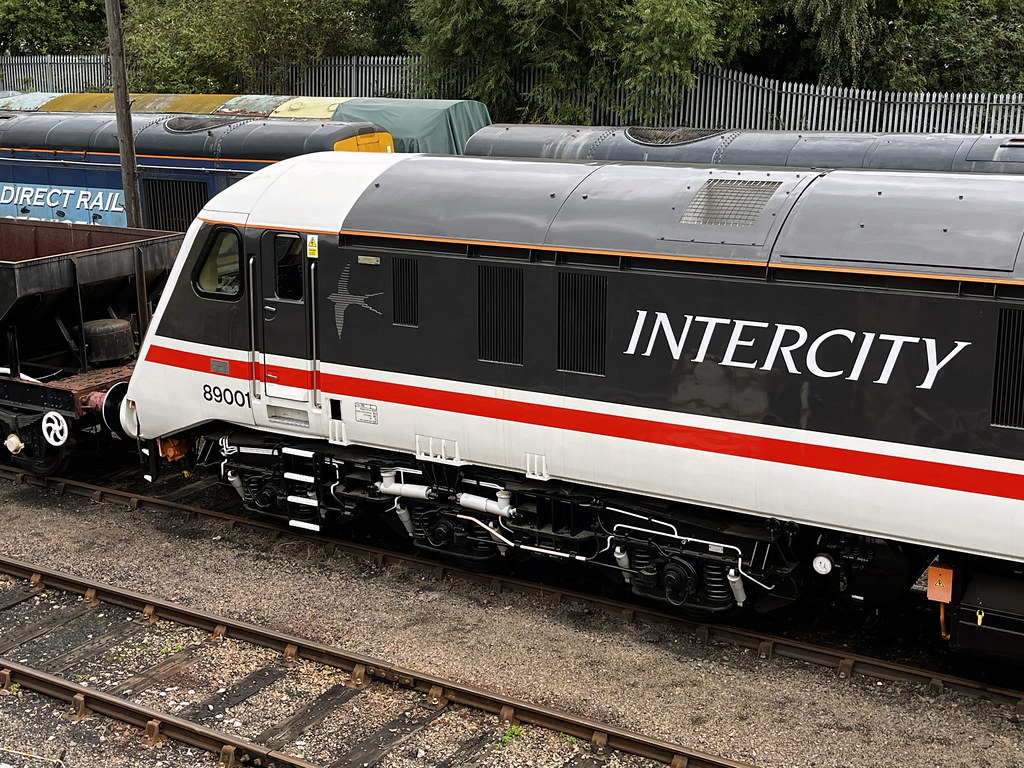
89 001 at Barrow Hill Roundhouse


Information
Number built: 1
Built: 1986
Builder: BREL Crewe / Brush Traction
Motor: 6 Brush TM2201A traction motors (25kV AC OHLE)
Power: 5, 748 hp (4, 286 kW)
Wheel arrangement: Co-Co

The locomotive was designed by Brush Traction and built by BREL Crewe in 1986. Early in the programme the Class 89 was considered as potential traction for the East Coast Main Line [1] and an eventual fleet of 33 to be built though by the time the Class 89 was built the specification for the ECML had changed (to be filled by the Class 91) and only one Class 89 ended up being built.

The Class 89 was used on test trains on both the West Coast Main Line and ECML in the late 1980s. Operations continued until 1992 when the locomotive suffered a serious failure, it was withdrawn by BR as being surplus to requirements (by then) and non-standard [2].

The Class 89 was saved by the privatising railway in 1996. The new operator on the ECML, Great North East Railway bought it back into service [3] and paid for an overhaul to help cover a shortage of motive power at the time. The Class 89 was withdrawn due to another failure in 2000 and again surplus to requirements. The locomotive was purchased for preservation in 2006, after a long overhaul and refurbishment it is planned for the Class 89 to return to the mainline for charter work.

89 001 front profile

89 001 wears Intercity swallow livery

Another photograph of 89 001


[1] Brian Haresnape, Electric Locomotives (Ian Allan, 1983) p. 20
[2] Gavin Morrison, AC Electric Locomotives (Ian Allan, 2013) p. 57
[3] Colin J. Marsden, Diesel & Electric Locomotive Guide (Ian Allan, 2011) p. 234

Class 458 5-JOP

The Class 458 4-JOP (Juniper Outer-suburban Porterbrook) was built for South West Trains in the late 1990s to replace some Class 411s. Although they were designed for the 750v DC third rail network they were "future proofed" with provision to support a pantograph and overhead electric collection, though have not carried one yet [1].

South Western Railway 458 506 at Reading


Information
Number built: 120 (30 4-car sets)
(rebuilds) 180 (36 5-car sets)
Built: 1999-02
(rebuilds) 2013-6
Builder: Althom (Washwood Heath)
(rebuilds) Wabtec (Doncaster) & Brush Traction (Loughborough)
Motor: 6 Althom ONIX 800 traction motors (750v DC third-rail)
Power: 2, 172 hp (1, 620 kW)
Formation: (original) Driving Motor Composite Open (DMCO)+
Pantograph Standard Open (PSO)+Motor Standard Open (MSO)+
DMCO
(rebuilds) Driving Motor Standard Open (DMSO)+
PSO+MSO+TSO+DMSO

Their entry into service as 458/0 was unfortunately fraught with technical difficulties with serious usage on the London Waterloo to Reading and Guildford-Ascot routes not happening for several years and after many modifications [2]. The unreliability of the trains saw SWT plump for the "Desiro" Class 444/450s instead of more 458s to order to replace the majority of its "slam door" EMU fleet [3].

In 2011 after the withdrawal of the similar Class 460 from the Gatwick Express it was decided to use cars from the 460 to strengthen the 458s as five car trains (5-JOP). The trains were also refurbished and rebuilt with an improved appearance including full gangways. Five "new" 458/5s (as they became known) were also created from spare rebuilt 460 cars. Work was completed in 2016 [5]. They are now operated by South Western Railway.

458 509 arrives at Winnersh Triangle

In SWT days, 458 534 and friend at Clapham Junction

458 520 arrives at Addlestone

458 535 at Clapham Junction

458 515 at Clapham Junction


[1] "Class 458" Southern Electric Group <http://www.semgonline.com/gallery/class458_01.html>
[2] Colin J. Marsden, DMU and EMU Recognition Guide (Ian Allan, 2013), p. 356
[3] "Train firm to replace new fleet", BBC News <http://news.bbc.co.uk/1/hi/england/london/3388679.stm>
[4] "Fire damaged 458 under repair", Railways Illustrated Issue 157 (March 2016)
[5] "458/5 programme nears completion", Today's Railways UK Issue 171 (March 2016)

Belfast Corporation Tramways

Belfast Corporation Tramways began life in 1905, taking over from the horse drawn Belfast Street Tramways Company and electrifying the 1, 448mm gauge network. A batch of open-topped double decker trams cars was bought from Brush Traction with British Westinghouse electrical equipment and Brill 21E trucks. Many of these trams were retrofitted with top covers in the 1920s [2]. Some of these cars survived in service until the early 1950s. One has been preserved.
Tram shed [1]


Information for original batch of cars
Number built: 170
Built: 1905
Builder: Brush Traction
Motor: 2 British Westinghouse 200 Series motors (DC OHLE)

Belfast's tram network at it's largest extent reached for just under 83 kilometres. The tram network was gradually converted over to trolleybus operation from the 1930s and then motor buses. The final trams ran in 1954.
Belfast Brush tram [1]


[1] "The Belfast Tramways", Street Railway Journal Vol XXVII No. 5 (February 3 1906) p. 186
[2] R.W. Rush, British Electric Tramcar Design 1885-1950 (Oxford Publishing, 1976) p. 71

Class 768

The Class 768 is a parcels carrying version of the Class 769 Flex bi-mode built for Orion Logistics (part of the Rail Operations Group). These are refurbished Class 319 electric multiple units which have been fitted with diesel engines to operate away from electrified routes. After the completion of the conversion to bi-mode units the Class 768s were fitted out to carry parcel cages and pallets at Eastleigh.
Orion Logistics 768 001 heads through Rugeley Trent Valley


Information
Number built: 8 (2 4-car sets)
Built: 2020- (Original build 1987-90)
Builder: Brush Traction (conversions)
Motor: 2 MAN D2876 diesels per set 
25kv AC OHLE / 750v DC third-rail
Power: 1, 046 hp (780 kW)

Two conversions were been carried out with eight more planned however, any plans were put on hold after the closure of the historic Brush Traction works at Loughborough were the conversions took place. It is unknown if the other conversions will now take place. The Class 768s ran some demonstration services in late 2021, at first diesel hauled then under their own power.
EuroPheonix 37 884 hauls two Class 768s through Rugeley Trent Valley


Class 73/9 Rebuilds

The Class 73 Electro-diesel was for a long time a unique specimen on Britain's railways, being able to operate using electric or it's own diesel generators (bi-modes as they are now termed are more common now). While the Class 73 remains in service with various operators in the early 2010s there were two separate re-engineering efforts to rebuild locomotives and greatly increase the diesel power (the original Class 73s only had a 600hp diesel).
Cummins powered 73 952 at Kidderminster Town


Information
Number built: 13 (Rebuilds)
Built: (Original) 1962-67
(Rebuilds) 2013-4
Builder: (Original) BR Eastleigh / English Electric
(Rebuilds) Brush Traction or Rail Vehicle Engineering Limited
Motor: MTU 8V 4000 R43L diesel or
2 Cummins QSK19 diesels / 750v DC third rail
Power: 1, 600 hp (1, 193 kW) (MTU)
1, 500 hp (1, 119 kW) (Cummins)
1, 420 hp (1, 059 kW) Electric
Wheel arrangement: Bo-Bo

Although the two types of re-engineered locomotives have quite different equipment they are all termed Class 73/9 although at one time it was considered to renumber them Class 75 (this would have cost more in administration and re-certification). In both cases the work included replacing the original EE diesel with a much more powerful motor and replacing worn electrical and mechanical components.

Thirteen have been re-engineered to date in two phases. The "Phase 2" Class 73s with MTU diesels have had their third rail equipment removed. As virtually "new" locomotives they will likely serve with Network Rail, GB Railfreight and Caledonian Sleeper for a long time to come (they are expected to last at least twenty-five years). Two were converted by RVEL with two Cummins diesel, these are used by Network Rail. The other eleven are MTU powered.
MTU powered 73 964 at Tonbridge

73 952 cab

73 952 at Kidderminster Town

73 963 and friend at Derby

73 951 and a test train at Derby


Class 47 (Brush/Sulzer 2,580hp Type 4 Diesel-Electric)

The Class 47 is the largest single class of mainline diesel locomotive built for British railways with a total of 512 built in the 1960s [1]. They became the standard Type 4 diesel locomotive and have operated over all parts of British railways on passenger, freight and engineering services. Most have now been withdrawn but there are still around thirty in mainline service plus others in preservation. Thirty-three have also been rebuilt and re-engined as Class 57s.
47 580 at Crewe


Information
Number built: 512
Built: 1962-68
Builder: Brush / BR Crewe
Motor: Sulzer 12LDA28-C diesel
Power: 2, 580 hp (1, 920 kW)
Wheel arrangement: Co-Co

The Class 47 was built to allow British Railways to finally withdraw steam traction on mainline services by 1968 and became the definitive second generation diesel locomotive for BR.

Originally they were a follow-on from the Class 45/46 Peaks and indeed the first twenty Class 47s replaced the last twenty Class 46s on order [2] with some of the equipment used (and in subsequent locomotives) was chosen because it was left over from the "Peak" production. The Class 47 had an uprated version of the Sulzer 12LDA28 powerplant but had a flat front as mandated by British Rail and took advantage of improvements in technology especially in terms of weight savings to be a Co-Co not a 1Co-Co1.


There were some teething problems as might be expected with such a big class, the Sulzer diesels needed to be derated to 2, 580hp to reduce wear and tear on the engine, but the Class 47 soon became the mainstay of heavy duty services. Five locomotives were fitted with the Sulzer V12 12LVA24 engine and classified as Class 48 though were later converted back into "normal" Class 47s.

Sub-class Details
47/0 Original with train steam heating boilers
47/3 Dedicated freight locos with no train heating
47/4 Fitted with electric train heating
47/6 Single loco fitted with Rushton 16RK3CT engine testing for later Class 56
47/7 Fitted for push-pull services 
47/8 Fitted with extra fuel tanks
47/9 47/6 loco later fitted with engine to test for Class 58 

Surviving Class 47s are still used on a variety of services such as charters, spot-hires and engineering services. Over thirty have been preserved to date many in working order. One Class 47 has even worked charters in Hungary. When the class was being built in the 1960s few would have suspected that might happen! [3]
West Coast 47 237 at Tyseley

ROG 48 813 at Derby

47 773 in BR green livery at Tyseley

West Coast 47 804 at Birmingham New Street

GBRf 47749 (with 56081) at Derby


[1] Colin J Marsden, Traction Recognition (Ian Allan, 2011) p. 40
[2] Brian Haresnape, Production Diesel-Electrics Types 4 and 5 (2nd Edition) (Ian Allan, 1984) p. 52
[3] "47 375 named Falcon", Railways Illustrated No.166 (December 2016) p. 10

Class 56 (BR/Brush 3,250hp Type 5 Diesel-Electric)

In the wake of the early 1970s oil crisis, British Rail had a need for a new generation of more powerful diesel locomotives in the Type 5 classification (rated for over 3, 000 hp) for what was expected to be a much greater demand for heavy coal haulage. The Class 56 was the first of these new locomotives and when the first arrived in 1976 it was the new class of diesel locomotive for nearly a decade [1].

Colas 56 096 and 302 at Stafford

It was based on the successful Class 47 but with a more powerful engine (a development of the successful English Electric CSVT engines used in many classes of diesel like the Class 50) and was fitted with slow speed control for Merry-Go-Round coal trains when they were loaded and unloaded [2].

Information
Number built: 135
Built: 1976-84
Builder: Brush Traction/Electroputere (first 30)
Brush Traction/BREL Doncaster and Crewe
Engine: Ruston Paxman 16RK3CT diesel
Power: 3, 250 hp (2, 424 kW)
Wheel arrangement: Co-Co

Because of a lack of manufacturing capacity at the time at Brush Traction, who had designed the Class 56, the first thirty were built by Electroputere in Romania with the rest being built at BR Doncaster and Crewe. The Romanian examples unfortunately suffered from a number of problems said to be due to poor workmanship which delayed their entry into service for over a year [3]. The decision to build the first batch in Romania and the urgency with which the locomotives were needed saw the locomotive have bogies of a Swiss design as these were widely used in Romania at the time and were easily available.

The Class 56 worked on heavy freights throughout the 1980s and into the privatisation era but most were withdrawn in the early 2000s. Some were later reinstated into traffic and undertook heavy refurbishment as the Class 56/3 [4].

Many have been scrapped, some sold for use on the continent and three have been preserved. Today around thirty remain in service. A project is ungoing to re-engine at least ten Class 56s with an EMD 12N-710G3B-T2 diesel (as fitted to some Class 66s) along with some other new equipment. The re-built locomotives are known as the Class 69.
56 078 at Kidderminster Town

DCR 56 103 and 191 at Derby

Colas 56 302 at Derby

56 302 again, this time at York

DCR 56 303 at Derby

[1] Chris Heaps, BR Diary 1968-1977 (Ian Allan, 1988) p. 104
[2] Brian Haresnape, Production Diesel-Electrics Types 4 and 5 (2nd Edition) (Ian Allan, 1984) p. 75
[3] Ibid p. 75
[4] Colin J Marsden, Traction Recognition (2nd Edition) (Ian Allan, 2011) p. 51

Burton and Ashby Light Railway

The Burton and Ashby Light Railway was opened in 1906 by the Midland Railway, running for sixteen kilometres between Burton-upon-Trent and Ashby-de-la-Zouch [1]. The tramway used the tracks of the Burton Corporation Tramway in Burton and then it's own tracks when it reached Swadlincote. The tramway used 1, 067 narrow gauge like a number of tram networks in the Midlands. It had to deal with some steep gradients on it's route, one tram being involved in a serious accident when it was a runaway backwards down a steep slope and overturned in 1919.

Number 14


The tramway was electric from the start, power was generated by two diesel engines in Swadlincote (which also housed the tram depot) rather than steam as was usual practice [2]. Open-topped double decker trams, built by Brush, were operated, a maximum of twenty were owned by the tramway. The tramway was taken over by the LMS in 1923 and closed down in 1927.

Information
Number built: 20
Built: 1906
No. 14 rebuilt 2014
Builder: Brush
Motor: 2 Westinghouse 80 electric motors (DC OHLE)
(No. 14) Clayton battery electric motors
Power: 50 hp (37 kW)

Tram number 14 managed to survive scrapping, the body was used as a garden shed until 1970. The tram body was exported to the USA and married to a 900mm gauge Lisbon tram truck. The tram returned to the UK in 2014 and was fitted with a Clayton battery electric traction system for use on the Statfold Barn preserved railway, able to run without wires!
No.14 on the Statfold Barn Railway

Side view of No. 14

Oak Tree Halt is the terminus of the short tramline on the Statfold Barn site

View from the top deck

Another view of No. 14 at Oak Tree Halt

[1] Charles Knapper, The Golden Age of Tramways (David & Charles, 1974) p. 34
[2] Ibid. p. 135

Northern City Line Stock

The Northern City Line was a London railway opened by the Great Northern Railway in 1904. The line originally stretched from Finsbury Park to Moorgate and was underground though the tunnels were built larger than contemporary "tube" tunnels and were able to operate full sized trains. The first batch of motor cars and trailers was built by the Electric Railway & Tramway Carriage Works (a.k.a. Dick, Kerr) with teak and mahogany bodies on a steel underframe. In 1906 Brush built a second batch of cars with steel bodies. All the motor cars used British Thomson-Houston electrical equipment.
Wooden bodied motor car, all images [1]


Information
Number built: 76 (31 motor cars 45 trailers)
Built: 1901-06
Builder: Electric Railway & Tramway Carriage Works, Preston
Brush Electrical Engineering
Motor: 2 British Thomson-Houston electric motors per motor car (550v DC fourth rail)
Power: 250 hp (186 kW) per motor car

The railway was bought by the Metropolitan Railway in 1913 and became part of the London Underground, eventually becoming part of the Northern Line. In 1976 it was returned back to British Rail and is currently operated by Great Northern using Class 717s. As for the original rolling stock it was replaced by Standard Stock in 1939.
Motor bogie

Trailer


[1] "The Great Northern & City Railway", The Street Railway Journal Vol. XXIV No. 10 (March 5 1904) p. 340

Class 769 Flex

In the mid-2010s there was a need for diesel multiple units to replace life-expired stock such as the Pacer family but (at the time) little chance of new DMUs being built. Instead, Porterbrook in conjunction with Northern, sought to fill the gap with converting surplus Class 319 electric multiple units into bi-mode multiple units with diesel power packs. The result was the Class 769 Flex which retains it's EMU systems (indeed the two diesels feed power into the unit's existing traction system) and so can take it's power from electrified lines where available.
GWR 769 959 on test at Guildford


Information
Number built: 36 (Conversions from Class 319)
Built: 2017-21 (Original build 1987-90)
Builder: Brush Traction (conversions)
Motor: 2 MAN D2876 diesels
Power: 1, 046 hp (780 kW)

Work began at Brush's Loughborough Works in 2017 with Class 769s ordered by Northern, Transport for Wales and Great Western Railway (their examples will be "tri-mode" as they will be able to take their power from overhead and third rail). Testing of the first example began in 2018 however, the development of the trains has not been trouble free and has had numerous delays and reliability problems. Northern hoped to start using their Class 769s in 2019 but this was delayed until 2021. Transport for Wales' units entered service in 2020 though have not been without technical issues. GWR hopes to start using their 769s before the end of 2022.

A parcel carrying version of the unit is the Class 768.
769 959 departs on test


Central London Railway 1903 Stock

The Central London Railway (which eventually became the London Underground's Central Line) was the first true "tube" railway in London [1]. It initially used electric locomotives hauling trailers but as soon as the railway opened in 1900 it was drawing complaints from property ownes above the line about excessive vibration, this was found to be caused by the heavy locomotives and their large unsprung weights [2]. The locomotives were replaced in 1903 by electric multiple units, known as 1903 Stock, some of which were new build and some converted from the loco-hauled trailers.
Preserved Sleet locomotive ESL 107 at LT Museum Acton

Information
Number built: 259 (88 motor cars, 99 trailers, 72 control trailers)
Built: 1900-03, 1913
Builder: Ashbury Railway Carriage & Wagon Company
Birmingham Railway Carriage & Wagon Company
Metropolitan Amalgamated Railway Carriage & Wagon Company
(later Metro-Cammell)
Brush
Engine: (Original) 2 British Thomson-Houston traction motors per motor car
(Ealing) 2 GE212 traction motors per motor car (550v DC third rail)
Power: (Original) 500 hp (372 kW)
(Ealing) 960 hp (720 kW)

The new motor cars were built by the Birmingham Railway Carriage & Wagon Company (BRCW) and Metropolitan Amalgamated Railway Carriage & Wagon Company, the original trailers having been built by the Ashbury Railway Carriage & Wagon Company and Brush. In 1908 some trailers were converted to control trailers to allow for shorter trains in the off-peak [3].

The fleet was augmented in the 1910s with the extension of the line to Ealing, extra stock was built by Brush with more powerful traction motors (the original stock was found to be underpowered when used in a lengthy formation). In the 1920s all stock was retrofitted with air-doors.

The CLR became part of London Underground in 1933 (and was renamed the Central Line soon afterwards). The 1903 Stock was replaced by Standard Stock as the CLR's central third rail system was replaced by the standard LU fourth rail.

Some 1903 Stock lived on as sleet locomotives. One of these locomotives, ESL107 has been preserved, it is the only 1903 Stock to have survived.
1903 Stock in service [5]

Interior view [5]

Another view of ESL 107


Cab of ESL 107

[1] Paul Moss, London Underground (Haynes, 2014) p. 29
[2] J. Graeme Bruce & Desmond Croome, The Twopenny Tube (Capital Transport, 1996) p. 15
[3] Brian Hardy, Underground Train File Tube Stock 1933-1959 (Capital Transport, 2001) p. 5
[4] John Glover, London Underground Rolling Stock in Colour (Ian Allan, 2009) p. 31
[5] "Fireproof cars on the Central London", Street Railway Journal Vol. XXII No. 9 (Nov 7 1903) p. 851