Waterloo and City Line Shunter 75S

As well as electrical equipment for the Waterloo & City Railway Siemens Brothers were also contracted by the LSWR to built a small electric shunter for use on the self-contained underground line [1]. 75S (as it was numbered by the Southern Railway, British Railways later renumbered it DS75) spent all of it's working life underground. The locomotive was used for the shunting of Waterloo & City Stock and also hauling wagonloads of coal which had been bought down the Armstrong Lift up the line for the power station.

Information
Number built: 1
Built: 1898
Builder: Siemens
Engine: 2 Siemens traction motors (530-600v DC third rail)
Power: 120 hp (90 kW)
Wheel arrangement: 4w

75S had a driving cab at only one end and had two nose-suspended traction motors of the same type used on the passenger stock [2] with air brakes fed from a reservoir. It remained in service until 1969 and has been preserved by the National Railway Museum. A second electric locomotive (74S later DS74), a larger Bo-Bo type with a central steeple-cab was also built for the line though was moved to work on the surface at Wimbledon in 1915 [3].
75S as preserved at NRM Shildon in Southern Railways livery
Another view of 75S
[1] Colin J Marsden, Diesel & Electric Locomotive Recognition Guide (Ian Allan, 2011) p. 245
[2] John C. Gillham, The Waterloo & City Railway (Oakwood Press, 2001) p. 133
[3] R.L. Vickers, DC Electric Trains & Locomotives in the British Isles (David & Charles, 1986) p. 23

Birmingham Corporation Tramways 301 Class

The Birmingham Corporation Tramways street car network was the fourth largest in Britain. Unlike most other tram networks it was to 3ft 6in narrow gauge (and was the largest narrow gauge tram network [1]). The 301 Class was built for an expansion of the network in 1911 for routes Birmingham Corporation Tramways had taken over to Handsworth, Selly Oak and Kings Norton [3]. However the 301 Class was also slightly lower than earlier trams (and a bit longer) to allow it to pass under a low bridge at Aston. This became the standard height for subsequent trams.

Information
Number built: 100
Built: 1911
Builder: United Electric Car Company / Dick, Kerr & Company
Engine: 2 DK13A traction motors (550v DC OLHE [2])
Power: 80 hp (60 kW)

The 301 Class introduced a number of new features which later became standard across the fleet, the design taking advantage of operational experience gained from earlier types. The 301 Class had interpole electric motors (which were better for tram cars with electric braking and which were used on more challenging routes [4]). They also had notch regulator controllers, a new type of Westinghouse magnetic brake and some flexibility in the movement of the axles.

The original order for the 301 Class was for sixty cars with the car bodies built by the United Electric Car Company and equipment by Dick, Kerr. Another forty cars were ordered to replace cars inherited from the companies Birmingham Corporation Tramways had taken over which were found to be in a poor condition [5].

Some cars were converted into single deckers in the First World War though later converted back as the routes they were being used on saw passenger increases. Most of the fleet remained intact until the Second World War though post-war withdrawals began in earnest and the 301 Class ended service in 1950. Car 395 was saved from scrapping (one of only two Birmingham trams to survive) and since 1953 has been in Birmingham Science Museum / Thinktank.
395 preserved at Thinktank

View of 395's roof

Notice the staircase

Upper floor was open at both ends on this class of tram

Entrance

Guards at the front and sides

[1] P.W. Lawson, Birmingham Corporation Tramway Rolling Stock (Birmingham Transport Historical Group, 1983) p. 13 
[2] “New power station at Birmingham, England”, Street Railway Journal December 1906 Vol. XXVIII No.22 p. 1043 [3]
[3] Lawson p. 43
[4] Lawson p. 192
[5] Lawson p. 45

Class 09 (BR Darlington / English Electric 400hp Diesel-Electric)

A relatively tiny adjutant to the huge Class 08 shunter fleet, twenty six Class 09s were built for Southern Region. They were almost exactly the same as the 08 but had different gearing [1] to allow a top speed of 27.5 mp/h [2] (compared to the Class 08's 15 mp/h) and waist high air brake connections for working with Southern multiple-units. Because of this different gearing they have a lower tractive effort than the 08s.

Information
Number built: 38 (including 12 conversions from Class 08)
Built: 1959-62
1992-93 (09/1 and 09/2 conversions)
Builder: BR Darlington & Horwich
09/1 and 09/2 conversions by RFS Kilnhurst
Engine: English Electric 6KT
Power: 400 hp (268 kW)
Wheel-arrangement: 0-6-0

In the early 1990s twelve more Class 09s were built from 08s to fulfil a need for faster shunters [3]. These later conversions, known as the 09/1 and 09/2, lack the high-level air brake connections (the original locomotives became 09/0). The main difference between the two later sub-classes is that the 09/1 has an 110v electrical equipment and the 09/2 90v.

Although the Class 09s spent most of their time on shunting duties there were the odd occasions they were used for passenger duties such as deputising for a Class 33 on Clapham Junction-Kensington Olympia services! The 09s originally were largely restricted to Southern Region but in the privatised era they can be found much wider afield. Ten have been preserved including one used as the National Railway Museum's yard shunter.
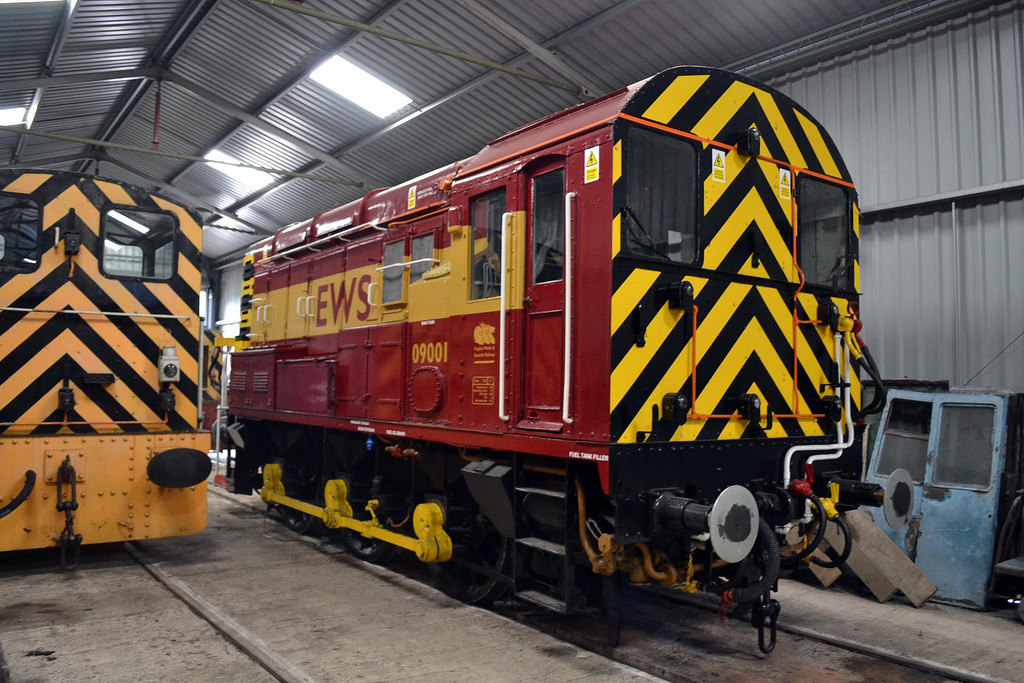
EWS liveried 09 001 at the Heritage Shunter Trust

D4100 at Kidderminster SVR

The National Railway Museum's 09 017

09 001 next to 03 099

Another view of 09 017

D4100 amid Class 50s


[1] Brian Haresnape, Diesel Shunters (Ian Allan, 1984) p. 71
[2] Colin J. Marsden, Traction Recognition (Second Edition) (Ian Allan, 2008) p. 12
[3] Colin J. Marsden, Diesel & Electric Locomotive Recognition Guide (Ian Allan, 2011) p. 90

City and South London Railway Locomotives

The City & South London Railway, which opened in 1890 between Stockwell and King William Street, was the first deep-level tube railway and the first major railway to use electric traction. To haul trains the C&SLR ordered a number of electric locomotives. The first two were built by Mather & Platt in 1889 in conjunction with Beyer Peacock [1] who provided the bodywork. The C&SLR ordered a production series of twelve others of a similar configuration. Later on more locomotives were built to augment the fleet from a variety of different manufacturers including the C&SLR itself though all followed the same design though with different equipment.

Information
Number built: 52
Built: 1889-1901
Builder: Mather & Platt, Siemens, C&SL Stockwell Works,
Crompton & Company, Electric Construction Company, Thames Ironworks
Engine: 2 Edison-Hopkinson traction motors (500v DC third rail)
Power: 100 hp (75 kW)
Wheel arrangement: 4w

The C&SLR tunnel had a very limited diameter of just over three metres with a rolling stock gauge just over two metres wide. The C&SLR Locomotives were only three metres long. The locomotives has two electric motors controlled by a hand-operated rotary controller. The controller was originally mounted vertically with exposed electrical contacts but later a horizontal enclosed controller similar to those used on electric trams was used.

The C&SLR locomotives hauled trains of three passenger coaches. At each terminus the locomotive would be uncoupled and another locomotive following behind would be coupled to the other end to take the train back. The tiny locomotives struggled with fully loaded trains especially with the steep gradients and twisty tunnels at King William Street. Sometimes the locomotive would not make it and the driver had to back the train back down to the level part of the tunnel (under the Thames) and make another attempt! [4] When the C&SLR extended Northwards to Moorgate King William Street as closed in 1900, earning it the dubious honour of being the first tube station to close. Without the restrictions of King William Street the C&SLR could operate longer trains.

Later locomotives had four-pole motors, built-in air compressors (the earlier locomotives filled a reservoir at Stockwell for their brakes) and nose-suspended motors though the limited tunnel dimensions meant the external appearance of the locomotives did not change much. The C&SLR was closed for reconstruction in the early 1920s, the tunnels being widened to match other (and later) tube lines. This now allowed the C&SLR line (which became part of the Northern Line) to use Standard Stock. The C&SLR locomotives were withdrawn by 1925. One has been preserved.
Preserved C&SLR Locomotive #13 at London Transport Museum

Inside the cab of the preserved locomotive

C&SLR Locomotive and it's train, public domain image [2] 
Drawing of C&SLR train, public domain image [3]

[1] Piers Connor, The London Underground Electric Train (Crowood Press, 2015) p.10 
[2] "City & South London", The Street Railway Review Vol. 3 (1893) p. 590
[3] "London's Subterranean Electric Railway", The Electric Railway Gazette No.12 (December 1890) p. 231
[4] J.E. Connor, London's Disused Underground Stations (Capital Transport, 2012) p. 9
LNER J45 (LNER Doncaster / English Electric or Brush 350hp Diesel-Electric)

All of the "Big 4" railway companies were experimenting with diesel shunters by the late 1930s and 1940s for economic and operational reasons. The LNER was the last to join the party with an order for four locomotives based on the LMS/EE design which led to the Class 08 (and would soon become very familiar indeed). The LNER J45 differed in cab design, had vacuum brakes and had a slightly longer wheel base [1]. The shunters were numbered 8000-8003 but within a couple of years were renumbered 15000-15003 by BR. Later they were given class names DES1, DEJ1, D3/9 and 3/10 but never received TOPS numbers.

Information
Number built: 5
Built: 1944
(15004) 1947
Builder: LNER Doncaster
(15004) Brush
Engine: English Electric 6KT diesel
(15004) Brush Petter S54 diesel
Power: 350 hp (261 kW)
(15004) 360hp (268 kW)
Wheel arrangement: 0-6-0

A fifth shunter was built by Brush for the LNER to a similar design but with Brush equipment. 15004 (it was delivered after Nationalisation so received a BR number) had some external differences including the lack of a battery box on the side as it used compressed air to start the engine [2]. The shunter operated under trial for a couple of years before being accepted into BR service in 1949. It was given the original class name DES2, later DEJ2, D3/14 and 3/2.

The shunters were originally sent to work at Whitemoor yard though also could be seen working elsewhere [3]. LNER had planned to build one hundred and sixty seven more of these shunters (either with EE or Brush equipment) though Nationalisation put paid to these plans. The four original locomotives continued in BR service until 1967 when they were withdrawn. 15004, having a slightly less successful time with reliability and being a one-off, was withdrawn in 1962.
LNER liveried 8003 at Whitemoor in 1949 (KD Collection)

15004 at Whitemoor in 1949, note the lack of the battery box on the side (KD Collection)

[1] Brian Haresnape, Diesel Shunters (Ian Allan, 1984) p. 30
[2] Ibid. p. 31
[3] Colin J Marsden, Diesel & Electric Locomotive Recognition Guide (Ian Allan, 2011) p. 14

Class 123 (BR Swindon Intercity Services 4-car)

The Class 123 was the last type of first generation diesel multiple unit to enter service and in many ways the best, being designed for longer inter city routes with a high degree of passenger comfort including some corridor compartments and B4/B5 bogies which gave a better ride at higher speeds [1]. They had a similar front-end design to the Class 309 EMU with wrap around cab windows [2].

Information
Number built: 40 (10 4-car sets)
Built: 1963
Builder: BR Swindon
Engine: 2 BUT (Leyland Albion) 6-cyl per power car
Power: 920 hp (686 kW)
Formation: Driving Motor Brake Standard Lavatory (DMBSL)+
Trailer Composite Corridor (TCK)+Trailer Standard Lavatory or
Trailer Buffet Standard (TSL/TSLRB)+
Driving Motor Standard Corridor (DMSK)

The Class 123 was also fitted with Pullman style gangways to the cab ends so everyone on a train could access the buffet car. They were used on South Coast-Wales services though were based on Western Region as Southern Region did not want to have anything to do with diesel-mechanical units! They were later used on outer-suburban services out of London Paddington [3].

They were surplus to requirements by the late 1970s but had a short reprieve in the North East of England before finally being withdrawn in 1984.
Class 123 at Swindon (KD Collection)

[1] Brian Haresnape, Diesel-Multiple Units: The First Generation (Ian Allan, 1985) p. 71
[2] David Lawrence, British Rail Designed 1948-97 (Ian Allan, 2016) p. 135
[3] Colin J Marsden, DMU and EMU Recognition Guide (Ian Allan, 2013) p. 83