Class 466 Networker

The Class 466 is part of the Networker family and the companion to the 4-car Class 465. The Class 466 was built for Network South East's lines in Kent. The 466 is a 2-car version of the 465 for lower patronage branch lines and also to augment other services in peak times [1]. Unlike the 465 production which was split between BREL York and GEC, the 466 was built entirely by GEC Alstom and thus the fleet has a standard traction package [2].
Southeastern 466 012 at Lower Sydenham


Information
Number built: 86 (43 2-car sets)
Built: 1993-94
Builder: GEC Alstom Birmingham
Engine: 4 Alstom G352AY traction motors (750v DC third rail)
Power: 1, 500 hp (1, 120 kW)
Formation: Driving Motor Standard Open (DMSO)+
Driving Trailer Standard Open (DTSO)

Following privatisation the Class 466s were taken over by Connex South Eastern, then South Eastern Trains and currently is operated by Southeastern. Withdrawals of some 466s and 465s began in 2021 to make space for transferred Class 707s.
466 020 at Waterloo East


466 006 at Grosvenor Road Sidings

466 030 passing through Peckham Rye

[1] Colin J. Marsden, DMU and EMU Recognition Guide (Ian Allan, 2013) p. 363
[2] Colin J Marsden (ed.) "The Networker Family", Modern Locomotives Illustrated No. 233 February-March 2017 (Networker, Juniper & Javelin Stock) p. 4

Aberdeen Corporation Tramways

Aberdeen Corporation Tramways was formed in 1898 with the purchase of the horse-drawn Aberdeen District Tramways Company and began a programme of electrification. The first converted line opened in 1899 with the final line converted opening in 1903. A new line to Torry was also opened in 1905. The tramway reached it's maximum extent of just under twenty six kilometres in the 1920s. The corporation operated a mixture of purpose built and second-hand trams. The original fleet of electric trams were built by Brush though these soon proved insufficient for demand though no other trams were bought for the time being, the Corporation converted thirteen horse cars to electric though these did not prove a success and most soon became works cars [1].
Aberdeen Corporation tram [2]


Information for original fleet
Number built: 56
Built: 1899
Builder: Brush Traction
Motor: Dick Kerr DK105 or 108 or BTH 200 electric motors (DC OHLE)

The Corporation upgraded most of it's trams with top covers from 1904-09. In the 1930s the tram fleet was converted to use Fischer bow collectors instead of trolley poles to reduce wire wear. The older cars were modernised with Dick Kerr or BTH electrical equipment and Peckham P35 trucks. New cars were finally added to the fleet in the 1920s including some built at the Corporation's own works.

The Corporation also worked in partnership with a private company, the Aberdeen Suburban Tramways Company which operated two lines which were extensions of the Corporation's lines but outside the municipal boundary. Through-running was possible though as the ASTC company went into decline the Corporation terminated it's agreement.

The Corporation experimented with pay as you enter on some routes in 1913-15, the first scheme of it's type in Britain, though these proved unpopular and the scheme was abandoned. The tramway went into decline in the 1920s though any closures were put off until 1931. The Corporation began to operate buses and slowly converted it's tram routes to the bus. The last tram operated in 1958 and the network was shut down for good.
On the top deck [2]

Tram during pay as you enter experiments [3]


[1] Charles Klapper, The Golden Age of Tramways (David & Charles, 1974) p. 229
[2] Walter Jackson, "The zone fare in practice", Electric Railway Journal (Vol. 53 No. 17 April 26 1919) p. 814
[3] "Double deck pre-payment cars at Aberdeen", Electric Railway Journal (Vol. XLI No. 9 March 1 1913) p. 385

Class 37 (English Electric 1,750hp Type 3 Diesel-Electric)

The Class 37 has been one of the workhorses of the British Rail network since the 1960s and, while their numbers have decreased in recent years, many still perform a valuable role day in and day out for both the main line and preserved railways.
37 610 at Derby


The Class 37 is a Type 3 diesel locomotive, after its introduction in the early 1960s it was found that it's power rating made the locomotive highly versatile compared to the Type 2s which had dominated most early dieselisation efforts and often were underpowered. The Class 37's power coupled with a relatively low axle loading for a locomotive of this size meant the locomotive could handle a wide variety of mixed traffic from secondary passenger services to freight and engineering trains across much of the network. This is work it continues to this day, Class 37s can be found hauling freights, engineering trains and often passenger trains on the network.

Information
Number built: 309
Built: 1960-65
Builder: English Electric
Motor: English Electric 12CSVT diesel
(37/9 fitted with Mirrlees Blackstone MB275Tt or Rushton RK270Tt)
Power: 1,750 hp (1,305 kW)
Wheel arrangement: Co-Co

Between 1960 and 1965 three hundred and nine Class 37s were built by English Electric and proved to be one of the most reliable classes of diesel locomotive built for British Rail [1]. Though with their front end "noses" they were rather dated in appearance when they entered service as other locomotive types had moved to flat fronted designs (indeed they were the last class built for BR with front noses).

However, this appearance was due to English Electric being reluctant to leave the American styling they had championed since Deltic [2] and the locomotives reused some tooling and equipment from the earlier Class 40. This reduced the unit price to British Rail which no doubt helped to overcome any doubts over the aesthetics! [3]

Around thirty five are still registered for use on Network Rail and some will remain in service for some time following refurbishments. Many Class 37s have also been preserved.

As can be expected with a large fleet that has remained in service for over fifty years there have been a number of sub-class variants of the Class 37 mostly following a series of refurbishments in the 1980s [4].

37 609 heads through Spondon

37 219 at Derby with a test train

In BR green, 37 057 also with a test train at Derby

Overhead view of 37 227 at Princes Risborough

DRS 37 716 at Kidderminster Town


[1] Colin J. Marsden, Traction Recognition (2nd Edition) (Ian Allan, 2008) p. 28
[2] David Lawrence, British Rail Designed 1948-97 (Ian Allan, 2016) p. 145
[3] Brian Haresnape, Production Diesel-Electrics Types 1-3 (Ian Allan, 1983) p. 67
[4] Pip Dunn, British Rail Main Line Locomotives Specification Guide (Crowood Press, 2013) p. 65

Class 720 Aventra

The Class 720 is part of the Bombardier Aventra family like the Class 345 and is being built for Greater Anglia and c2c to replace a number of older electric multiple units such as the Class 317 and 321. All units on order are five-car sets, earlier plans for a ten-car version were changed. The first Class 720s were built in late 2018. Originally it was planned for the Greater Anglia 720s to enter service in 2019 on services out of London Liverpool Street though delays to testing and software issues pushed that back until November 2020.
Greater Anglia 720 548 at London Liverpool Street


Information
Number built: 725 (145 5-car sets)
Built: 2018-
Builder: Bombardier Derby
Motor: Bombardier traction system (25kV AC OHLE)

c2c's fleet of 720s is due to enter service in 2022. The c2c 720s are classified 720/6, the Greater Anglia units are 720/5. Compared to other Aventra family EMUs like the Class 345 and 710, the 720 has a higher top speed and an interior better suited to longer distance journeys such as London to Colchester or Southend Victoria. They are the first units to be fitted with under floor seating.
720 562 at Stratford

720 550 at Stratford

Another view of 548 at London Liverpool Street


Post Office Railway 1927 Stock

These trains were the original rolling stock on the Post Office Railway which began operating in tunnels below London linking major railway termini and post sorting offices. Ninety of these units were built which typically operated in trains of two or three [1]. Each unit carried wheeled trollies which could contain mail bags, these were loaded or unloaded at the various stops on the Post Office Railway.
Preserved unit 601 at Mail Rail


Information
Number built: 90
Built: 1927
Builder: English Electric
Motor: English Electric (440v DC third rail)
Power: 22 hp (16 kW)
Wheel arrangement: 4wRE

Unfortunately the original rolling stock had a number of drawbacks which became apparent soon after the railway began operating in 1927. As the units had a fixed wheelbase this was causing excessive wear and tear on the unit's own wheels and on the track. This resulted in increased power consumption [2]. The system was already becoming overwhelmed with the amount of mail being carried.

The 1927 Stock was replaced within a couple of years by the 1930 Stock which consisted of two smaller powered units either side of a mail carrying wagon. These articulated units solved many of the problems with the original stock. Many of the 1927 Stock's internals were reused in the replacement 1930 Stock including the motors, axles and wheels. One unit of 1927 Stock has been preserved.
A train of 1927 Stock in operation [3]


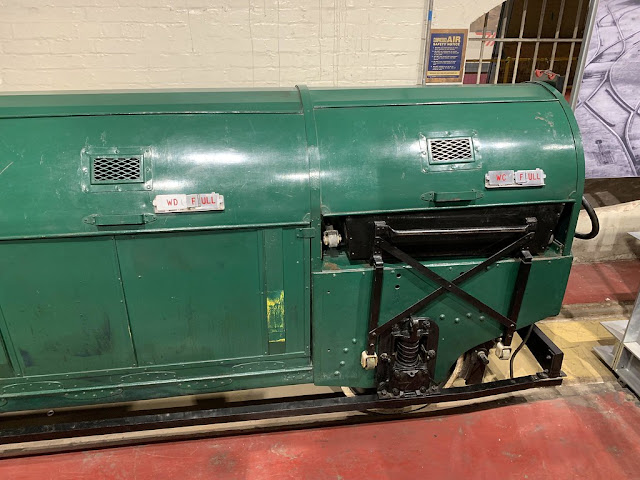
Side view of 601, notice the hatches to the mail carrying compartments

Another view of 601


Loading mail trollies [4]


[1] Mike Sullivan, Mail Rail (Redshank Books, 2019) p. 19
[2] Peter Johnson, Mail by Rail (Ian Allan, 1995) p. 118
[3] "London's Post Office Tube Railway", Meccano Magazine (October 1928) p. 812
[4] E. Flaxman, "New cars for London P.O. Tube Railway", Meccano Magazine (June 1930) p. 463
Hunslet 1697 (LMS 7051)

In 1932 the Hunslet Engine Company built a small diesel-mechanical shunter as a demonstrator. It was unveiled at the British Industries Fair in that year and for a time worked at the colliery. It was given a trial by the LMS in 1933. They liked it so much they bought it a few months later! The shunter, given the LMS number 7051, had an eventful life. It was loaned to the War Department in 1940. After the war it was sold back to Hunslet who used it as a works shunter and was hired out to industry. Since 1960 the shunter has been preserved by the Middleton Railway.
The shunter's early days on the Middleton Railway [1]


Information
Number built: 1
Built: 1932
Builder: Hunslet Engine Company
Motor: (original) MAN WV16/22 diesel
Power: 150 hp (112 kW)
Wheel Arrangement: 0-6-0DM

The shunter has a four speed pre-selector gearbox. The original MAN diesel was replaced by a 132 hp (98 kW) McLaren Ricardo MR6.

[1] Arthur Gaunt, The World's Oldest Railway (Meccano Magazine November 1963) p. 451