The "All Red Route" was a special electric railway set up at Crystal Palace for the 1911 Festival of Empire [1] which celebrated the coronation of King George V. The railway followed a continuous loop (see the map below) with stations at regular intervals for marquees dedicated to various components of the British Empire such as New Zealand and India. The train ran slowly (up to six and a half kilometres per hour) so the passengers, who sat on cross-benches in a "toast rack" style body like seaside trams, could take in the scenery [2]!
Information
Number built:
18 (9 2-car sets)
Built:
1911
Builder:
Dick, Kerr & Co.
Motor:
2 Dick, Kerr interpole electric motors (450v DC third rail)
Power:
64 hp (48 kW)
Formation:
Driving Motor + Trailer
The line was to 1,067mm gauge and was very much based on tram technology by the contractors Dick, Kerr & Company. The cars used a Brill 21E truck and could carry up to thirty-five passengers. The conductor rail and insultators were based on current London Underground practice. One of the motor cars later was used on the Dublin & Lucan Electric Railway [3].
The All Red Route
A train arrives at "Africa" station
[1] "Around the empire by electric traction", Railway Times (Oct 7, 1911) p. 343 [2] Ibid. p. 344 [3] John B Gent & John H Meredith, Croydon's Tramways (Middleton Press, 1994) Fig. 45
RAF Chilmark was a former limestone quarry near Salisbury, Wiltshire used for the storage of RAF equipment and weapons from 1937 to 1995. The base was connected to the railway network and had an extensive 610mm narrow gauge network stretching over fourteen kilometres [1]. The base had a number of locomotives operating on it over the years including some battery electric Baguley-Drewry shunters, some of the earliest were Ruston & Hornsby diesel-mechanical shunters built in 1939-1940.
Information
Built:
1939-40
Builder:
Ruston & Hornsby
Motor:
Ruston 4-cyl diesel
Power:
44 hp (33 kW)
Wheel arrangement:
4wDM
These locomotives were powerful enough to pull two hundred tons on the level and thirty-six tons up a one in thirty slope. Three survived in service until the closure of the base, one being used to haul the fire-fighting train until the 1970s when it was replaced by more modern fire-fighting equipment. At least two have been preserved, RH28 seen below is at Stonehenge Works on the Leighton Buzzard Light Railway.
RH28 at the Leighton Buzzard Light Railway
RH28 is Ruston & Hornsby 200516
RH28 is seen here at Stonehenge Works
Another view of RH28
[1] The Little Trains of Chilmark (Railway Magazine, 1976)
Work began on the Warrington tramway in 1901 following a failed attempt to introduce horse drawn trams in the late nineteenth century. Operations on the first two lines began in April 1902 with three other lines opening later that year. The total length of the network was just over eleven kilometres. Twenty one trams (built in two batches) were introduced, initially as open-top trams but later fitted with canopies. Six new trams were bought from Brush in 1919 to allow for greater service frequencies. Unlike many other tram networks the Warrington system had made a profit most years but as the 1930s approaches there was the need to renew the network and buses were chosen instead as a cheaper alternative. The network was gradually run down and closed completely in mid-1935.
Information for G.F. Milnes built cars
Number built:
21
Built:
1901-02
Builder:
G.F. Milnes
Very little of the Warrington Corporation Tramway now survives however one of the original trams, Number 2, had a second life as a bowling green shelter and was saved for preservation in 1977. It is now being restored at the Wirral Transport Museum as Warrington 28.
Warrington No. 2 on the right
The tram is being restored back to it's later operating condition
The Sheffield Corporation began building a new generation of trams in-house in the 1930s to modernise it's fleet and replace it's legacy and ageing trams some of which dated back to 1899. Seventy five trams were built of this batch of the "standard" car. The design was derived from one by local firm Cravens who developed a sample tramcar design in 1927. The standard cars were fully enclosed with a modern streamlined appearance and had the latest innovations including air brakes and upholstered seats!
Information
Number built:
75
Built:
1933-35
Builder:
Sheffield Corporation Transport
Motor:
2 x Metropolitan Vickers 102DR electric motors (DC OHLE)
Power:
100 hp (75 kW)
The standard cars survived in service until the end of the Sheffield Corporation tram system in 1960. The preserved example 189, which is now at Crich Tramway Museum, being withdrawn and preserved in 1958.
The Chesterfield & District Tramways Company was formed in 1879 and began operation in 1882 with horse drawn trams. The company went insolvent not long after though the successor Chesterfield Tramways Company was able to expand the network and was bought by the Chesterfield Corporation in 1897 [1].
In 1904, as the original line needed replacement, the decision was taken to expand and electrify the line which at it's greatest extent stretched nearly six kilometres. The tramway eventually had a fleet of fifteen tramcars (one being a water car for works purposes) though some were badly damaged in a tramshed fire in 1916. Like most tramways the Chesterfield service struggled to maintain the condition of the line and pay creditors a dividend. The corporation switched to trollybuses and motorbuses in the mid-1920s, the tramway closing for good in 1927 [2].
Information for 1904 Aston type cars
Number built:
12
Built:
1904
Builder:
Brush
Motor:
2 Westinghouse 90M electric motors,
later 2 British Thomson-Houston RGE20 electric motors
(550v DC OHLE)
Power:
50 hp (37 kW) later 80 hp (60 kW)
The majority of the fleet consisted of twelve Aston type open double deck cars which were introduced in 1904 when the tramway was electrified. The fleet was strengthened in 1907 with two more double deck cars, the water car arriving in 1909. Finally in 1914 three new cars with covered top decks arrived. After the war the earlier cars had their top decks given covers.
One of Chesterfield Corporation's electric tram cars has been preserved, as well as one of the earlier horse drawn tram cars, at Crich Tramway Village. Number Seven was one of the original twelve Aston type cars. It was withdrawn in 1927 when the tramway was closed and became a holiday cottage [3] before being preserved in 1973. After a long restoration process it was returned to working order in 1997. Number 7 originally had an open top deck but had the deck covered in 1919 when it was repaired following the 1917 tramshed fire (see above).
Chesterfield Tram #7
Preparing to depart
#7 has been restored to running order at Crich Tramway Village
Top floor of #7
Although the top floor is covered, platforms are still open to the elements
Chesterfield horse tram #8, also preserved at Crich
[1] Barry Marsden, Chesterfield Tramways (Middleton Press, 2004) p. 2 [2] Marsden Fig. 118 [3] Marsden Fig. 120
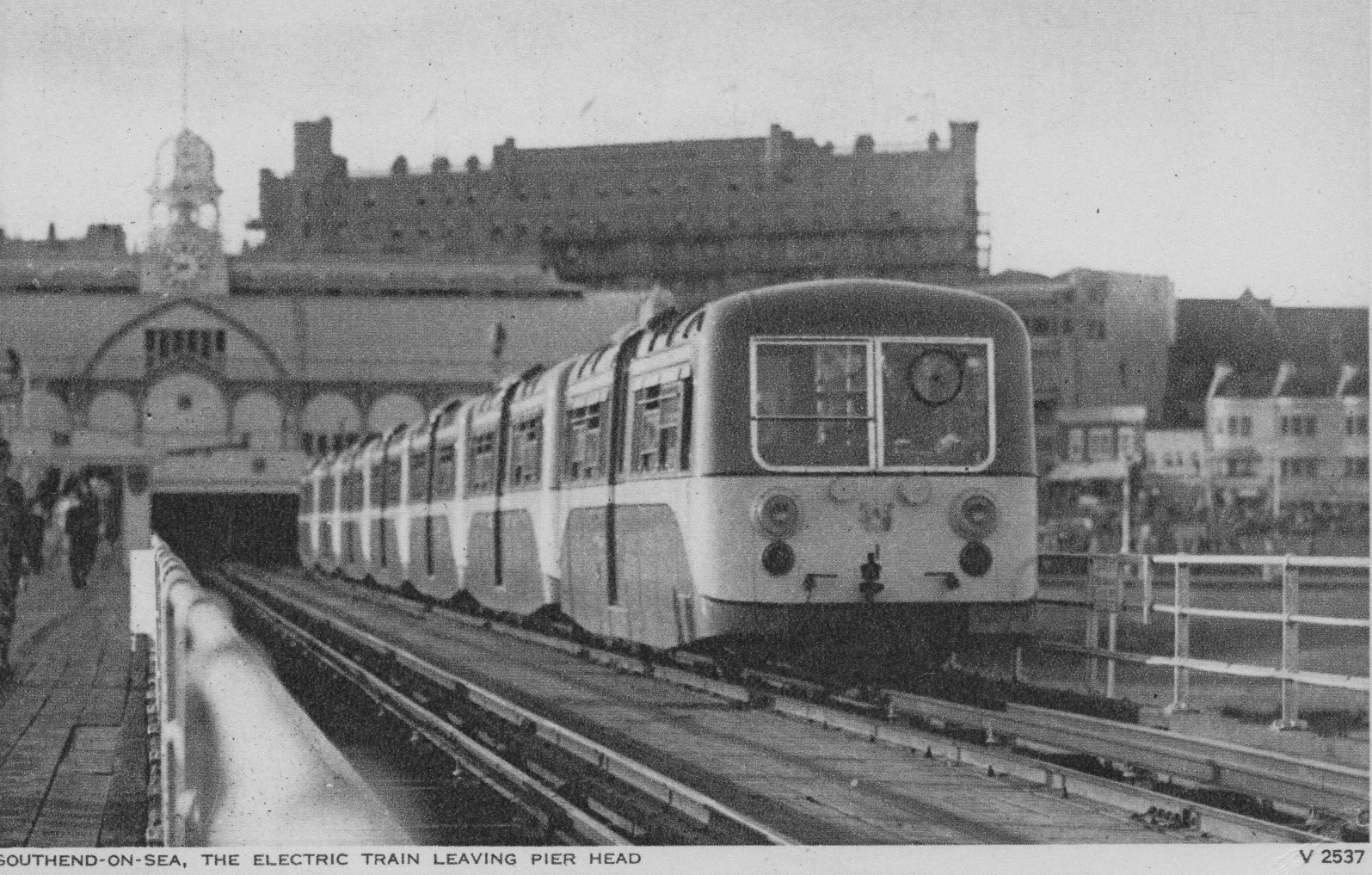
The Southend Pier Railway opened in 1890 and operated toast-rack style electric tram cars along it's length. After the pier and railway was re-opened following a period of closure during the Second World War passenger numbers greatly increased and the need was felt to replace the original cars with a more modern design. AC Cars of Thames Ditton were contracted to built four trains of seven cars each (in total twelve motor cars and sixteen trailers) for the 1,067mm gauge railway, each using design and technology similar to London Underground tube trains of the time including air operated sliding doors and rheostatic electric brakes [1]. The cars had four wheel trucks (made by Maley and Taunton [2]) with a 4.4m long wheelbase, somewhat long for four wheel vehicles though the pier railway lacked any tight curves and the long wheelbase aided stability.
Information
Number built:
28 (4 7-car trains)
Built:
1949
Builder:
AC Cars
Formation:
Driving Motor (DM)+Trailer(T)+T+DM+T+T+DM
The new rolling stock proved reliable in service though passengers numbers gradually dropped during the 1950s and 1960s. The pier was also beginning to become in serious need of refurbishment. Much of the pier head was damaged in a fire in 1976 though the railway was undamaged [3] and had proved highly useful in evacuating the pier, it was finally closed in 1978. The pier remained railway-less until 1986 when a new diesel railway began operation [4]. Several electric cars have been preserved at the pier railway's own museum and at Leigh-on-Sea.
Car #21 preserved at Leigh-on-Sea
Postcard view of pier railway seen from the pier head end (KD Collection)
Another postcard view, this time at the shore end (KD Collection)
Another view of #21, it now lives on in an art gallery cafe!
[1] Keith Turner, Pier Railways & Tramways of the British Isles (Oakwood Press, 1999) p. 55 [2] Robert Harley, Southend-on-Sea Tramways (Middleton Press, 1994) Fig. 115 [3] Turner p. 61 [4] Dr Edwin Course, Barking to Southend (Middleton Press, 2002) Fig. 117