Tramlink is a light rail network in Croydon and across South London which is part of Transport for London. It commenced operations in 2000 along former heavy rail lines (the six and a quarter mile route from Wimbledon to West Croydon for example is nearly all ex-railway apart from a few diversions [1]) and new street lines. Bombardier's Flexity Swift tram was chosen for the initial rolling stock of the network. Twenty four articulated cars were produced ready for the start of operations.
Information
Number built:
24
Built:
1998-2000
Builder:
Bombardier
Engine:
4 Bombardier Three-Phase traction motors (750v DC OHLE)
Power:
644 hp (480 kW)
The CR4000 tram is similar to the K4000 tram built for Cologne. It has a "seventy six percent" low floor design with a cab at each end. The tram has six axles with the articulated section being on an unpowered bogie. The fleet received a refurbishment in 2008-9 which included new seats and LED lights.
In November 2016 a CR4000 overturned at speed (later found to be travelling too fast for the junction it was travelling over). Seven people died and fifty-eight others were injured. Following the incident a number of extra safety features have been rolled out to the fleet including a reduction in the top speed to forty five mp/h [2].
2543 at Wimbledon
2531 at Mitcham Junction
Behind the cab
2543 departs Mitcham Junction
Some sections of the network are single track
[1] John C. Gillham, Wimbledon to Beckenham before Tramlink (Middleton Press, 2001) p. 3 [2] Colin J. Marsden, Light Rail (Key Publishing, 2018) p. 32
Tramway companies employed a number of vehicles for maintenance and, what would be termed on the railways, departmental use. One frequent need were for water cars to help keen the roads (and tracks) as clear as possible from mud and animal waste (horse drawn vehicles still being the majority at the start of the twentieth century). Many purpose built water cars were built with a wide variety of different set-ups depending on the operator's requirements [1].
Information
Number built:
1
Built:
1902
Builder:
Electric Railway & Tramway Carriage Works of Preston
Engine:
2 GEC 200K traction motors (550v DC OHLE)
Power:
60 hp (45 kW)
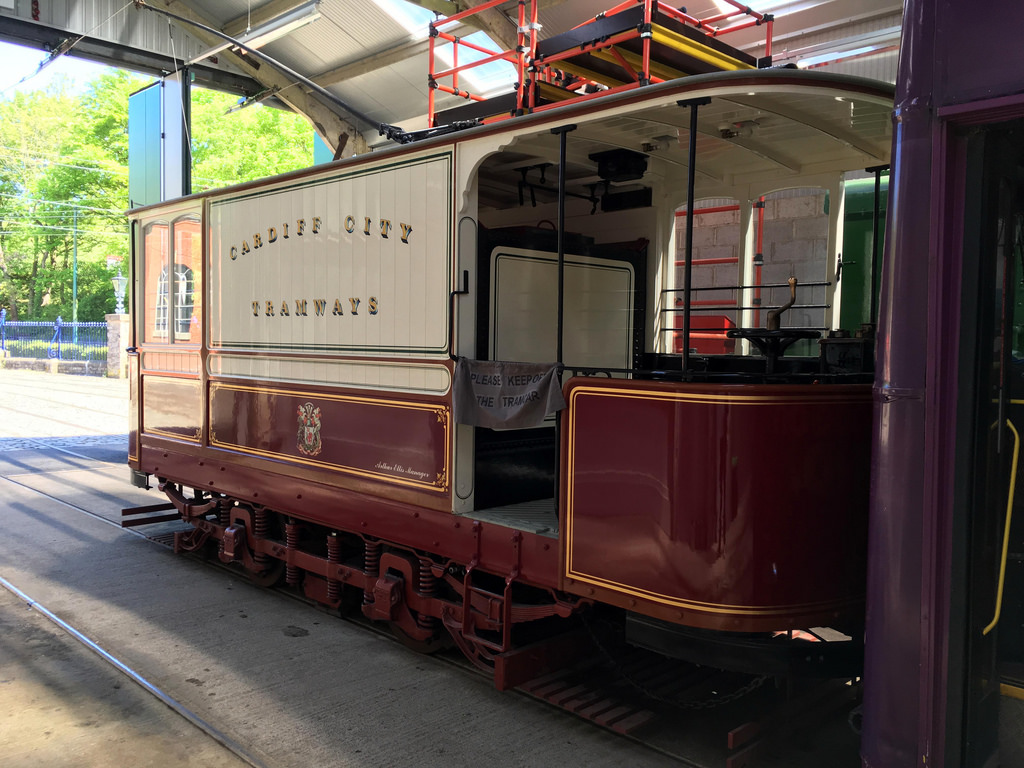
Cardiff Corporation 131 is the only water car to have survived into preservation. A small single truck tram, it was built for the Corporation in 1902 with a thousand gallon water tank. It was in use until 1950 when the Cardiff tram system was closed. Originally 131 had open sides but wooden panelling was added in 1913, which was not usual for water cars which were usually kept open. The tram was also fitted out for rail grinding and was used for staff transport.
Cardiff Corporation 131 at Crich Tramway Museum
Original configuration, public domain image [2]
131 isn't large, compare the double decker tram behind
The water tank can be seen inside behind the cab
131 has a cab at both ends
[1] R.W. Rush, British Electric Tramcar Design (Oxford Publishing, 1976) p. 119 [2] "The Cardiff Corporation Tramways", Electric Railway Journal Vol. XX No. 1 (July 1902) p. 42
Beaudesert is number 80 in the Leighton Buzzard Narrow Gauge Railway fleet. The locomotive is used for shunting, engineering trains and standby passenger duties. The locomotive is a rebuild of an earlier T-Series locomotive made by Simplex which was used as a shunter on the Channel Tunnel project, and before that was owned by the National Coal Board.
Information
Number built:
1
Built:
1979
(Rebuilt 1999)
Builder:
Simplex
(Rebuild Alan Keef)
Engine:
Dorman 6DA diesel
Power:
112 hp (84 kW)
Wheel arrangement:
4wDH
Originally built as Simplex 101T018 in 1979 the locomotive was rebuilt by Alan Keef in 1999 with the works number 59R [1]. The locomotive was re-gauged from 900mm to 610mm. The locomotive is named after a school near to the railway.
Four views of Beaudesert on the Leighton Buzzard Narrow Gauge Railway
The District Railway bought ten of these locomotives from the Metropolitan Carriage & Wagon Company of Birmingham to haul London & North Western Railway and later London, Tilbury & Southend Railway services along the electrified section of its outer circle route between Earl's Court and Mansion House [1] and later onto Barking (the District Railway no longer wanted steam locomotives operating through these tunnels). The locomotives operated in pairs and only had a cab at one end. They were based on the railway's then-current fleet ofB Stock EMUs and had wooden bodies and clerestory roofs [2].
Information
Number built:
10
Built:
1905
Builder:
Metropolitan Carriage and Wagon Company
Engine:
4 British Thomson-Houston GE69 traction motors
(600v DC fourth rail)
Power:
800 hp (597 kW)
Wheel arrangement:
Bo-Bo
The locomotives were equipped with British Thomson-Houston traction equipment though in 1922 the traction motors were replaced by GE260 from F Stock. Three locomotives were scrapped in 1911 though the rest remained in service until 1939 when the LTSR service was withdrawn.
Model of locomotive at London Transport Museum
Public domain image [3]
Public domain image [3]
[1] "Electric Locos for London & North Western Cars in London", Street Railway Journal (1906) Vol XXVII No. 1, p. 46 [2] R.L. Vickers, DC Electric Trains & Locomotives in the British Isles (David & Charles, 1986) p. 29 [3] Street Railway Journal p. 46
The Class 20 is the most successful Type 1 diesel bought by BR (by some margin) and indeed the only one still in service - sixty years after it was first introduced! After early trials with prototype diesels BR ordered a number of "pilot scheme" diesels in the mid-1950s as part of its Modernisation Plan to eliminate steam. Twenty of these diesels were from what would become the Class 20 and in fact the first one built (D8000) was the very first diesel delivered to BR under this pilot scheme [1].
The Class 20 has a cab only at one end, though typically it works in pairs with the cabs outer most to make one "virtual" 2, 000hp locomotive. When it is operated bonnet first drivers have had problems with seeing the line ahead (as they did with large steam locomotives). Because of this BR decided to standardise on the Class 17,which had a central cab and much better visibility,instead for its Type 1 however various problems with the Class 17 forced BR to do an about face in the late 1960s and restart Class 20 production. [2]
Information
Number built:
228
Built:
1957-68
Builder:
English Electric
Engine:
English Electric 8SVT Mk2 diesel
Power:
1, 000 hp (746 kW)
Wheel arrangement:
Bo-Bo
The Class 20 became one of BR's most reliable locomotives popular with BR and enthusiasts who have given them the name "Choppers". They were usually found on freights with the occasional passenger service in the Summer (they have no train heating provision) [3]. There have been a number of sub-classes, most Class 20s have remained as standard (20/0) but a small number were modified as 20/3 for aggregate workings in the 1980s. 20/3 was later re-used for locomotives modernised and refurbished post-privatisation. A few locos have also been modified for remote control trials as 20/9.
The fleet was run down in the 1980s with most withdrawn by the time of privatisation but since then the Class 20 has seen a bit of a renaissance and has found a niche on spot hire trains and a number remain in service to this day [4]. A large number has also been preserved including the very first one, and pilot scheme loco, built which is with the NRM.
20 189 at Kidderminster SVR
20 132 in original Railfreight livery at Derby
First of the Class 20s D8000 at the NRM York
GB Railfreight 20 905 at Derby
Cab of D8059
20 189 at Kidderminster SVR
[1] Brian Haresnape, Early Prototype & Pilot-Scheme Diesel-Electrics (Ian Allan, 1981) p. 35 [2] Brian Haresnape, Production Diesel-Electrics Types 1-3 (Ian Allan, 1983) p. 26 [3] J.A.M. Vaughan, Profile of the Class 20s (OPC, 1984) p. 3 [4] Colin J Marsden, Traction Recognition (2nd Edition) (Ian Allan, 2011) p. 14
Leeds City Tramways Radial Class was a large class of street trams built in three batches between 1925 and 1931 by Brush Traction, English Electric and by the tramway company itself at it's Kirkstall Road works.
Information
Number built:
200
Built:
1925-31
Builder:
Brush Traction, English Electric, Leeds City Tramways
Engine:
2 Dick Kerr 30B1 traction motors (550v DC OHLE)
Power:
100 hp (75 kW)
The trams were the first completely enclosed trams in the Leeds fleet and also had a four wheel radial E.M.B. trucks with a centre pivot between each pair of wheels [1], the Leeds examples being the only authority to use such a truck. Two trams (one of which was 399 pictured below) were fitted with Peckham P22 trucks for comparison purposes. The pivot trucks were not deemed a success (there were problems with brakes due to the geometry of the radial motion) and most trams were retrofitted with Peckham P35s after the Second World War, those not modified had the centre pivot locked.
The trams were withdrawn in the first half of the 1950s. Number 399 was withdrawn in 1951 but was used for some time afterwards as a depot shunter. It was preserved in 1959 and is now at Crich Tramway Museum.
Leeds 399 in the depot shed at Crich
Front of 399
[1] R.W. Rush, British Electric Tramcar Design 1885-1950 (Oxford Publishing, 1976) p. 105