Class 401 2-BIL

The Class 401 2-BIL (2 Bi-Lavatory - signifying the trains were 2 cars with a lavatory in each car) were built by Southern Railway in the mid-1930s as a development of the 4-LAV. The first 10 motor cars built by Metro-Cammell & BRCW with the rest built by Southern Railway itself at its Eastleigh and Lancing Works.

Information
Number built: 304 (152 2-car sets)
Built: 1935-38
Builder: (First batch) Birmingham Railway Carriage & Wagon Company, Metro-Cammell
(Later batches) SR Eastleigh, Lancing Works
Engine: 2 MV/EE339 traction motors, some later replaced by EE507C (660-750v DC Third Rail)
Power: 550 hp (410 kW) (EE339) / 500hp (279kW) (EE507C)
Formation: Driving Motor Brake Third class Lavatory (DMBTL)+
Driving Trailer Composite Lavatory (DTCL)

The 2-BILs were designed for long-distance semi-fast services on the newly electrified lines to Eastbourne, Portsmouth and Reading [1], later also being used on the Waterloo-Portsmouth route.

They had full-width bodies with a corridor and the aforementioned toilets [2] which were needed in both cars as there were no gangways between them [3]. The earliest were built with Metropolitan-Vickers power equipment with the rest built with English Electric.

The 2-BIL was a successful type and remained in service until 1971 with a number of sets receiving BR Blue livery [4]. A couple were also used as hauled coaching stock in surplus 4-SUB trailers as the 7-TC though it was not a true push-pull set [5]. One 2-BIL set has been preserved by the National Railway Museum.
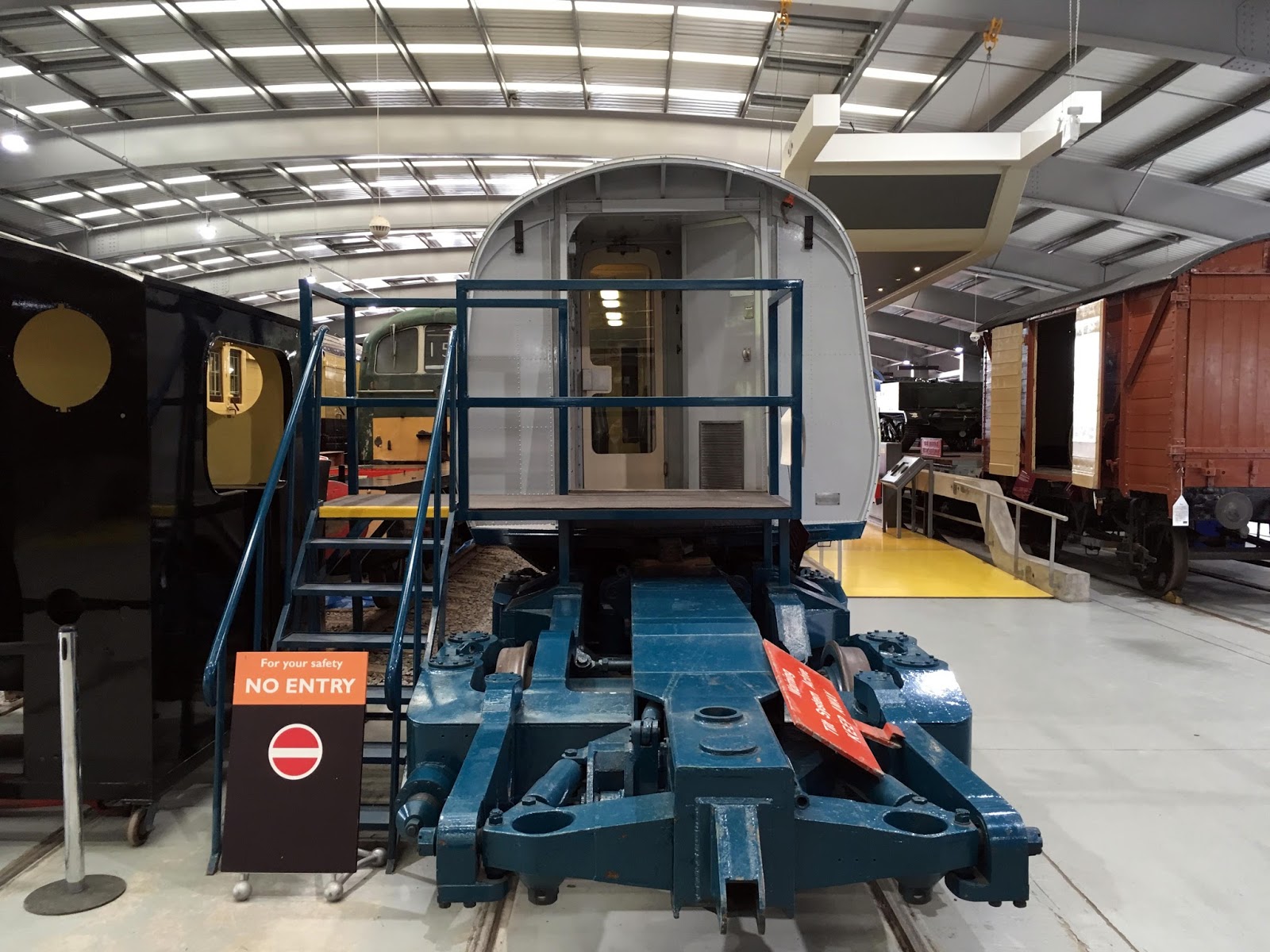
Preserved 2090 at NRM Shildon

2067 at Farnham (K Davies Collection)

Another view of 2090

2034 in BR Blue, location unknown (K Davies Collection)

Cab side view of 2090


[1] Colin J Marden, DMU and EMU Recognition Guide (Ian Allan, 2013) p. 300
[2] David Brown, Southern Electric Vol 2 (Capital Transport, 2010) p. 104
[3] Alan Williams, Southern Electric Album (Ian Allan, 1977) p. 24
[4] Bruce Oliver, British Railway Southern Region Electrics in Colour (Ian Allan, 2008) p. 19
[5] Brown p. 112

London Underground Sleet Locomotives

The Central London Railway initially used electric locomotives hauling trailers but these were found to be causing problems with their large unsprung weights [1]. The locomotives were replaced in 1903 by electric multiple units, known as 1903 Stock. These in turn were replaced by Standard Stock in the 1930s, a number of 1903 Stock motor cars were then converted into Sleet locomotives to clear snow and ice from the track in 1939.
ESL 107 at LT Museum Acton


Information
Number built: 18
Built: (Original tube stock) 1900-03, 1913
Sleet Locomotives converted 1939
Builder: Birmingham Railway Carriage & Wagon Company
Metropolitan Amalgamated Railway Carriage & Wagon Company
Engine: GE66 traction motors (630v DC fourth rail)
Power: 960 hp (720 kW)

These were built by taking two driving ends to make a single locomotive [2]. Most sleet locomotives survived in service until the mid-1980s though as tube stock began to have its own de-icing equipment fitted their role reduced over the years, but they could also be used to clear leaves from the line. One locomotive ESL107 has been preserved, it is the only 1903 Stock to have survived.
Sleet locomotive ESL 107

Cab of ESL 107

1] J. Graeme Bruce & Desmond Croome, The Twopenny Tube (Capital Transport, 1996) p. 15
[2] John Glover, London Underground Rolling Stock in Colour (Ian Allan, 2009) p. 31

Advanced Passenger Train - Experimental (APT-E)

In the late 1960s British Rail began to look into high speed trains in order to compete with road and air transport for long intercity routes. Although BR would have loved to have been able to construct entirely new routes such as in France and Japan which were not constrained by the legacy of Victorian planning and loading gauge they knew there would not be the funding available for this and so instead looked into how to produce high speed trains that could run on existing BR rails. One way to increase speeds was thought to be a tilting train that could handle curves much faster and more comfortably than existing stock and the Advanced Passenger Train - Experimental (APT-E) was built to help develop and test tilting technology [1].

Information
Number built: 4 (1 4-car set)
Built: 1972
Builder: Metro-Cammell / BR Derby
Engine: 8 Leyland 350 gas turbines
Power: 2, 384 hp (1, 778 kW)

Gas turbines were chosen for the APT-E in order to produce the desired power-to-weight ratio (it was decided not to produce an electric APT-E so it wouldn't be restricted as to the routes it could be tested on) [2]. The early design of the APT-E owned more to aeronautical than railway practice but in the end a faceted wedge was chosen for the shape of APT-E [3].

The bodies of APT-E, 2 power cars and 2 trailers were built by Metro-Cammell, a light weight construction from sheet aluminium. They were married to articulated bogies which were designed to improve ride at speed by "part-steering" the train through curves [4]. One trailer was filled with test equipment with the other having some seating to test passenger experience in a tilting train however it was never used in revenue earning service.

The APT-E began operations in 1973 (delayed by industrial action) and ran until 1976 which it was withdrawn from service (the high cost of gas turbines contributing to the decision) and preserved at the National Railway Museum. In its time it reached 152.3mp/h [5], then a new British railways speed record. It was followed by the Class 370 APT-P which was hoped to be the future of the British Rail intercity fleet but ultimately the project failed, however tilting technology was later used in trains that run down the WCML and ECML to this very day.

Interestingly the APT-E project grew out of the High Speed Freight Vehicle (HSFV 1) project in the early 1960s, the fruits of which included the underframe and suspension of the Class 140 Pacer railbus!
Preserved APT-E at NRM Shildon
Test gear laden trailer car 
View of the articulated bogie and body profile

APT-E

Front on view

[1] Colin J. Marsden, 25 Years of Railway Research (OPC, 1989) p. 30
[2] Ibid. p. 31
[3] David Lawrence, British Rail Designed 1948-97 (Ian Allan, 2016) p. 188
[4] Brian Haresnape, High Speed Trains (Ian Allan, 1983) p. 34
[5] Marsden, p. 33

Class 950 Track Recording Unit

Unlike most of the powered Network Rail fleet the Class 950 did not have an earlier life in revenue earning service. The Class 950 was built for the then-Research Division of British Rail in 1987 using the Sprinter Class 150/0 as a base. Following delivery the Class 950 was fitted out with specialist equipment for its role as a Track Recording Unit [1].

Information
Number built: 2 (1 2-car set)
Built: 1987
Builder: BREL York
Motor: Cummins NT855R5 diesel per vehicle
Power: 570 hp (426 kW)

The Class 950 began service in late 1987 and can be used where the track is not suitable or able to support locomotive hauled Network Rail trains.


Originally the unit was classified the Class 180 though was later reclassified 950. It is now in Network Rail service and in NR yellow livery [2]. One of the cars (999 601) looks very similar to a standard Sprinter power car though 999 600 has a very different window and grill arrangement along the side.
950 001 at Derby

999 601

999 600

[1] Colin J. Marsden, 25 Years of Railway Research (OPC, 1989) p. 50
[2] Colin J. Marsden, Rail Guide 2016 (Ian Allan, 2016) p. 203

Class 59 (Electro-Motive Diesel 3,300hp Type 5 Diesel-Electric)

In the mid-1980s aggregates company Foster Yeoman was growing frustrated with the low availability of British Rail's diesel locomotives and so made the then bold move of buying their own locomotives to haul their trains. In many ways the resulting Class 59, which utilised standard and proven General Motors equipment in a form of a version of the EMD SD40-2 design for the British loading gauge (with a cab layout based on the Class 58), was a pioneer.

Up until the Class 59 nearly all diesel locomotives and units operated on British metals had been British made but this changed after the Class 59 was introduced. Though the numbers of this locomotive built where in the end pretty small it directly led to the Class 66 (which is very similar externally though different internally) which was built in huge numbers (eventually 455) now handles the majority of freight traffic on the network.

Information
Number built: 15
Built: 1985-95
Builder: GM-EMD USA (59/0) and GM-DD Canada (59/1 and 59/2)
Engine: EMD 16-645E3C
Power: 3, 300 hp (2, 460 kW)
Wheel arrangement: Co-Co

Following Foster Yeoman's fleet of 5 (59/0) the type was also ordered by ARC Southern (59/1) who bought 4 and National Power (59/2) who bought 6. There are differences between the 3 sub-classes with the latter 2 sub-classes able to travel at higher speed than the original Foster Yeoman locomotives. The 59/2s also have more advanced slow-speed control for coal merry-go-round trains.

All are now operated by Mendip Rail on behalf of Foster Yeoman and ARC who retain overall ownership, except 59 003 which spent some time in Germany before being bought by GB Railfreight and returned to the UK.
GB Railfreight operated 59 003

59 005 in original Foster Yeoman livery at Bescot open day in 1988, photographer unknown (KD collection)

[1] Colin J. Marsden, Traction Recognition (2nd Edition) (Ian Allan, 2009) p. 61

London Underground A60/A62 Stock

The A60/A62 Stock was built in the early 1960s for the Metropolitan Line to replace a variety of legacy stock and remaining steam hauled trains on the line. The A60 Stock was built to replace T Stock trains on services to Watford and Rickmansworth and finally through to Amersham and Chesham when electrification was completed. The trains were indeed named A Stock after Amersham as they were ordered as part of the electrification extension programme. The second batch, A62 Stock, replaced F and P Stock on the Uxbridge service. Due to the long distances some passengers had to travel on the Metropolitan (Amersham is 43km from central London for example) the A Stock has more attention given to passenger comfort and performance [1].

Information
Number built: 464 (104 4-car sets)
Built: 1960-62
Builder: Cravens
Engine: GEC LT114 traction motors (630v DC fourth rail)
Power: Driving Motor (DM)+Trailer (T)+T+DM[+DM+T+T+DM]

The two batches looked pretty much identical with the biggest difference being the compressor used. They entered service in 1961 and remained in service until September 2012 - finally being replaced by S8 Stock [2], making them one of the longest serving British EMUs with 51 years service and still the longest serving London Underground unit (though the 1972 Tube Stock will probably overtake them). As well as the Metropolitan Line they were also used on the East London Line from the late 1970s onwards.

The A Stock was usually employed in 8 car rakes consisting of 2 4-car sets coupled together. Unlike some types of LU stock the sets had driving cabs at both end so could be used on their own - as indeed they were on the Chesham branch of the Metropolitan [3].

With the Metropolitan having longer distances between stations than on most lines the A Stock could reach up to 70mph making them the fastest fourth rail units in the world! [4] By the 2000s however they had been restricted to 50mph to help nurse them along in their final years. One car has been preserved and a couple more (plus some spares) remain in service as one of LU's Rail Adhesion Trains - though a new RAT made from D78 Stock has been recently built and may replace it.
Preserved 5034 at LT Museum Acton Depot

Aboard 5034, the Metropolitan Line retains transverse seating unlike most tube lines

Overhead view of 5034

Cab view

[1] John Glover, ABC London Underground (Ian Allan, 1997) p. 54
[2] Piers Connor, The London Underground Electric Train (Crowood Press, 2015), p. 167
[3] John Glover, London Underground Rolling Stock in Colour (Ian Allan, 2009) p. 5
[4] Paul Moss, London Underground (Haynes, 2014), p. 112