Class 26 (Birmingham Railway Carriage and Wagon Company 1,160hp Type 2 Diesel-Electric)

The Birmingham Railway Carriage & Wagon Company's Class 26 was one of the earliest pilot-scheme diesel-electrics built as part of British Railway's Modernisation Plan and ended up being one of the longest lived of the Type 2 designs. They out lasted a number of later built (and more powerful) locomotives being finally withdrawn in 1994. The Class 26 had a good basic design which was later used on the Class 27 and Class 33, the latter still in service on National Rails.

D5343 (26 043) at Duffield

Information
Number built: 47
Built: 1958-59
Builder: Birmingham Railway Carriage & Wagon Company
Engine: Sulzer 6LDA28-A diesel
Power: 1, 160 hp (865 kW)
Wheel arrangement: Bo-Bo

Twenty locomotives were ordered from the BRCW in the Type B power classification (later Type 2). The Class 26 shared some visual design guidance (Wilkes & Ashmore) with the Brush Type 2 (Class 30, later 31) [1] though had an improved power/weight ratio and hence was able to use a Bo-Bo not A1A-A1A wheel arrangement [2].


Following the success of the pilot-scheme batch a further twenty seven were built before the design was power uprated to form the Class 27. Initially the Class 26 was allocated to Eastern Region for London suburban services [3] though later were reallocated to Scotland where they spent the majority of their careers. The pilot-scheme locomotives became the Class 26/0 under TOPS with the later batch 26/1. There were a number of detail differences between the two sub-classes though some of these differences were removed during refurbishments [4].

The Class 26 remained in service working mostly on freight traffic in Scotland, including Merry-Go Round coal traffic, seven locomotives being fitted with slow speed control [5]. Their numbers were gradually reduced in the late 1980s and early 90s with the last examples withdrawn by 1994, being surplus to requirements. Thirteen have been preserved.
D5343 runs around its train at Duffield

D5343 at Wirksworth
Another view of D5343 at Duffield

[1] David Lawrence, British Rail Design 1948-97 (Ian Allan, 2016) p. 128
[2] Brian Haresnape, Early Prototype and Pilot-Scheme Diesel-Electrics (Ian Allan, 1981) p. 56
[3] Colin Alexander, The British Railways Pilot Scheme Locomotives (Amberley, 2017) p. 49
[4] Colin J Marsden, Motive Power Recognition 1: Locomotives (Ian Allan, 1988) p. 33
[5] Alexander p. 55

Class 73/9 Rebuilds

The Class 73 Electro-diesel was for a long time a unique specimen on Britain's railways, being able to operate using electric or it's own diesel generators (bi-modes as they are now termed are more common now). While the Class 73 remains in service with various operators in the early 2010s there were two separate re-engineering efforts to rebuild locomotives and greatly increase the diesel power (the original Class 73s only had a 600hp diesel).
Cummins powered 73 952 at Kidderminster Town


Information
Number built: 13 (Rebuilds)
Built: (Original) 1962-67
(Rebuilds) 2013-4
Builder: (Original) BR Eastleigh / English Electric
(Rebuilds) Brush Traction or Rail Vehicle Engineering Limited
Motor: MTU 8V 4000 R43L diesel or
2 Cummins QSK19 diesels / 750v DC third rail
Power: 1, 600 hp (1, 193 kW) (MTU)
1, 500 hp (1, 119 kW) (Cummins)
1, 420 hp (1, 059 kW) Electric
Wheel arrangement: Bo-Bo

Although the two types of re-engineered locomotives have quite different equipment they are all termed Class 73/9 although at one time it was considered to renumber them Class 75 (this would have cost more in administration and re-certification). In both cases the work included replacing the original EE diesel with a much more powerful motor and replacing worn electrical and mechanical components.

Thirteen have been re-engineered to date in two phases. The "Phase 2" Class 73s with MTU diesels have had their third rail equipment removed. As virtually "new" locomotives they will likely serve with Network Rail, GB Railfreight and Caledonian Sleeper for a long time to come (they are expected to last at least twenty-five years). Two were converted by RVEL with two Cummins diesel, these are used by Network Rail. The other eleven are MTU powered.
MTU powered 73 964 at Tonbridge

73 952 cab

73 952 at Kidderminster Town

73 963 and friend at Derby

73 951 and a test train at Derby


LNWR Electric Units

In 1914 the London & North Western Railway introduced 3-car EMUs for its London DC electrified lines including routes from London Euston to Watford and Broad Street to Richmond. The first four sets were built with Siemens traction equipment (after Westinghouse who were originally given the order failed to deliver) with a follow-on batch of 38 sets with Oerlikon equipment, the change of supplier to a Swiss firm was needed due to the outbreak of the First World War and therefore the unavailability of equipment from German manufacturer Siemens [1]!

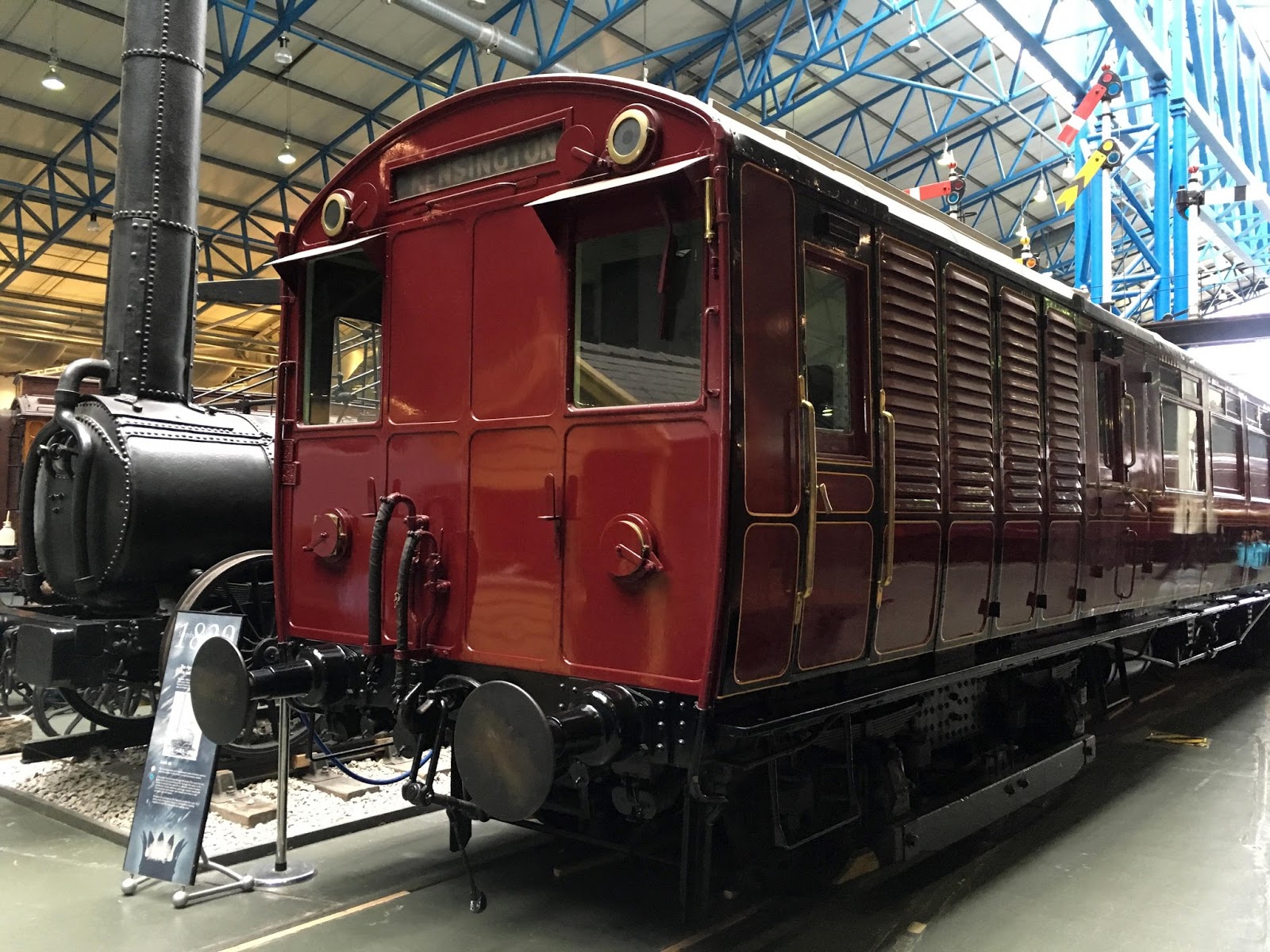
Two views of 28249 now preserved at the NRM York

As well as different traction equipment, the Oerlikon sets had other differences compared to the Siemens sets. Originally the EMUs had first and third class accommodation, the first class compartments being very luxurious, but were downgraded to third class only as a wartime economy measure. The EMUs were built as 3-car sets (with some spare motor cars) and generally operated as a 6-car train.

Information
Number built: 356 (117 3-car sets + 8 spare cars)
Built: 1914-23
Builder: Metropolitan-Cammell
Engine: 4 Siemens or Oerlikon traction motors (630v DC third/fourth rail)
Power: (Siemens) 1, 000 hp (746 kW)
(Oerlikon) 1, 040 hp (776 kW)
Formation: Driving Motor Brake Third (DMBT)+Trailer Third (TT)+
Driving Trailer Third (DTT)

After the First World War a third batch of 75 sets were built, again with Oerlikon equipment [2]. Although some of the DC routes (some of which now are part of London Overground) were run down in the 1930s and following the Second World War, the LNWR sets (later operated by the LMS and British Railways) survived in use until 1960. Some sets were converted to prototype 25kv AC OHLE EMUs as AM1. One DMBT has survived into preservation.
28249 is preserved in LMS livery

[1] R.L. Vickers, DC Electric Trains and Locomotives in the British Isles (David & Charles, 1986) p. 69
[2] Colin J. Marsden, DMU and EMU Recognition Guide (Ian Allan, 2013) p. 186

Class 85 (AEI/British Railways AL5)

British Railways, in it's wisdom, split an order for 100 AC electric locomotives for the West Coast Main Line five ways. The largest share however, was kept in house with 40 of the locomotives built at BR's Doncaster Works using AEI electrical equipment. The Class 85 was similar to the BRCW Class 81, having the same AEI equipment. However, the Class 85 had semiconductor based rectifiers (at first a mixture of germanium and silicon, later retrofitted to be all silicon) and rheostatic braking [1].

Information
Number built: 40
Built: 1961-64
Builder: Associated Electrical Industries / BR Doncaster
Motor: 4 AEI 189 traction motors (25kV AC OHLE)
Power: 3, 200 hp (2, 400 kW)
Wheel arrangement: Bo-Bo

The Class 85 (along with the 81) proved to be the best of the prototype AC electrics, their only real issue being ride quality at top speed. They were displaced from expresses by the Class 86 but remained in service on secondary passenger services and freight until the early 1990s when they were finally withdrawn. One has been preserved.
85 006 preserved at Barrow Hill


[1] Brian Haresnape, Electric Locomotives (Ian Allan, 1983) p. 61

Class 180 Coradia 1000

The Class 180 is part of the Coradia 1000 family of Diesel Multiple Unit like the Class 175. The Class 180 however, has a very different appearance with a sleek streamlined exterior [1]. The Class 180 was built for First Great Western to supplement High Speed Trains on services out of London Paddington. Like the iconic HST, the Class 180 is also able reach 125 mp/h. Unfortunately, the Class 180s had a number of faults and problems and their entry into service was delayed until the end of 2001, over a year late.
Grand Central 180 at London Kings Cross

Information
Number built: 70 (14 5-car sets)
Built: 2000-01
Builder: Alstom Birmingham
Engine: Cummins QSK19 diesel per car
Power: 3, 750 hp (2, 800 kW)
Formation: Driving Motor Standard Lavatory (DMSL)+Motor First Lavatory
(MFL)+Motor Standard Lavatory (MSL)+Motor Standard
Lavatory Restaurant Buffet (MSLRB)+DMSL

FGW (by now GWR) replaced most of their 180s with extra HSTs, which they received from cascades elsewhere though GWR kept five sets for services on the Cotswold Line for a time. The Class 180s have found further use with other operators. Nowadays, they are operated by Grand Central and East Midland Railway. They have also been operated by a number of other operators including Northern Rail and Hull Trains.
EMR 180 109 at Leicester


Grand Central 180 102 passes through Peterborough

In FGW/GWR days a Class 180 at Worcester Foregate Street

Grand Central 180 101 at York

[1] Colin J Marsden, DMU and EMU Recognition Guide (Ian Allan, 2013) p. 166

Bath Electric Tramways Company

The Bath Electric Tramways Company began operations in 1904, taking over from an earlier horse drawn narrow gauge system. The initial fleet of trams were double deckers built by G.F. Milnes. These had Milnes four wheel trucks and British Westinghouse electrical equipment. The open topped trams had seating for fifty five passengers. They were later augmented by a smaller number of single decker trams.
Number 3 and a friend [1]


Information for double deckers
Number built: 18
Built: 1903-04
Builder: G.F. Milnes
Motor: 2 Westinghouse 49-B electric motors (500v DC OHLE)
Power: 60 hp (45 kW)

The company was taken over by the Bristol Tramways & Carriage Company in 1936, who began the process of replacing the trams with motor buses. The final trams ran in Bath in 1939. No electric trams have survived though one of the original horse drawn trams is preserved.
Walcot Street depot, a building which still exists

Number 22


[1] "The tramway system of Bath, England", Street Railway Journal Vol. XXIV No. 10 (March 5 1904) p. 371