Class 370 APT

The Advanced Passenger Train (APT) project was begun by British Rail in the early 1970s and was supposed to be the future of InterCity travel. Indeed, the High Speed Train which was introduced later in the decade was seen as a bit of a stop-gap! The APT project unfortunately never came to fruition despite over a decade of development and failed to enter service, though the Class 370 electric multiple unit came (fairly) close.
370 003 preserved at Crewe Heritage Centre

Information
Number built: 44 (6 7-car sets - though making 3 trains + 2 spares)
Built: 1977-78
Builder: BR Derby / ASEA
Engine: 4 ASEA/LJMA 410F traction motors (25kV AC OHLE)
Power: 4, 000 hp (2, 983 kW) (per power car - 2 are used in a train)
Formation: Driving Trailer Second (DTS)+Trailer Second (TS)+Trailer Unclassified
(Restaurant) (TU)+Trailer Buffet Second (TRSB)+Trailer First (TF)+
Trailer Brake First (TBF)+Non-Driving Motor (M)+
[M+TBF+TF+TRSB+TU+TS+DTS]

The Class 370 was built on the experience gained from the gas-turbine powered APT-E in the early 1970s [1]. The Class 370, often referred to as the APT-P, was designed to be able to travel at 125mp/h along the West Coast Main Line, the coaches tilting to allow for the increased speed on legacy tracks. The tilting unfortunately proved the APT's Achilles Heel causing a lot of trouble and technical headaches. The project was finally cancelled in the mid-1985s. It was not a complete waste however as some of the technology developed was later used on the InterCity 225 and also used on the Pendolino sets which now run on the WCML - though these were not built in the UK.

Each of the six Class 370 sets built consisted of seven vehicles, a non-driving motor car and six passenger carrying cars. Two sets made up an in-service rake with the two motor cars being in the centre of the train.

The Class 370 had a number of "interesting" features, notably the train's power cars which had no passenger gangway access meaning that there was no passenger access between the two halves of the train while in motion (and also wasted a lot of platform space). Buffet facilities therefore had to be duplicated. The limitations of the central power cars were well known during testing and the production APT (or "squadron service") version of the train (known as the APT-S) would have had a single power car at one end of the train [2]. In the end this layout is what was used on the Class 91 hauled (and propelled) Intercity 225.

Seven cars have been preserved including a six-car rake at the Crewe Heritage Centre and another Motor car.
Side of the Motor car showing the APT branding

By contrast the other preserved Motor, in undercoat

Interior design in one of the trailers

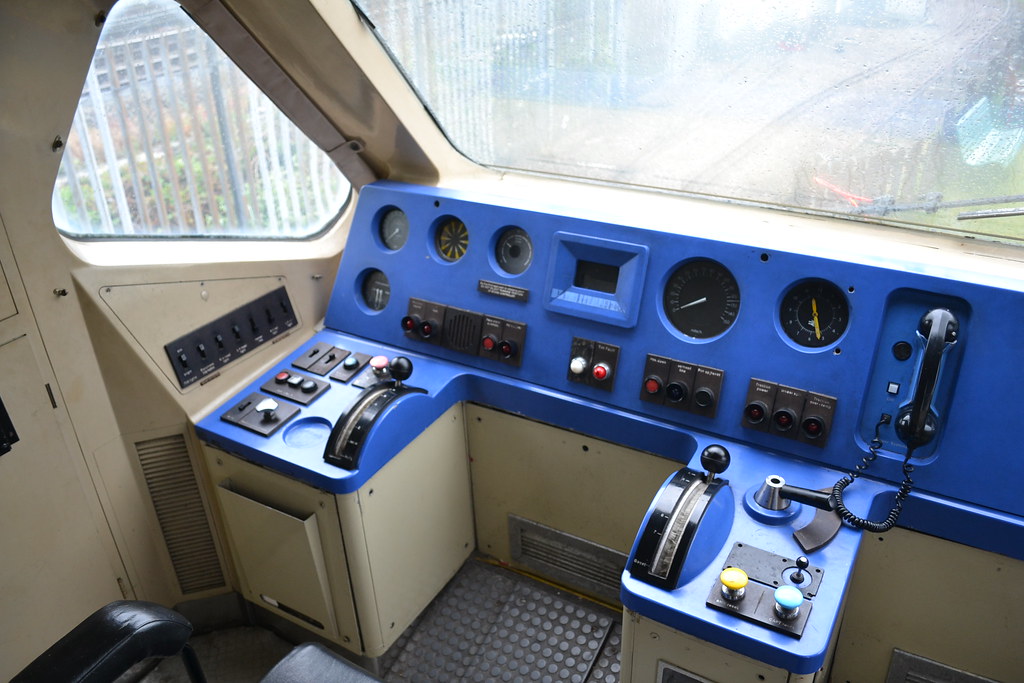
Cab view

[1] Brian Haresnape, High Speed Trains (Ian Allan, 1983) p. 70
[2] David N Clough, APT: the Untold Story (Ian Allan, 2016) p. 104

Orenstein and Koppel 20777 (RL3)

This locomotive was built by Orenstein & Koppel for the German Navy in 1936, working on a narrow gauge (60cm gauge) railway at Kiel naval base. Post-war it was imported, along with another RL3 (21159/1938), to work at the Norden Clay Works in Dorset.
20777 at the Statfold Barn Railway

Information
Number built: 1
Built: 1936
Builder: Orenstein & Koppel
Motor: Diesel
Formation: 0-4-0DM

In 1972 the locomotive was preserved (it's class mate was also preserved and later converted into a steam locomotive!) 20777 lived on the Durley Light Railway for a number of years but since 2012 has been at the Statfold Barn Railway.

Leith Corporation Tramways

The Leith Corporation Tramways was a short-lived tramway company in Leith, Scotland. The company took over from the horse-drawn Edinburgh Street Tramways [1] in the Leith corporation district in October 1904. Work on electrification began immediately with electric tram services up and running by August 1905. The company survived until 1920 when it was taken over by Edinburgh Corporation Tramways. The tram routes continued to operate until 1956.
Tram on Newhaven Road [1]

Information
Number built: 36
Built: 1905
Builder: British Thomson-Houston & Brush Electrical
United Electric Car Works of Preston
Motor: 2 GE54 electric motors (500v DC OHLE)

Leith Corporation operated a fleet of thirty-six trams (plus a couple of works cars). All were double decker trams, thirty were open on top and six having a covered top deck. The tram car order was shared equally between British Thomson-Houston and Brush Electrical. The bodies were made by the United Electric Car Works in Preston, all trams used Brill 21E trucks and GE motors.

These trams were inherited by the Edinburgh Corporation and most of the open top deck were modernised with covers. The trams survived until the mid-1930s with the last scrapped in 1936. The company also operated a combined sweeper and sprinkler car.
Car depot [2]

Tram on Craighall Road [2]

[1] "Leith Corporation Tramways", Street Railway Journal (Vol. XXVI No. 24) Dec 9 1905, p. 1014
[2] Ibid. p. 1017

Class 503

The Class 503 was a third rail DC (650v) electric multiple unit used on the Wirral and Mersey lines. The class was built in two batches, the first nineteen 3-car sets built in 1938 for the LMS (known as 1938 Stock) and a near identical second batch of twenty-four sets for British Railways in 1956-7 (1956 Stock) [1]. The Class 503s were advanced for their day with air-operated sliding doors and a high power to weight ratio thanks to the construction methods used which employed light alloys and avoided heavy frames [2].
28690 in LMS livery

Information
Number built: 129 cars (43 3-car sets)
Built: 1938, 1956-7
Builder: Metro-Cammell / Birmingham Railway Carriage & Wagon Company
Engine: 4 BTH traction motors (650v DC third rail)
Power: 540 hp (403 kW)
Formation: (Original) Driving Motor Brake Standard (DMBS)+Trailer
Composite (TC)+Driving Trailer Standard (DTS)
(Modified) DMBS+Trailer Standard (TS)+DTS

In the 1970s the stock was modified to have central end doors to comply with Department of Transport regulations for stock which operates in single track tunnels (to allow for the exiting of passengers in an emergency if the side doors cannot be used) [3]. They also had their first class provision removed to become fully standard class.

After a long career the Class 503 was finally withdrawn in 1985 and replaced by Classes 507 and 508. One set was retained and kept for special services until 1988, then it was preserved. The preserved set was from the 1938 Stock batch and is one of only two pre-war EMUs still in existence in close to original condition.
Another view of the preserved unit

[1] Colin J. Marsden, DMU and EMU Recognition Guide (Ian Allan, 2013) p, 381
[2] R.L. Vickers, EC Electric Trains and Locomotives in the British Isles (David & Charles, 1986) p. 74
[3] Brian Haresnape & Alec Swain, Third Rail DC Electric Multiple Units (Ian Allan, 1989) p. 28

Hunslet Engine Company 9321-9338

Hunslet built these 610mm gauge locomotives, to the Jenbach DH25 design, for export to Singapore in the mid-1990s. They were operated by the Jan-Pan hire fleet. Some worked in the UK on the Jubilee Line Extension before heading back out to Singapore.
9332 at Statfold Barn

Information
Number built: 18
Built: 1994
Builder: Hunslet Engine Company
Motor: Kubota diesel
Wheel arrangement: 4wDH

A number have now returned to the UK and can be found on preserved narrow gauge lines such as Statfold Barn and Fairbourne. Some of the preserved locomotives have been regauged and fitted with enclosed cabs [1].
9332 is as built with an open cab

9332 wears SBR livery

[1] Royston Morris, Miniature Railway Locomotives & Rolling Stock (Amberley, 2018) p. 78

Class 316 / 457 Networker Testbed

To help develop the Class 465 "Networker" electric multiple unit British Rail took four coaches from the Class 210 prototype diesel electric multiple unit and used them as a test bed, firstly as the Class 457 for DC third rail and later as the Class 316 for AC overhead [1].

The former Class 210s were converted at RTC Derby and then ran for a while on Southern Region. The 457 was fitted with three-phase traction motors which allowed for significant energy savings over earlier types of motor [2].
67300 when at the Electric Railway Museum

Information
Number built: 4 (1 4-car set)
Built: 1989-90 (Class 210s originally built 1981)
Builder: BREL Derby / RTC Derby
Engine: Brush three-phase traction motors
(750v DC third rail (457) 25kV AC OHLE (316))
Power: 1, 140 hp (850 kW) 
Formation: (457) Driving Motor Standard Open (DMSO)+Trailer Standard Open (TSO)+TSO+DMSO
(316) DMSO+Pantograph Trailer Standard Open (PTSO)+TSO+DMSO

Later they returned to Derby and were converted to AC traction by inserting a PTSO from a Class 313 and worked AC electrified lines North of the Thames. Of the four cars used two were later converted to form part of Class 455/9 EMUs. One car, 67300, has been preserved.
Side view of 67300's cab

The other end of 67300, it wears Network South East livery

[1] Colin J Marsden, DMU and EMU Recognition Guide (Ian Allan, 2013) p. 355
[2] Alec Swain, Overhead Line Multiple Units (Ian Allan, 1990) p. 80