The Class 20 is the most successful Type 1 diesel bought by BR (by some margin) and indeed the only one still in service - sixty years after it was first introduced! After early trials with prototype diesels BR ordered a number of "pilot scheme" diesels in the mid-1950s as part of its Modernisation Plan to eliminate steam. Twenty of these diesels were from what would become the Class 20 and in fact the first one built (D8000) was the very first diesel delivered to BR under this pilot scheme [1].
The Class 20 has a cab only at one end, though typically it works in pairs with the cabs outer most to make one "virtual" 2, 000hp locomotive. When it is operated bonnet first drivers have had problems with seeing the line ahead (as they did with large steam locomotives). Because of this BR decided to standardise on the Class 17,which had a central cab and much better visibility,instead for its Type 1 however various problems with the Class 17 forced BR to do an about face in the late 1960s and restart Class 20 production. [2]
Information
Number built:
228
Built:
1957-68
Builder:
English Electric
Engine:
English Electric 8SVT Mk2 diesel
Power:
1, 000 hp (746 kW)
Wheel arrangement:
Bo-Bo
The Class 20 became one of BR's most reliable locomotives popular with BR and enthusiasts who have given them the name "Choppers". They were usually found on freights with the occasional passenger service in the Summer (they have no train heating provision) [3]. There have been a number of sub-classes, most Class 20s have remained as standard (20/0) but a small number were modified as 20/3 for aggregate workings in the 1980s. 20/3 was later re-used for locomotives modernised and refurbished post-privatisation. A few locos have also been modified for remote control trials as 20/9.
The fleet was run down in the 1980s with most withdrawn by the time of privatisation but since then the Class 20 has seen a bit of a renaissance and has found a niche on spot hire trains and a number remain in service to this day [4]. A large number has also been preserved including the very first one, and pilot scheme loco, built which is with the NRM.
20 189 at Kidderminster SVR
20 132 in original Railfreight livery at Derby
First of the Class 20s D8000 at the NRM York
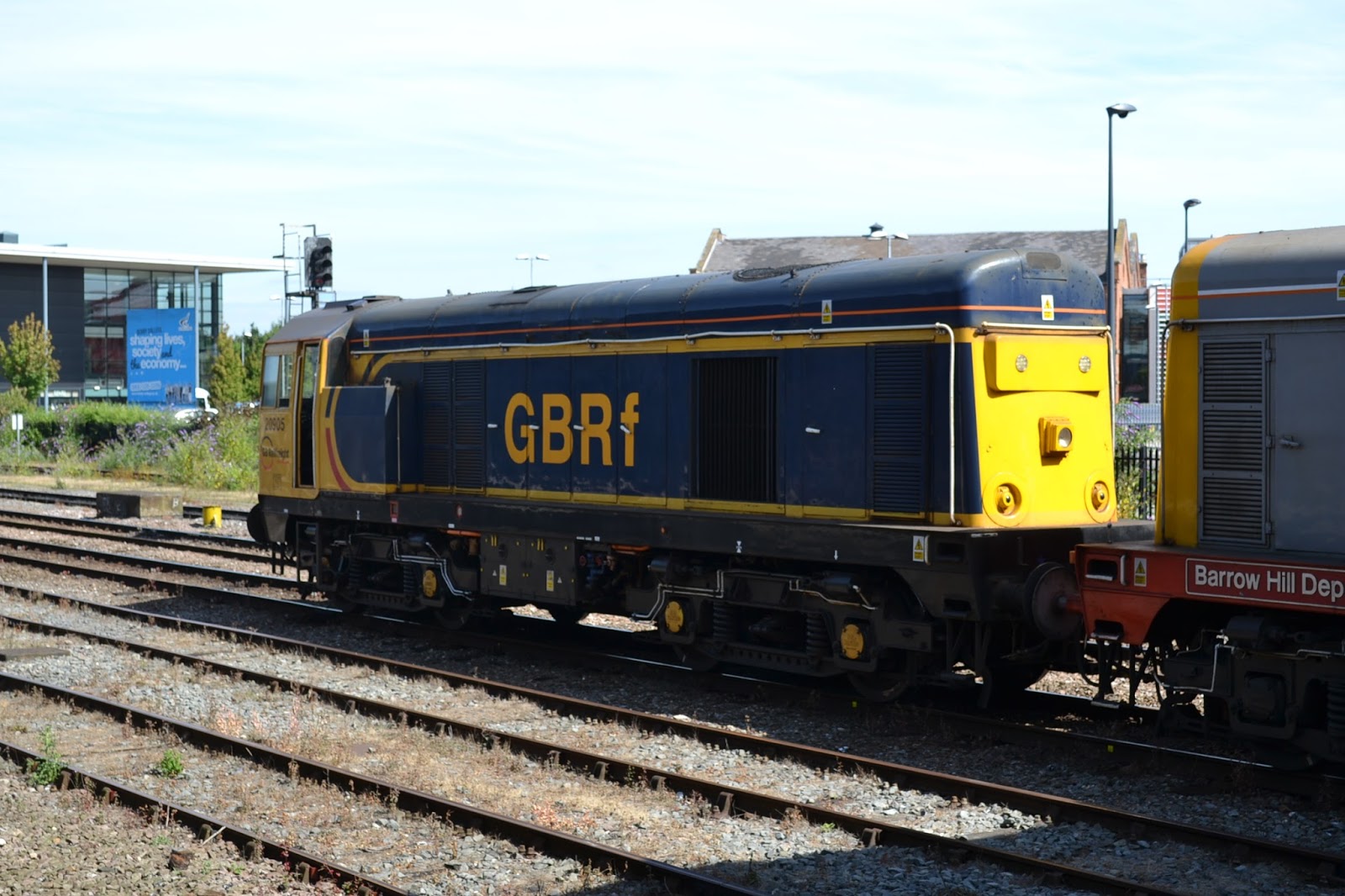
GB Railfreight 20 905 at Derby
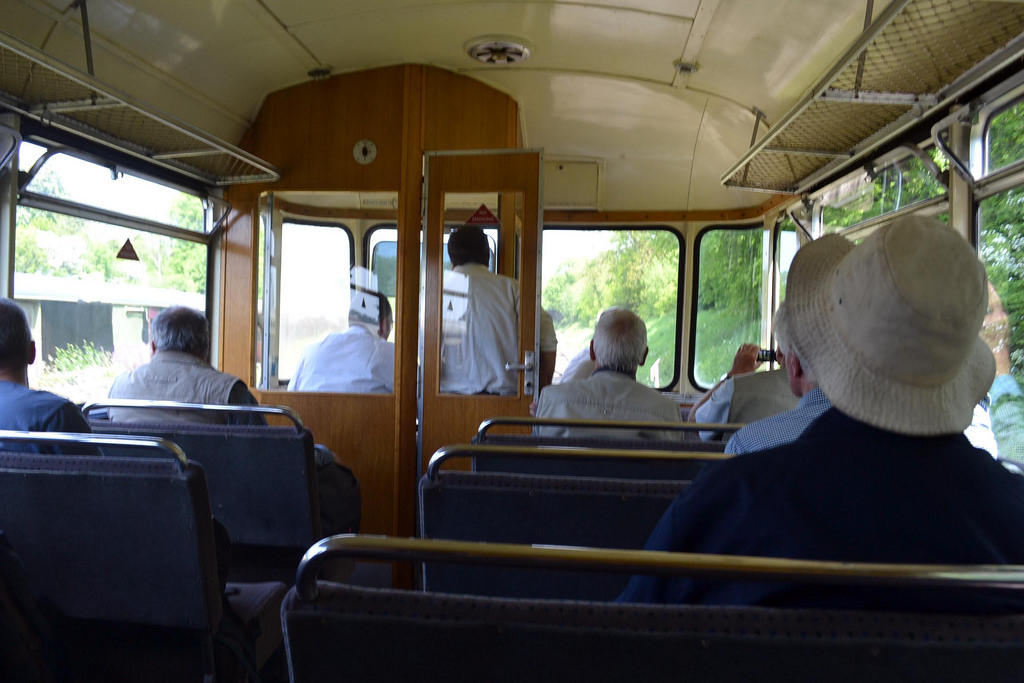
Cab of D8059
20 189 at Kidderminster SVR
[1] Brian Haresnape, Early Prototype & Pilot-Scheme Diesel-Electrics (Ian Allan, 1981) p. 35 [2] Brian Haresnape, Production Diesel-Electrics Types 1-3 (Ian Allan, 1983) p. 26 [3] J.A.M. Vaughan, Profile of the Class 20s (OPC, 1984) p. 3 [4] Colin J Marsden, Traction Recognition (2nd Edition) (Ian Allan, 2011) p. 14
Leeds City Tramways Radial Class was a large class of street trams built in three batches between 1925 and 1931 by Brush Traction, English Electric and by the tramway company itself at it's Kirkstall Road works.
Information
Number built:
200
Built:
1925-31
Builder:
Brush Traction, English Electric, Leeds City Tramways
Engine:
2 Dick Kerr 30B1 traction motors (550v DC OHLE)
Power:
100 hp (75 kW)
The trams were the first completely enclosed trams in the Leeds fleet and also had a four wheel radial E.M.B. trucks with a centre pivot between each pair of wheels [1], the Leeds examples being the only authority to use such a truck. Two trams (one of which was 399 pictured below) were fitted with Peckham P22 trucks for comparison purposes. The pivot trucks were not deemed a success (there were problems with brakes due to the geometry of the radial motion) and most trams were retrofitted with Peckham P35s after the Second World War, those not modified had the centre pivot locked.
The trams were withdrawn in the first half of the 1950s. Number 399 was withdrawn in 1951 but was used for some time afterwards as a depot shunter. It was preserved in 1959 and is now at Crich Tramway Museum.
Leeds 399 in the depot shed at Crich
Front of 399
[1] R.W. Rush, British Electric Tramcar Design 1885-1950 (Oxford Publishing, 1976) p. 105
The Class 04 was a development of the 0-4-0 shunter the Drewry Car Company built for the LMS before the war (see LMS 7050), the first example being a demonstrator built for the LNER just before nationalisation in 1947 [1]. Series production began in BR days a few years later, being the first attempt to build a standard small shunter [2]. The Class 04 performed a role similar to the Class 03 (which is almost exactly the same mechanically and similar looking) working in small yards and where a lighter locomotive was required. Drewry was more a design and sales company rather than an actual manufacturer (for most of the company's life) and so sub-contracted out the building of the locomotives to the Vulcan Foundry and Robert Stephenson & Hawthorns [3].
Information
Number built:
142
Built:
1948, 1952-62
Builder:
Drewry Car Company
Engine:
Gardner 8L3 diesel
Power:
204 hp (152 kW)
Wheel arrangement:
0-6-0
As the amount of shunting needed fell in the 1960s BR decided to standardise on the Class 03 for the small shunter role and the Class 04s began to be withdrawn from the late 1960s onwards along with dozens of other small shunter types. All were gone by 1972 though a number were sold for re-use by industrial railways both at home and abroad. Eighteen have been preserved.
D2284 cab end
D2337 at Rowsley South
D2284 at Rowsley South
D2229 at Rowsley South (as are the two other shunters below)
D2337, also preserved at the Heritage Shunters Trust
D2272
[1] Brian Haresnape, Diesel Shunters (Ian Allan, 1984) p. 38 [2] Colin J.Marsden, Diesel & Electric Locomotive Recognition Guide (Ian Allan, 2011) p. 78 [3] Ray King, British Industrial Diesel Locomotives (Traction & Rolling Stock Advertiser, 2006) p. 17
British Railways ordered five railbuses from Waggon und Maschinenbau, similar to railbuses then common on German Federal Railways, for loss-making branch lines. The hope being that the lower cost of running the railbus would allow the branch lines to break even and avoid closure. Seventeen other railbuses from four other manufacturers (though of a similar specification) were also bought. Along with the German engines used in Western Region diesel-hydraulic locomotives the W & M Railbuses were a rare foray by British Railways into employing overseas expertise [1] during modernisation from steam.
Information
Number built:
5
Built:
1959
Builder:
Waggon und Maschinenbau
Engine:
Büssing 6-cyl horizontal diesel
later replaced by AEC 220X
Power:
150 hp (110 kW)
Waggon und Maschinenbau adapted a fairly standard Deutsche Bundesbahn (DB) design for British Railways needs. The railbuses had four wheels, ride being interesting on the often poor quality track they were later used on! The railbuses had a single sliding door on each side. One interesting feature was the cabs only occupied half the width of the cabin. Passengers could thus sit at the front next to the cab. Three of the railbuses had their original Büssing engines replaced by AEC diesels.
The Railbuses were used on branch lines in the London Midland and Eastern Regions [2] especially in East Anglia. They indeed were successful in reducing running costs but the branch lines they were used on were still losing money and closed. Due to the problem with spare parts for this small fleet and the closure of lines they could be used on the fleet was largely redundant by 1964 though continued in intermittent use until 1967 when they were withdrawn. Remarkably four of the five have survived into preservation.
E79960 arrives at Wirksworth
Another view of E79960
Cab view
E79960 at Ravenstor
Notice the cab only occupies half the front, passengers can occupy the other half
E79960 at Shottle
[1] Brian Haresnape, Diesel Multiple-Units: The First Generation (Ian Allan, 1985) p. 79 [2] Colin J Marsden, DMU and EMU Recognition Guide (Ian Allan, 2013) p. 21
At the start of the twentieth century a number of experiments were made with railcars fuelled by light fuels such as kerocene and gasoline, the perfecting of the diesel engine put paid to these experiments. In 1903 the North Eastern Railway built two petrol electric railcars at it's York works.
Information
Number built:
2
Built:
1903
Builder:
NER York
Engine:
Napier later Wolseley petrol engines
Power:
100 hp (76 kW)
The railcars (known as Autocars by the NER as they had cabs at each end) were the forerunners of the diesel electric multiple unit. The petrol engine being coupled to a Westinghouse generator which generated 60kW which fed a 50hp motor under each bogie [1].
They were put into use on the line between Scarborough and Filey. One of the Autocars was later fitted with a 225hp engine and could haul an unpowered trailer. They remained in service until 1930 and 1931. The coach body of one survived scrapping to become a holiday home and is currently undergoing restoration with a new chassis and powertrain.
Front of an Autocar, all images public domain from [1]
Wolseley engine and generator
Inside the Autocar
Side view of the Autocar
[1] "Self-propelled Petrol Electric Railway Cars Operated by the North Eastern Railway Company of England", Street Railway Journal Vol XXIV No. 19 p. 842
The Class 70 diesel locomotive (not to be confused with the original Class 70 which was an early DC electric locomotive) is the most powerful freight diesel locomotive on British rails today with nearly 3,700hp to play with and the first General Electric traction built for the UK [1]. Over thirty have been bought by Freightliner and Colas Rail, they are used on intermodal and heavy haul freight services.
Information
Number built:
37
Built:
2008-14, 2017
Builder:
General Electric
Engine:
GE PowerHaul P616 diesel
Power:
3, 690 hp (2, 750 kW)
Wheel arrangement:
Co-Co
The Class 70 had a troublesome entry into service with a very poor availability rate in its early days on British metals and a number of fires. One locomotive (70 012) was very bad damaged during a mishap during unloading from a cargo ship at Newport Docks and had to be returned to the US [2]. Nowadays the locomotives are much more reliable.
The original twenty Freightliner locomotives are known as the 70/0 with the ten Colas Rail locomotives 70/8. Seven more Class 70s were later ordered for Colas for delivery in 2017.
Freightliner 70 003 at Stafford
Colas 70 807 at Leamington Spa (with a Class 66)
Freightliner 70 020 at Stafford
Freightliner 70 015 at Olton
Freightliner 70 014 and 004 double head through Leamington Spa
Unidentified Freightliner 70 at Lapworth
[1] Colin J Marsden, Diesel & Electric Locomotive Recognition Guide (Ian Allan, 2011) p. 202 [2] Pip Dunn, British Rail Main Line Locomotive Specification Guide (Crowood Press, 2013) p. 143